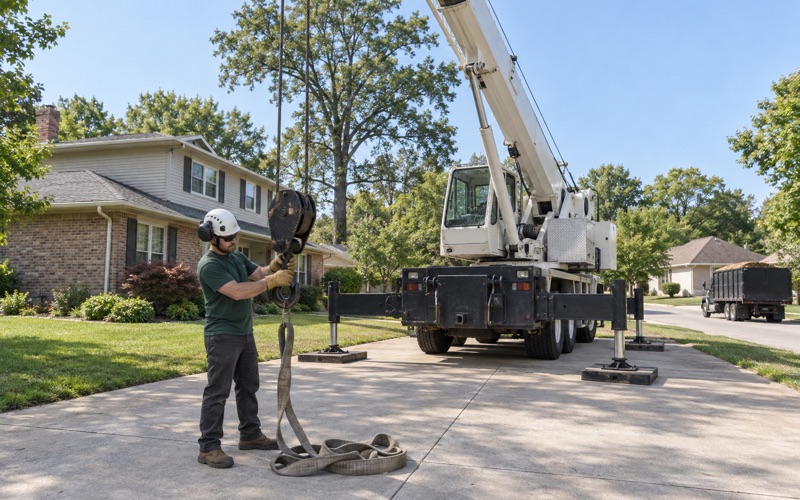
Blue Springs Tree Removal has handled tree removal in Belton for more than twenty years, working both sides of the state line across the Kansas City metro. Most of that work is ordinary: a dead silver maple leaning over a driveway, a split leader on a shade tree, a stump left behind by someone else. What makes a Belton job different is rarely the tree itself; it is where the crew has to stand to take it down.
Nothing in the city code requires you to ask permission before taking down a tree on your own finished lot. The provisions that mention trees sit inside Chapter 19, which governs streets, sidewalks, rights-of-way and other public places, and they read as maintenance duties and public-space controls rather than as an approval you apply for. In Belton the paperwork attaches to the street, not to the trunk.
That distinction decides how a removal here gets priced and scheduled. If the drop zone, the chipper, the crane outriggers or the log truck occupy any part of the right-of-way, the job needs permits before the first cut, and the city has written an unusually direct penalty for skipping them. We work out which of those apply during the free on-site assessment, and you get the answer in writing along with the price.
The permits Belton actually asks a tree crew for
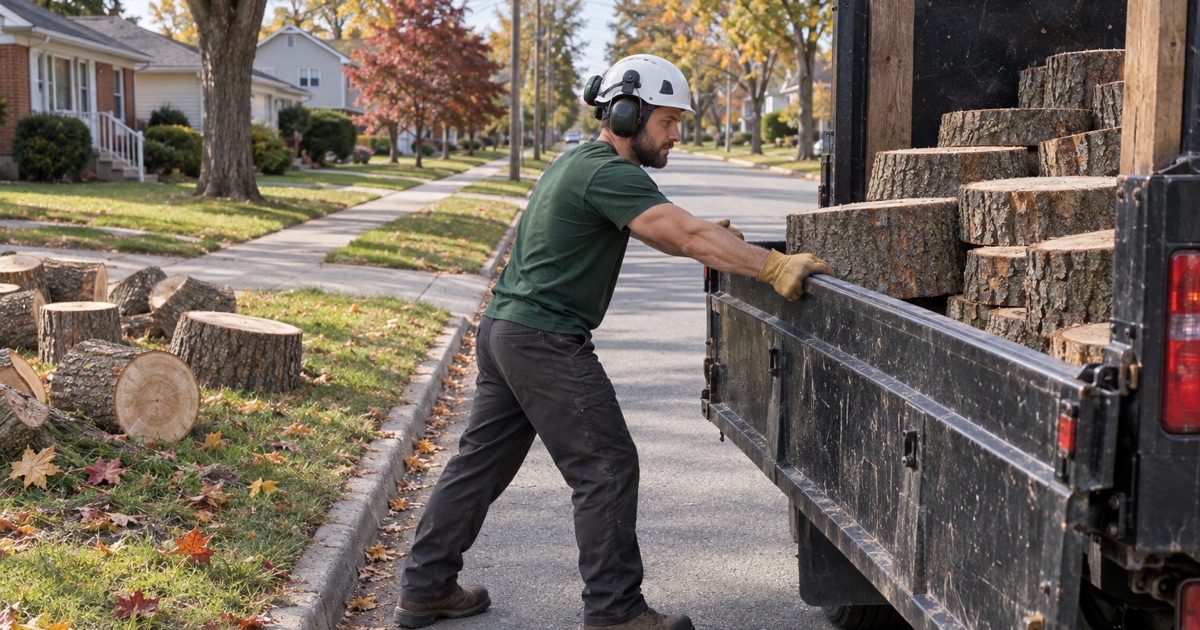
Section 19-129 opens with a flat prohibition. Except for the narrow exemptions listed at Section 19-140, no person or right-of-way user may perform work in the right-of-way without a right-of-way permit, and subsection (B) extends the same requirement to an adjoining owner who wants to place any fixed structure, material or object on the right-of-way next to their land. A tree crew reads that as a plain statement about equipment, cones, ground mats and stacked logs.
Traffic control is a second permit, not a footnote
Subsection (F) stands on its own and is the one crews miss. It bars anyone from narrowing, closing, altering, affecting or otherwise impacting the normal flow of vehicular or pedestrian traffic in the right-of-way without a temporary traffic control permit. You can trip it without ever putting a wheel on city property, because coning off half a lane so a limb has somewhere to land is an impact on the normal flow.
The fee that doubles
Plenty of cities treat a missing permit as a stop-work matter and leave it there. Belton does not. Under subsections (E) and (I), a crew found working in the right-of-way or narrowing traffic without the permit is stopped until the permit is on site, and the permit fee shall double.
That is a delay and a doubled cost landing on the same job at the same moment. We would far rather spend an extra day in the schedule getting the application filed than hand you a removal that halts with a truck in your street. Applications go to the City Engineer, whom Section 19-123 names as the principal city official responsible for administering right-of-way registration and permitting, so a lane-closure question has one desk to go to rather than three.
What needs no permit at all
A tree standing in your back yard, felled inside your own yard, chipped in your own driveway and hauled out through your own gate touches none of this. No city approval is required to take it down, and we will not invent one to pad an estimate. The permits follow the work zone, so the real question at the assessment is whether the whole operation fits inside the property line.
Frontage trees are where that question usually turns. Section 19-116 puts a standing duty on every owner or occupant to keep the vegetation along the street, avenue or sidewalk trimmed, and it names dead branches, dead trees and dead vegetation explicitly, which makes a dead curbside tree a code obligation rather than a cosmetic one. Two numbers govern the trim: branches no lower than twelve feet above the surface, and no branch extending more than one-fourth of the distance from the base of the tree over or across the street. The second is unusual: it is a fraction of the street width rather than a fixed distance, so the legal reach of a limb changes with the road it hangs over.
Looking for tree-removal closer to Prairie Village? See Tree-Removal in Prairie Village.
When the drop zone is the street
Belton’s older residential blocks and the lots fronting the US 71 commercial corridor produce the same problem from opposite directions: a tree with no interior landing area. When the only clear space large enough to receive a stem is the pavement, the removal turns into a traffic control job with a saw in it, and the sequencing changes before anything is cut.
Rigging first, pavement second
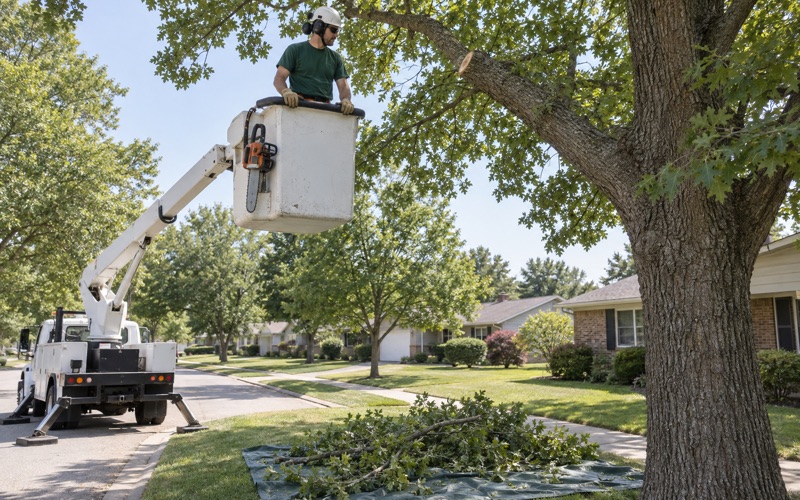
The first pass is always to find out how much of the tree can come down without the road. Rigging a bull rope through a Port-a-Wrap friction device and lowering sections into a tight drop zone keeps a surprising number of removals off the street, and a crane-assisted pick can lift a stem over a roofline instead of laying it across one. Which of those applies is settled before we quote, because it decides whether you are paying for a permit and a flagged lane.
Where the street cannot be avoided, we plan the closure to the smallest footprint and the shortest window the tree allows. That means staging the chipper and log truck to clear the zone as sections come down rather than after, with controlled lowering on anything hanging over a walkway.
Lines, and who owns which span
Nothing goes near an energized conductor. The ANSI Z133 safety standard bars work near energized conductors during thunderstorms, high winds, snow or ice storms, and a tree in contact with a live line is a call to Evergy’s emergency number rather than to us. Belton’s electricity comes from Evergy Missouri West, and the utility publishes a clearance posture worth knowing before you make that call.
Evergy treats the service drop, the span from the pole to your own meter, as the customer’s responsibility, which makes a limb resting on that wire ordinary contractor work rather than a utility assist. Requests for help elsewhere are evaluated by inspection before work is assigned to a maintenance crew, and an assist normally covers all limbs within ten feet of energized conductors. Any debris is left at the worksite, which is the clause that surprises people: the wood stays in your yard.
Section 19-117 adds a layer most cities do not have. It grants utility providers the right to trim trees, brush and hedges overhanging streets, alleys, sidewalks and public places, but it requires that all such trimming be done under the supervision and direction of the City Engineer and the related permitting processes. A Belton homeowner unhappy with a line-clearance cut therefore has a city official to raise it with.
Manufactured-home communities: access before equipment
Belton counts 1,066 mobile homes, 9.65 percent of its housing stock, and that share changes the shape of a removal more than any question about soil or species does. The trees in those communities are often mature, planted close to the units, and standing in lanes that were never laid out for a chip truck. None of the code changes; all of the approach does.
Getting the equipment in
We walk the route before the job is scheduled, not on the morning it starts. Interior drives are frequently narrow enough that a bucket truck cannot set outriggers without taking the whole lane, service runs sit low between units, and the turning radius at the end of a row decides whether a chipper gets in at all. Where the answer is no, the work goes back to climbing and rigging, with sections lowered to a drop zone measured in feet rather than yards.
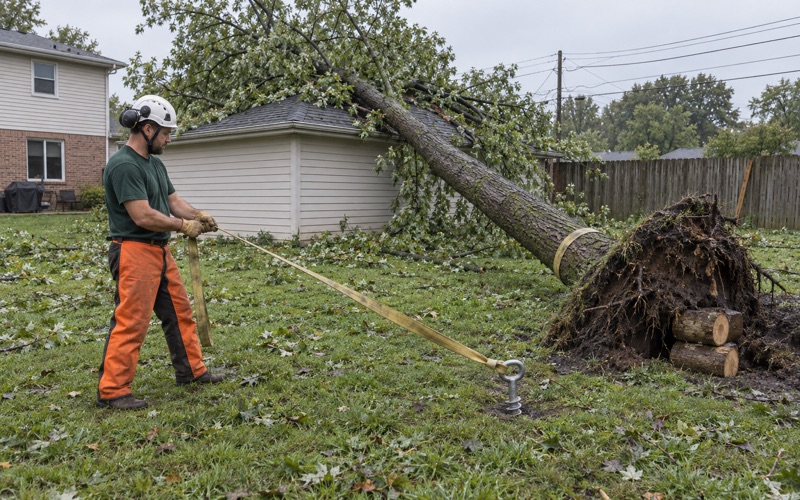
Setback distances that would be routine on a quarter-acre lot are simply not available here. A stem that would ordinarily be felled whole comes down in pieces, the working load limit at every rigging point is calculated for the actual piece rather than assumed, and the crew plans around the unit next door as well as the one the tree threatens.
Who authorizes the work
Community management usually controls the access, and often the tree. Before a crew is dispatched we confirm who owns it and who can authorize the work, because a lot lease and a fee-simple deed answer that differently and the wrong answer is expensive. Proof of insurance goes out before anyone sets foot on the property.
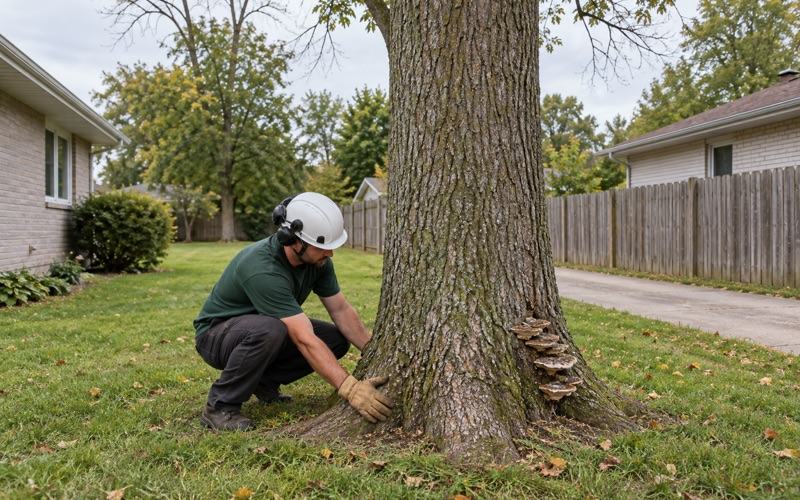
Every one of these jobs starts with a written condition assessment rather than a number scribbled on a card. Where units sit twenty feet apart, the difference between heartwood decay and a co-dominant stem with included bark is the difference between a removal and a cabling job, and if the tree can be kept we will price the cabling instead.
Where Belton brush and wood actually go
We tell you where the debris is going before the saw comes out of the truck, and in Belton that conversation is short, because there is one gate. Kansas City Composting, at 2008 E 171st Street, is the only yard-waste receiving facility established anywhere in Cass County, there is no public county drop-off, and it happens to sit inside the city limits. The advantage is haul time; the constraint is that its refusals decide what happens in your yard.
What the gate will not take
It is a private facility, so the terms are commercial rather than a public rule you can look up in an ordinance. Pricing runs by volume and vehicle instead of weight: $2 a bag, $6.50 per cubic yard, $185 for an end dump of brush, and a 3 percent card fee. There is no per-ton yard-waste rate at this gate at all.
The size and refusal rules matter more than the prices. The operator accepts brush and logs under ten feet in length and logs up to forty inches in diameter if they are under five feet long, and refuses stumps with dirt, tangled debris, brush over ten feet, landscape timbers, building materials, plastic bags, trash, dirt and rock, and railroad ties.
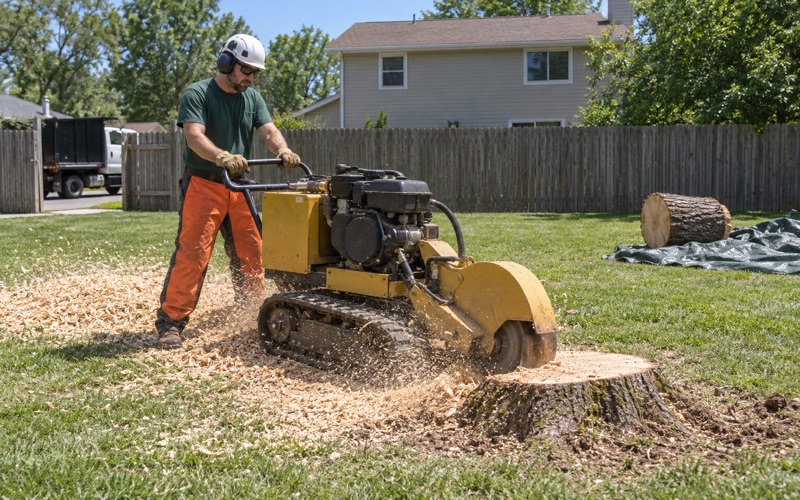
Stumps with dirt on them is the consequential one. It is the main reason grinding a stump in place is the economical choice on a Belton lot, and why pulling one out whole creates material with no local destination. We will tell you which we are recommending and why, though we will not promise a grinding depth before we have seen the flare and know what is under it.
The curb is not a disposal plan
City-contracted curbside collection through GFL Environmental takes yard waste weekly: up to ten biodegradable bags or ten bundles of limbs, or any combination, with bundles under eighteen inches in diameter, tied with twine or string, and no longer than thirty-six inches. GFL defines yard waste as limbs less than two inches in diameter, and refuses plastic of any kind, dirt, rocks, stumps, roots, shrubs with intact root balls and pots.
There is no contractor clause anywhere in that program, and the absence is the finding. Nobody here is refused for being a contractor; material is refused for being a six-inch limb, a stump, or a shrub with its root ball still attached. Section 19-118 limits depositing yard waste in the public right-of-way to compliant containers set out for the collector, and Section 19-119 makes it unlawful to dump leaves or other debris in any street, gutter, storm sewer or drainage way. The debris leaves with us, and nothing is stacked at your curb for the city to refuse.
- 20+ Years in the KC Metro
- Free On-Site Assessment
- Written Price, Insured Crews