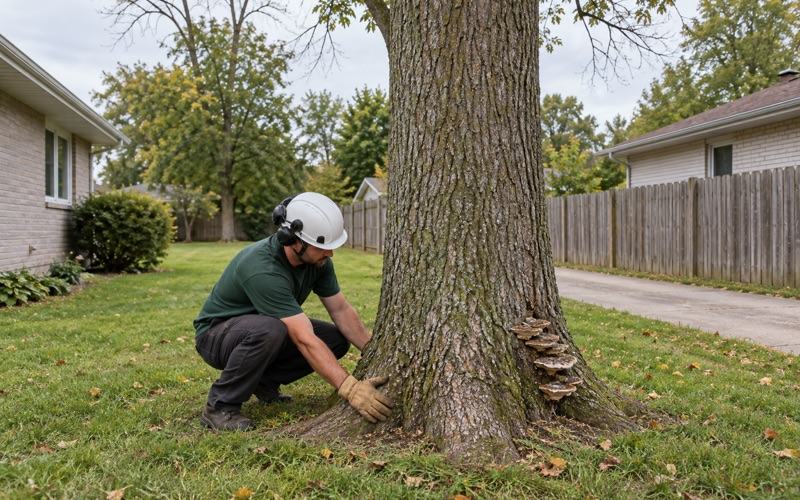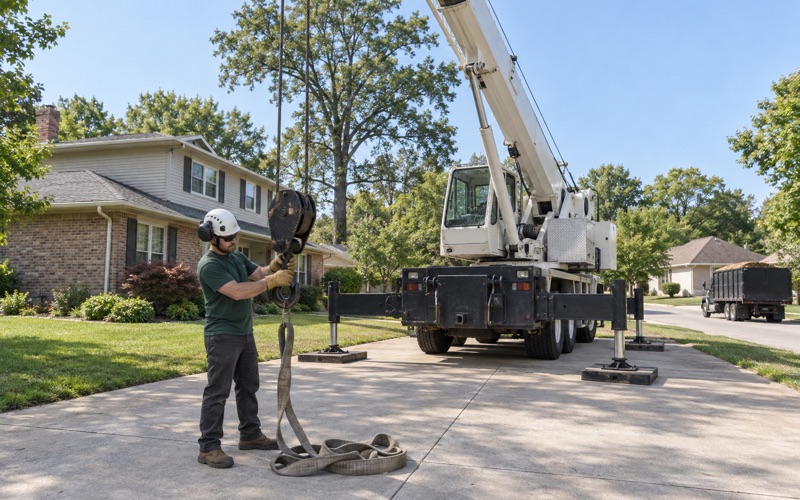
Blue Springs Tree Removal has handled tree removal in Excelsior Springs for more than twenty years, working both sides of the Kansas City metro and both sides of the state line. Every job here starts the same way: a free on-site assessment, a written condition report on the tree rather than a number scrawled on the back of a card, and a quoted price that stays the price. Proof of insurance reaches you before a crew sets foot on the property.
What separates a removal in this city from one twenty minutes down the road is where the wood and the brush end up. We tell you that before the saw comes out of the truck, because Excelsior Springs runs its own yard-waste gate with its own rules, its own season and a published price for anyone hauling in from outside the city limits. Nothing gets stacked at your curb for a truck that will not take it.
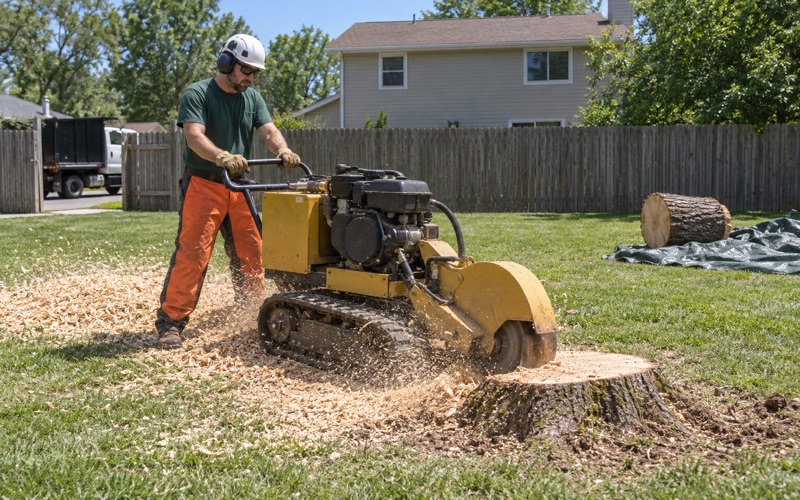
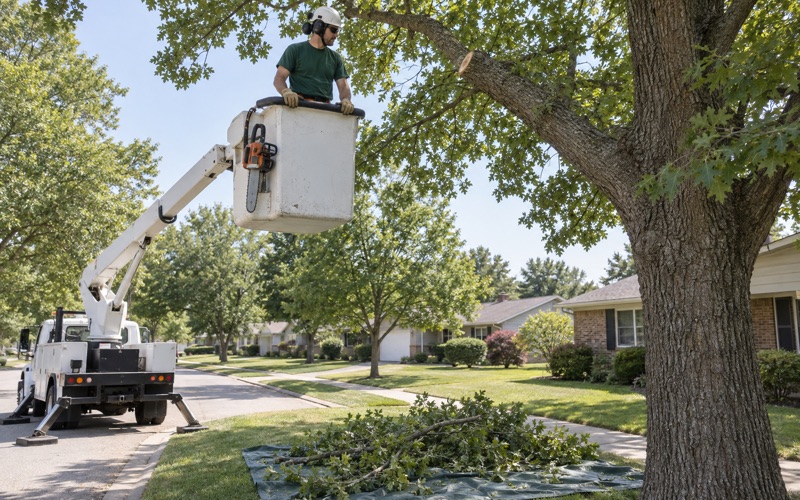
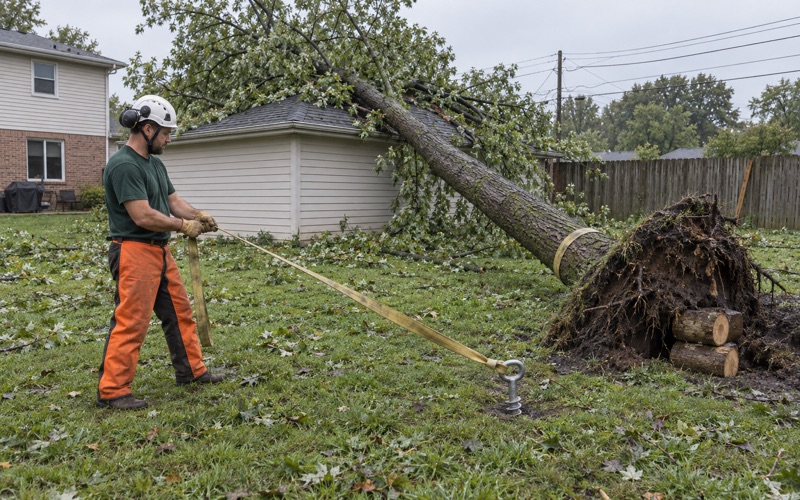
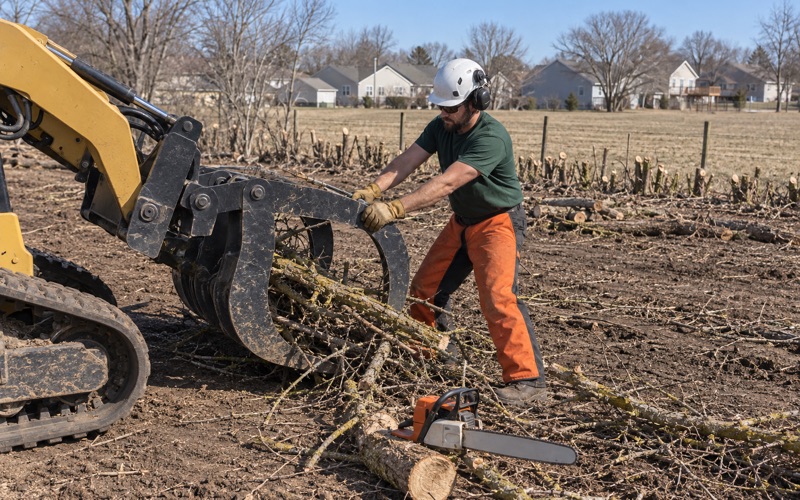
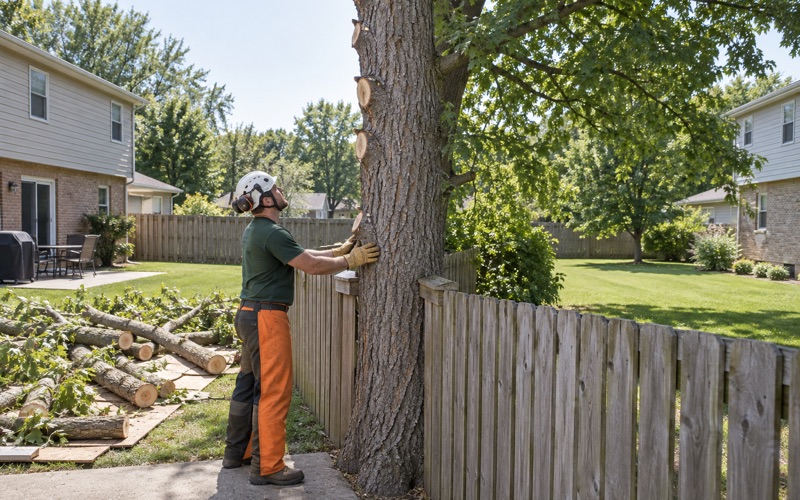
We handle takedowns, storm damage, pruning to the ANSI A300 standard, cabling and bracing, and stump grinding. We do not top trees, and when a tree can be saved with a crown reduction or a cable instead of a saw, we say so and price that instead. When something is on a roof, a car or a line, call and we respond the same day.
The one gate in reach that publishes a price for a contractor’s load
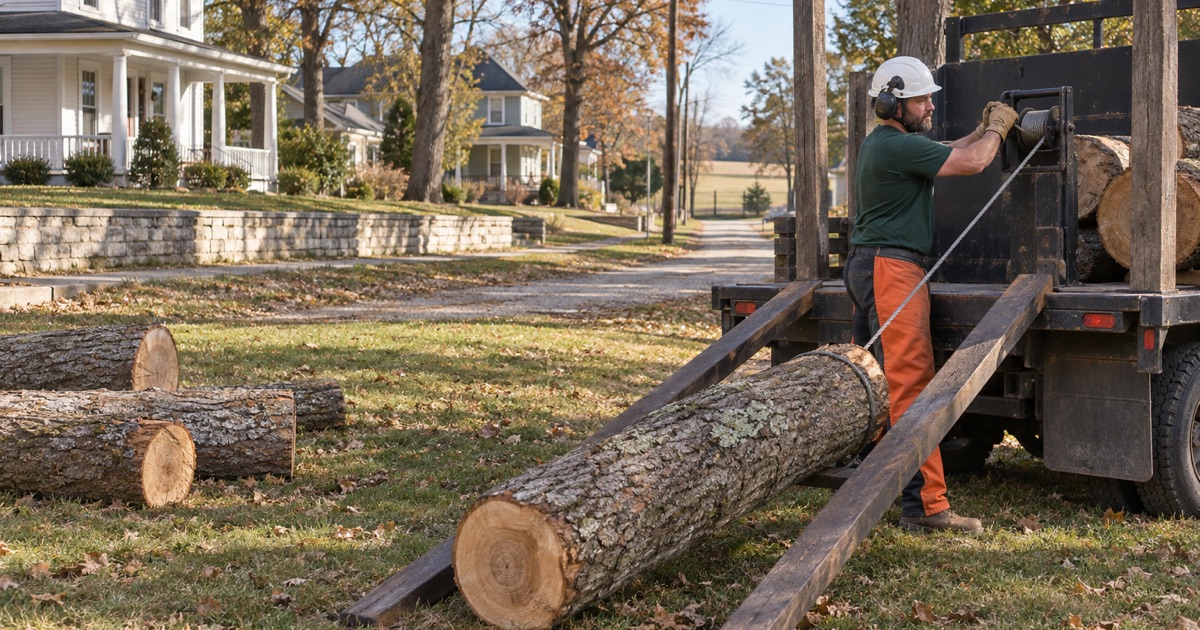
Most municipal brush sites in this metro answer the outsider question with a flat no. Excelsior Springs answers it with a rate sheet. The city’s yard-waste drop-off on South Marietta Street is free to city residents, and for everyone else it publishes a two-column ladder priced by what you arrive in.
A resident living outside the city limits pays $10.00 for a full-size pickup loaded to bed level, $15.00 at cab level, $20.00 above the cab or with built-up sides, $20.00 for a one-axle trailer, $30.00 for two axles and $40.00 for three. A commercial business inside the city limits pays a tier up, from $20.00 through $50.00 on the same vehicle rungs. No diameter or length cap appears anywhere on that sheet, which matters more than the money does, because a trunk section that is legal at one gate is refused at another.
Residency is a document, not an address
The proof the city asks for is specific. A current Excelsior Springs water bill establishes residency at the gate, which is worth knowing here because the city bills water itself while electric service comes from Ameren Missouri and gas from Spire. Telling the attendant where you live does not clear you, and neither does an envelope with a city address on it.
One caution about finding it: the city’s own newcomer packet gives the address as 1300 South Marietta Street while its Public Works page lists a different house number on the same street. We confirm the entrance with Public Works before a load goes out rather than trusting whichever number a search turns up first.
What the gate takes, and when it is shut
What the site takes is narrow. The posted rule reads all natural yard waste only, no bags, no treated lumber, no junk accepted, and every plastic or biodegradable bag has to be emptied out before the load leaves the truck. The season is published too, running from early April into late November with Saturday-only months on either shoulder, and the gate is closed outright in January and February.
That closed season is the practical reason a January removal in this city needs its debris plan settled before the crew arrives. Our trucks leave with the wood and the brush either way, and yard waste cannot go into a Missouri disposal area at all under state law, so every outlet within reach of this city is a composter rather than a landfill. The curbside trash route will not take green waste either, so a pile at the curb simply stays there.
Looking for tree-removal closer to Merriam? See Merriam Tree-Removal.
Two oaks on the same ground, and only one of them colors
Excelsior Springs sits in the EPA Level IV ecoregion known as the Loess Flats and Till Plains, mapped as 40a inside the Central Irregular Plains. The published vegetation for that unit is a mosaic rather than a single forest type: little bluestem and Indiangrass prairie, bur-oak woodland and white-oak woodland, all on the same ground. That mosaic is the operative detail for anyone deciding what to keep.
White oak turns an outstanding claret red in autumn. Bur oak, growing on the same block and often in the same yard, is not known for fall color at all, so a homeowner choosing between two mature oaks on that basis is choosing between two different answers. Any description of this city that names only one of those oaks is describing half the ground under it.
Where the work changes shape outside the limits
On the unincorporated acreage around the city the job stops being a takedown. Osage orange fencerows, called hedge here, and eastern redcedar pushing into pasture that stopped being grazed are a forestry mulching and lot clearing problem, priced by the acre and the density rather than by the tree. We quote those separately because the machine, the day and the debris plan are all different.
What stops a stump grinder here
A grinder rated for 12 to 25 inches below grade usually reaches its own stop first in the deep loess and till soils of northwestern Missouri. The series that would change that answer is Snead, a moderately deep soil formed in residuum from calcareous gray shale, whose depth to a paralithic contact runs 20 to 40 inches. The shallow end of that range sits inside a 25-inch cut, and Snead’s own setting is upland side slopes rather than flats, which describes the valley sides along the creeks here.
Whether that shale actually lies inside these city limits was never mapped, so we do not promise a below-grade cut depth on a lot we have not stood on. On a sloping yard we quote the grind against what the machine is rated to do and tell you at the stump if rock stops it short. A utility locate through Missouri One Call comes before any grinding starts, on our jobs and on yours.
An old core carrying a 1960s cohort on top of it
Almost a quarter of the housing in Excelsior Springs, 23.70 percent of it, went up before 1950, and 64.35 percent predates 1980. The single largest decade is the 1960s at 19.62 percent, which is 851 units inside ten years. Only 3.11 percent was built in 2010 or later and none at all since 2020, so this is not a market where anything about new construction applies.
Trees planted with a cohort of houses mature together and fail together. That is why the work here arrives in waves rather than one call at a time, and why our written assessment usually covers the whole yard and puts the removals in an order across two or three seasons instead of pretending everything is urgent at once. A tree that can hold with a cable and a crown reduction gets priced that way, and we say which ones those are.
Where the constraint actually sits
Old housing does not automatically mean tight access. At 73.53 percent detached and roughly 400 units per square mile, with 2,483 owner-occupied single-family detached homes on the ground, this is not an alley-and-fence pattern, and the constraint is usually in the back yard and the drop zone rather than at the curb. We check the plat and the gate before we quote.
Machine width and brush handling bind this trade more than horsepower does. Compact grinders and tracked lifts are built for gates in the 25 to 35 inch class, while the chipper is seven to eight feet wide and around ten thousand pounds and never goes through a gate at all. Narrow and shallow are not the same thing either: some 35-inch machines still cut 25 inches below grade, and a dual-wheel option widens the same machine to 56 inches, so we quote the machine as it will actually be configured on your lot.
At 68.17 percent owner-occupied there is a real rental share in this city, and a fair number of removals here are decided by a landlord answering a code letter rather than by the person living under the tree. Those jobs need the written assessment and the insurance certificate in hand before anyone signs, which is how we send them out anyway.
Limbs, burning, and who answers the phone
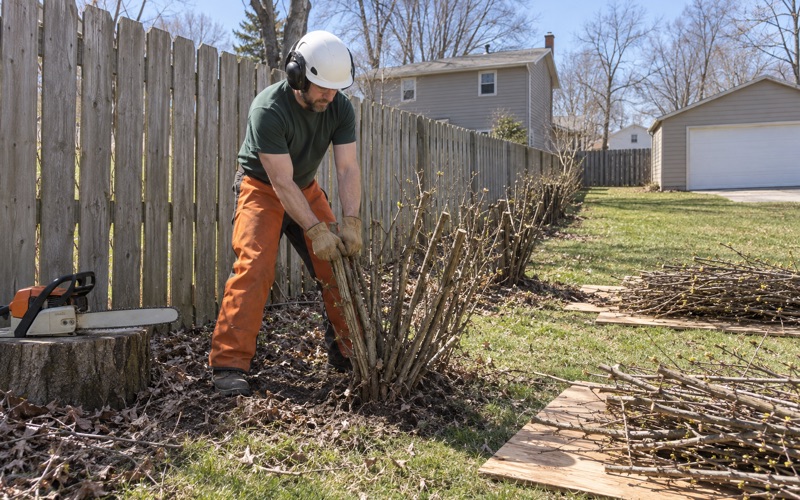
The city publishes its homeowner duties in plain language, and the limb rule is broader than most. Limbs that overhang the sidewalk, the street or a fence must be trimmed, and brush piles must be removed and properly disposed of. Notice that a fence is in there alongside the public way, which quietly drags the neighbor-boundary conversation into a code question.
Unlike some Missouri cities, Excelsior Springs attaches no number to that duty. There is no published clearance height over a sidewalk or a street here, only the instruction to trim, so we will not quote you a figure borrowed from somewhere else. We cut to the ANSI A300 standard with natural target pruning and a proper crown raise, and we write down what we took and why.
Burning flips at the city limit
Missouri’s open burning rule, 10 CSR 10-6.045, covers the whole state and treats trunks, limbs, trimmings and yard waste as vegetative waste. A commercial land clearing burn inside a city limit, or within 200 yards of an occupied structure, has to meet conditions that include burning only between sunrise and sunset, a 200-yard setback from the nearest structure, supervision throughout, and notice to the local fire control authority beforehand. No in-town lot in this city can meet a 200-yard setback, which is the practical end of that option for a contractor here.
A homeowner burning their own yard waste on a residential premises of four units or fewer sits outside those prohibitions, so the rule genuinely reads differently depending on who is holding the match. Whether the city adds its own permit condition on top of the state rule is not something we found published, so we do not tell you either way. Our own answer is simpler: the brush leaves on our truck and nothing is burned.
One city, two counties, two forecast zones
The city limit straddles the Clay and Ray county line, and it carries two National Weather Service forecast zones with it: MOZ029 on the Clay side and MOZ030 on the Ray side, both under the Kansas City office at Pleasant Hill. A severe thunderstorm or tornado warning can be issued for one of those zones and not the other, which means half of this city can be under a warning while the other half is not.
The local storm record here is convective wind, tornadoes and ice, and after any of them the calls come in an order. A downed conductor or a downed pole goes to the electric utility, because City Hall does not run the electric system and cannot de-energize a line. A limb in the right-of-way of a street, or a question about the yard-waste gate, goes to Public Works; a brush pile, an overhanging limb or tall grass goes to the single code enforcement officer at Community Development on East Broadway. Once the line is dead and the report is filed, that is where we come in, same day when a tree is on the house.
- 20+ Years in the KC Metro
- Free On-Site Assessment
- Written Price, Insured Crews