Blue Springs Tree Removal has handled tree removal in Fairway for more than twenty years, and the first question we answer on a property here is not how big the tree is. It is where the trunk sits. This city regulates trees on covered property, which the city’s own Public Tree Protection page describes as the public right-of-way along its streets plus green space and parkland, so a healthy tree standing well behind that line is a different job from one at the curb.
That line decides the schedule, the paperwork and the exposure before anyone puts a rope in a tree, so we measure from the curb before we quote. Inside the strip, the job runs through a city officer and carries a price for getting it wrong. Outside it, we are back to ordinary problems: crane reach, gate width, and a drop zone that fits.
We work Missouri and Kansas both, and we do not carry a Missouri answer across the state line. You get a written condition assessment rather than a number on the back of a card, proof of insurance before a crew sets foot on the property, and a plain account of where the wood and the brush are going. If the tree can be held with cabling and bracing, or brought back with sound pruning, we will price that instead and tell you why.
Where the city’s authority stops, and where the lot line begins
Fairway publishes the one sentence that settles most of these calls: the right-of-way runs approximately 10 to 12 feet from the curb, and it varies by street width because the right-of-way is typically measured 25 feet from the center of the street. That makes the rule geographic rather than dimensional. Nothing about the size, species or condition of the tree decides whether the city has a say; only whether the trunk stands inside that strip does.
Measure before you quote
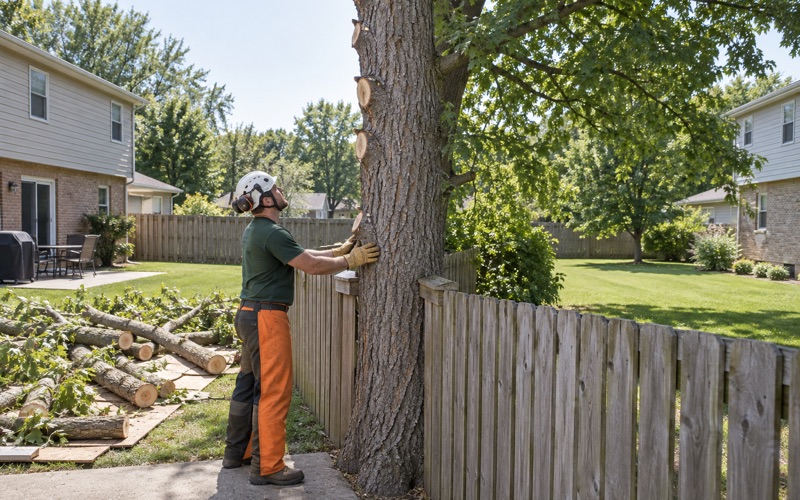
On a corner lot or a narrow street the strip can reach further into what a homeowner thinks of as the front yard than it looks from the sidewalk. We tape it on the first visit and mark the trunk against it, because a crew that discovers the line after the chips are down has already created a problem nobody can undo. The reverse is just as useful: once we can show a trunk standing clear of the strip, the conversation moves straight to access and price.
The neighbor’s tree, on this side of the state line
Kansas handles an overhanging limb differently from Missouri, and this is the single place where crossing State Line Road changes the answer for a homeowner. Kansas follows the nuisance rule set out in Pierce v. Casady: branches doing substantial harm or creating imminent danger make the tree a nuisance the neighbor can compel the owner to abate, and a court has ordered removal at the base or at the property line. Short of that, self-help stops at the line, with no right of entry and no easement earned in the airspace over time.
Looking for tree-removal closer to Belton? See Belton Tree-Removal.
Ordinance No. 1851, and the written request that starts the clock
The operative instrument is Ordinance No. 1851, passed by the City Council on June 8, 2026, which amended and repealed the existing Section 11-94 of the Code of Ordinances. It now reads that no person, directly or indirectly, shall cut down, destroy, move or remove, or effectively destroy, any protected tree or feature tree located on covered property without first obtaining tree removal authorization. Requests go in writing to the Community Tree Manager, and where the removal is tied to construction the written request has to be filed at the same time as the building permit application.
The Community Tree Manager may defer the decision to the Fairway Tree Board, and the Tree Board’s decision may be appealed to the City Council, whose decision is final. That is the whole ladder, and it is short. Approved removals requested by an owner are at the owner’s expense.
A feature tree is the harder case. Under subsection (e) an owner may remove one only with City Council approval, and only by carrying the burden on four points, the first being that removal is necessary for construction, development or redevelopment. Read plainly, an owner with no project cannot meet that first point at all. Subsection (f) is the separate route: the City may remove a feature tree where the Community Tree Manager finds it dead, dying, diseased or in decline and a threat, a finding the ordinance ties to a certified arborist’s determination, so a declining feature tree moves through the City rather than through an owner’s application.
Authorization expires, and the timing is yours to lose
Authorization tied to a building permit or a site plan lasts as long as that permit or plan does. Authorization that is not tied to one goes void 180 days after approval, which is the trap on a homeowner who gets a decision in the spring and then waits for a quieter season. We schedule against that date rather than against the weather, and if a job is going to slip past it we say so while there is still time to refile.
What replacement and violation actually cost
Replacement is measured by total caliper rather than by tree count: enough replacement trees have to be planted that their total caliper equals the caliper of the tree removed, measured at DBH. The ordinance names two species that escape payment into the Fairway Tree Fund, sweet gum and Callery pear, as determined by the Community Tree Manager. Callery pear is worth flagging separately, because the Kansas Department of Agriculture quarantine effective January 1, 2027 prohibits the sale and movement of all seeds, plants or parts, which is a debris-handling constraint on a crew and not just a nursery rule.
The city publishes what a violation costs: payment into the Fairway Tree Fund at $100.00 per diameter inch at breast height, plus administrative fines of up to $500 per incident, and the property owner then assumes all future maintenance responsibility. Unauthorized removal is only one way to trigger it; failing to install protective fencing before construction or damaging a right-of-way tree does the same. On a 24-inch trunk the per-inch figure alone is $2,400 before any fine, which is the number that makes this a real conversation rather than a technicality.
A 1940s and 1950s plat, and what fits down the side of it
Fairway was platted in 1937 and 1938 and built out fast: 37.26 percent of its housing stock dates from 1940 to 1949 and another 32.17 percent from 1950 to 1959, with 95.74 percent of it detached. There are 1,488 owner-occupied single-family detached units on 1.129 square miles, which works out near 1,600 housing units per square mile. Trees planted with those houses are now full-grown, and they stand on lots laid out before anyone imagined a chipper.
The chipper is the constraint, not the grinder
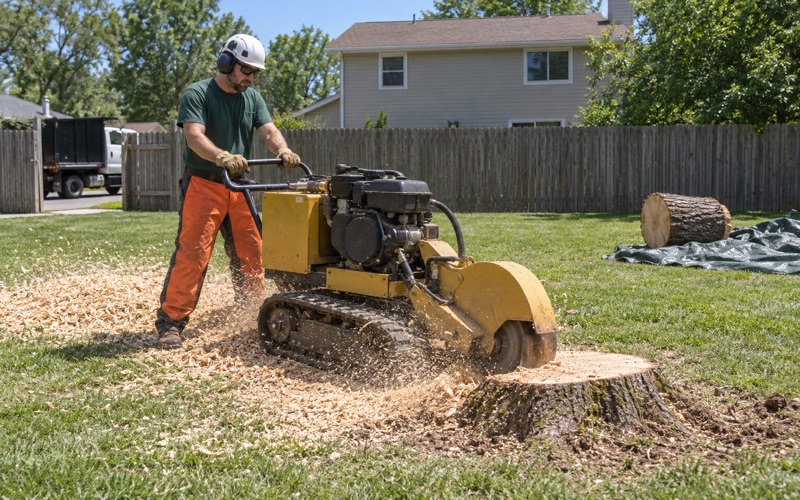
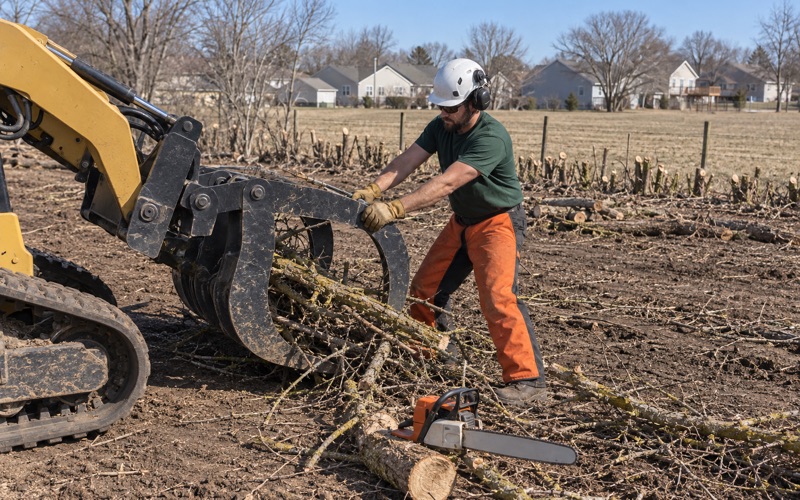
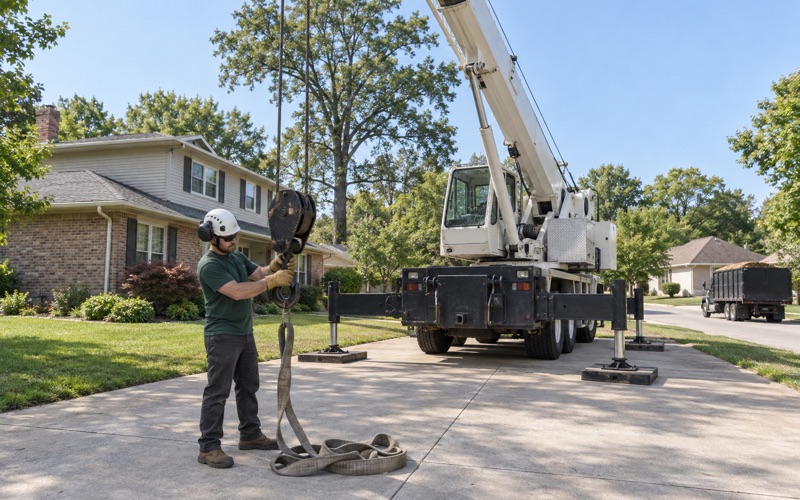
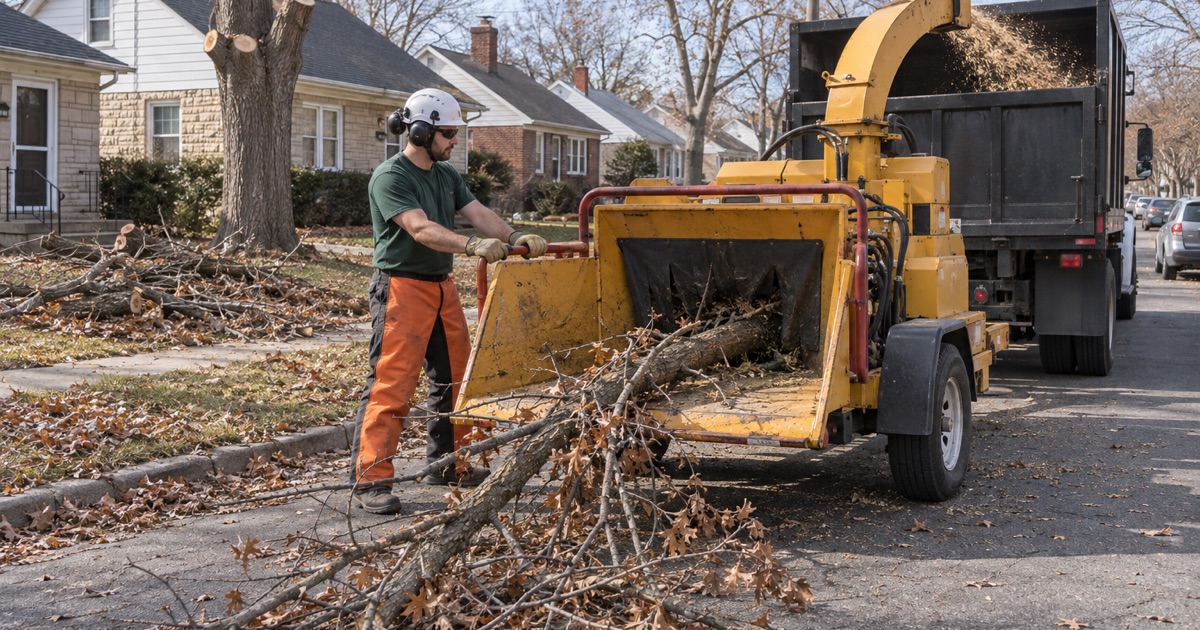
A compact stump grinder in the narrow-access class will pass a 35-inch gate and a pedestrian-gate machine will pass 25 inches, so the grinder usually gets where it needs to go. A large tow-behind chipper is another matter: at roughly 7 feet 9 inches wide and 10,500 pounds it never goes through a side gate at all. That is why brush handling and carry distance, not saw work, set the price on a back-yard removal here, and why we walk the route from the trunk to the truck before quoting rather than after.
Bedrock, 811 and what we will not promise
Grinding depth is a per-parcel question in Johnson County. Several series mapped in the county sit shallow to rock, Sogn at 4 to 20 inches to a lithic contact and Vinland at 10 to 20 inches to a paralithic one, against a stump grinder’s rated below-grade cut of roughly 12 to 25 inches depending on machine class. Oska and Sibleyville run 20 to 40 inches, and Sharpsburg has no bedrock restriction stated at all. This is cuesta country, alternating limestone and shale, so we will not promise a below-grade cut depth sight-unseen, and we call 811 before the tooth wheel turns because a right-of-way strip in a plat this old carries services nobody has mapped recently.
Where the wood goes, and who owns the wire above it
Curbside yard waste in Fairway runs through GFL Environmental, and it is built for yard work rather than for a removal. The city publishes a 40-pound limit on cans and bags and requires branches to be bundled and kept under 4 feet in length; the two first-party sources disagree on bundle girth, the city stating 2 feet and GFL’s own community page for Fairway stating 18 inches, and neither publishes a per-limb diameter cap. Either way, nothing that comes off a mature trunk qualifies.
Behind the curb the picture is tighter than most homeowners expect. Johnson County operates no public yard-waste gate, and the county landfill caps landscape waste at 3 inches in diameter, so there is no in-county outlet for a trunk section at any price. The route that actually takes removal wood is across the state line to Missouri Organic Recycling in Kansas City, Missouri, which charges $10.00 per cubic yard for brush and $7.00 per cubic yard for lawn debris, takes logs up to 40 inches in diameter if they are under 5 feet long, and refuses stumps with dirt attached.
That haul is a line item on our quote, priced by distance and volume, and we tell you the figure before the saw comes out of the truck. The debris leaves with us; nothing is stacked at your curb for a collection crew to refuse.
The line from the pole to your meter is yours
Evergy Kansas Metro serves this side of the metro and answers to the Kansas Corporation Commission rather than to Missouri’s regulator, and the difference shows: Kansas adopts the National Electrical Safety Code by reference and publishes no vegetation-management plan, so the trim cycle here is not a public document. Evergy does publish its posture. Vegetation on the service drop running from the pole to your meter is the customer’s responsibility, requests are evaluated by inspection, clearance is 10 feet at 600 to 50,000 volts, and on an assist Evergy removes all limbs within ten feet of energized conductors and leaves any debris at the worksite.
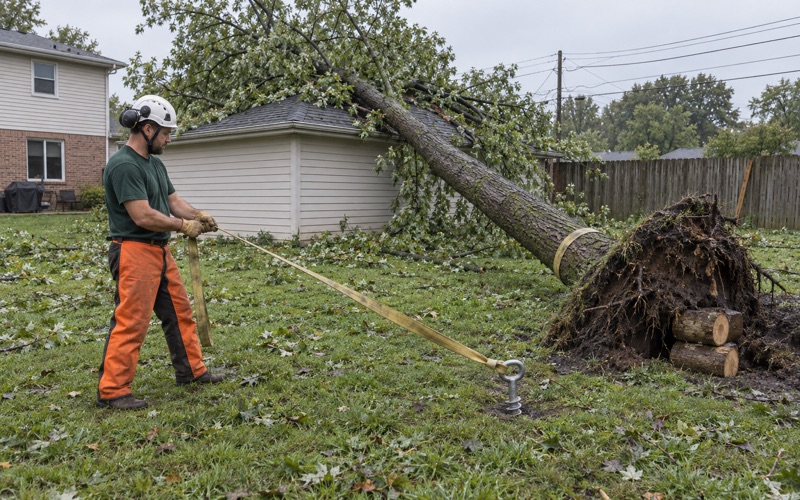
So a storm here splits into jobs with different owners. A conductor on the ground or a tree in contact with a primary line is Evergy’s call first and nobody’s to work in the meantime, because the ANSI Z133 safety standard forbids work near energized conductors during thunderstorms, high winds and ice storms. A limb resting on an energized line is still Evergy’s, and because the utility leaves what it cuts on site, you still need a crew for the cleanup and for the rest of the tree. A tree blocking a public street or a sight triangle is Fairway public works, and everything else is ours, same day when a tree is on a roof, a car or a line.
- 20+ Years in the KC Metro
- Free On-Site Assessment
- Written Price, Insured Crews