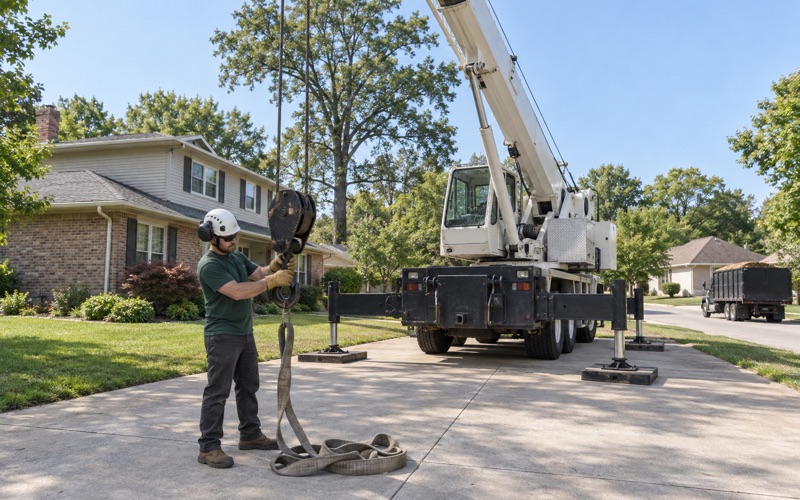
Blue Springs Tree Removal has been doing tree removal in Gladstone for more than twenty years, working takedowns across the Kansas City metro on both sides of the state line. In this city the tree is seldom the hard part of the job. The hard part is finding the footprint a crane needs, or working out the rigging that gets the wood down when no such footprint exists.
Gladstone is dense and finished. Its 12,476 housing units sit on 8.080 square miles of land, which works out to 1,544 units per square mile, and the yards were laid out when the houses were. Setbacks are short, driveways are narrow, and the tree that has to come out is usually behind the house rather than in front of it.
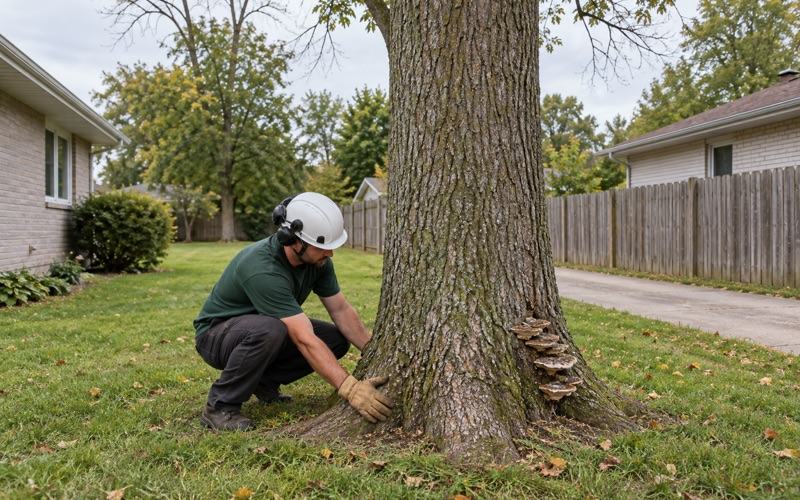
Every quote we give here starts with an access walk before it starts with a price. You get a written condition assessment, proof of insurance before a crew arrives, and a plain statement of where the wood and the brush are going, which in this city is a specific gate with specific rules.
The setup footprint, not the gate, is what gets negotiated
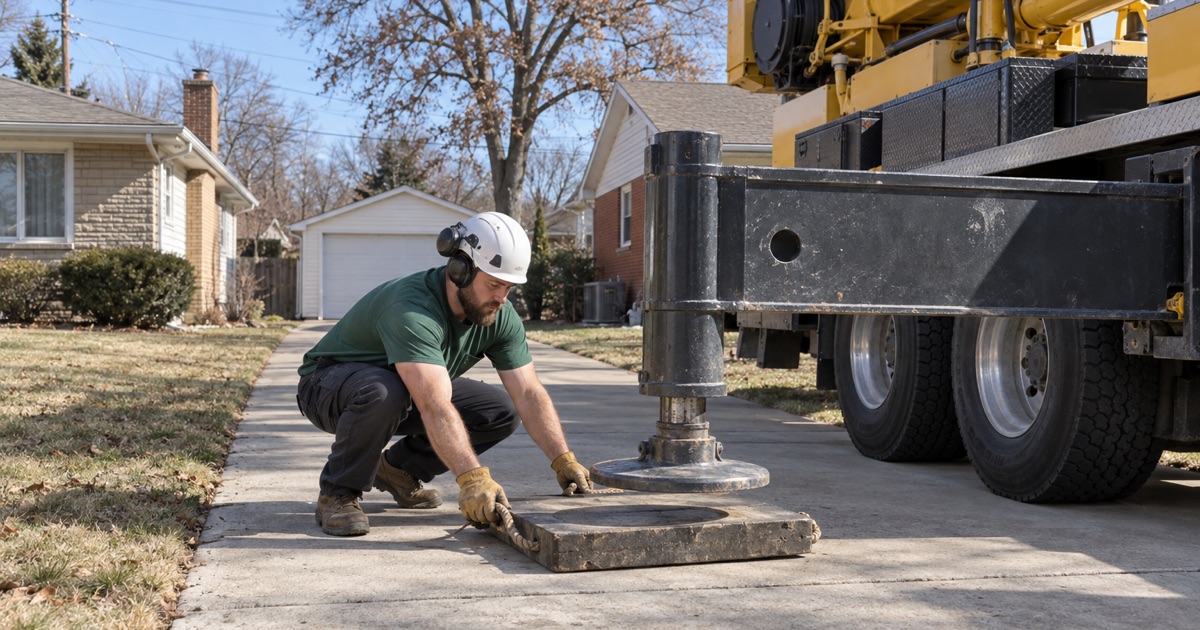
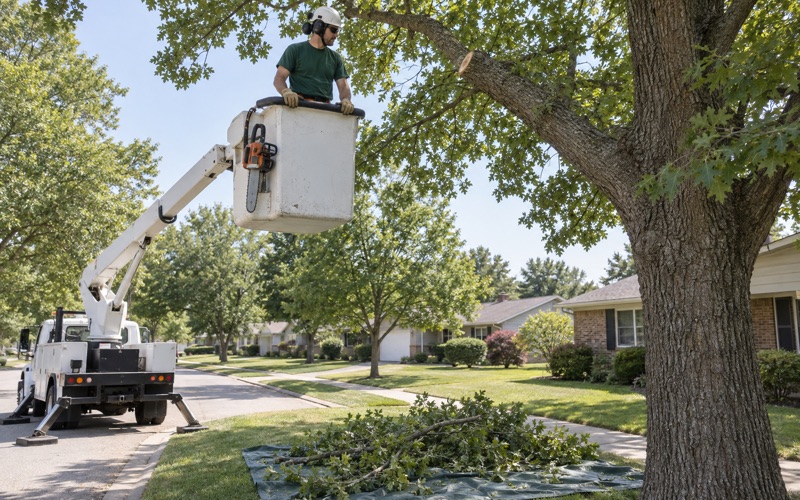
A crane makes a tight-lot removal safer and faster, but only when there is somewhere to put it. What we are measuring on the first visit is the run from the street to the trunk, the reach and radius the pick needs, and whether the outrigger pads can bear on something other than a sewer lateral or a soft parkway strip. On a lot where the answer is no, the tree comes down by rigging instead, and that changes the day rather than ending it.
Rigging when the crane cannot reach
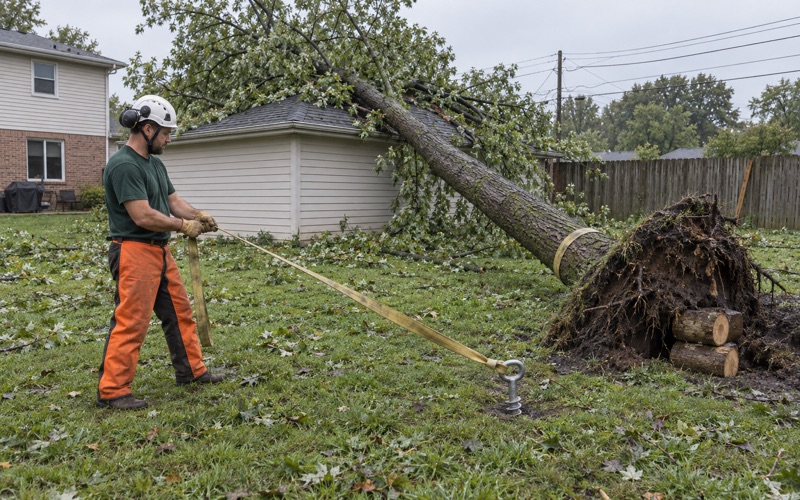
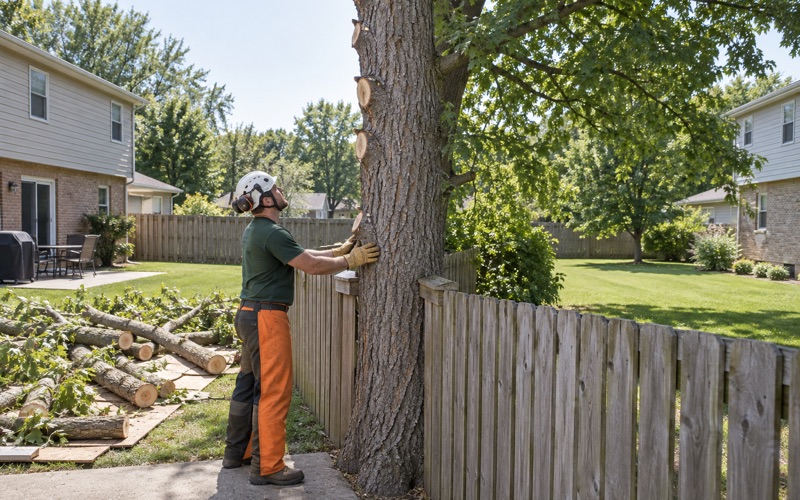
Rigging is how a mature silver maple comes out of a back yard in pieces small enough to carry. We set a bull rope through a rated block, run it to a Port-a-Wrap friction device at the base, and size every piece to the working load limit of the weakest part of that system rather than to what the climber feels like cutting. The three-cut method keeps the limb from tearing bark down the stem on its way out, which matters when the neighboring tree is staying.
What actually fits through the gate
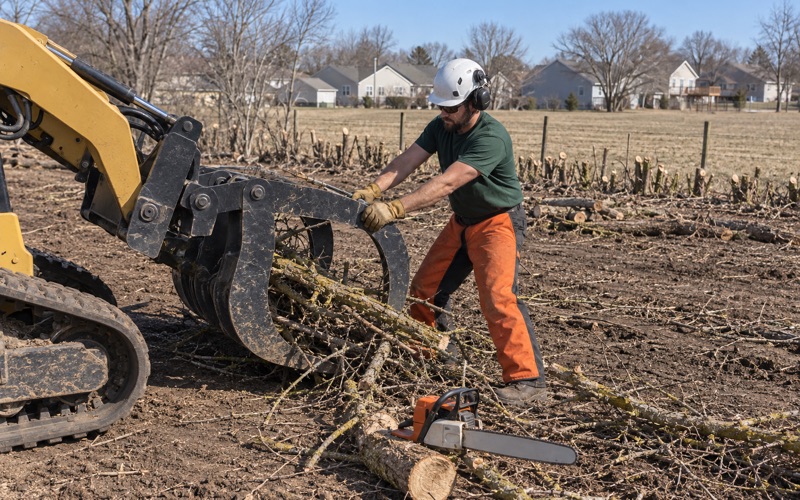
The machine that decides a back-yard job is the chipper, not the grinder. Compact grinders are built for the twenty-five to thirty-five inch gate class and a tracked lift will pass through a doorway, but a Bandit Intimidator 19XPC is seven feet nine inches wide and weighs around 10,500 pounds, so it stays on the driveway and the brush comes to it. Knowing that before quote day is the difference between a crew that works and a crew that stands around.
Carry distance is also why we do not pretend that leaving the wood is a favor here. The firewood credit in this trade is set by how far the rounds have to be moved to a truck, not by what the species is worth, so on a small lot the wood is worth less to you than the labor of stacking it. We take the debris with us, and nothing is left at the curb for the city to refuse.
Looking for tree-removal closer to Peculiar? See Peculiar Tree-Removal.
A canopy that was planted with the houses
Three consecutive decades each account for more than fifteen percent of Gladstone’s housing stock: the 1960s at 22.89 percent, the 1970s at 19.66 percent and the 1950s at 19.13 percent. Add them and 61.7 percent of the city went up inside thirty years, with 64.34 percent of all units predating 1980 and only 5.23 percent built since 2010. The trees went in with the houses, which means they are reaching failure age together rather than one at a time.
That shows up as a scheduling problem more than a pricing one. Failures arrive in the same storms, on the same streets, in the same week, and the crews that can reach a back yard are the bottleneck. We sequence a street rather than treat each call as an isolated emergency, and we tell you honestly where you are in that order.
The species that came with that cohort
Most of what we take down here is on the list the Johnson County K-State Extension refuses to recommend for the Kansas City area: silver maple for weak wood, pin oak for soil problems, green ash for emerald ash borer, along with Austrian and Scotch pine, box elder, Bradford pear, Lombardy poplar, Siberian elm and willow. The extension’s own wording on the pear is direct, warning against the Bradford cultivar because severe splitting occurs on trees ten to fifteen years old. A silver maple that went in with the subdivision is not a maintenance question any more.
Prairie ground, and what it does to a stump
Gladstone sits in EPA Level IV ecoregion 47f, the Rolling Loess Prairies, inside Level III ecoregion 47, the Western Corn Belt Plains. That is deep loess over glacial till, and the published natural vegetation for it is big bluestem and Indiangrass prairie with bur oak woodland, which is worth knowing before anyone promises you autumn color from an oak. Bur oak is not a fall-color tree; northern red oak and white oak are the ones that turn here, and we will tell you which one you actually have.
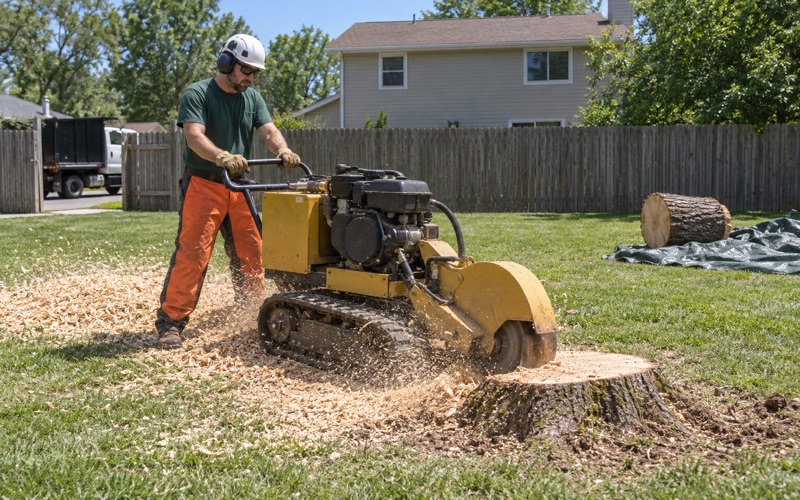
The soils behind that ground are loess-formed and essentially free of coarse fragments, so rock is not what stops a stump grinder in this city. Sharpsburg and Grundy are both fine smectitic clays, which means the ground shrinks, swells and cracks with the season, and a root plate in soil that moves behaves differently from one in soil that does not. That is also why we will not quote a below-grade cut depth before we have seen the stump and know what is under it.
Where the brush and the wood actually go
Missouri banned yard waste from its solid waste disposal areas after January 1, 1992 under RSMo 260.250, which is why every outlet for tree debris on the Missouri side of this metro is a composter and not a landfill. Gladstone happens to host the regional gate: the Gladstone Regional Yard Waste Collection Site at 4000 NE 76th Street, operating under Ordinance 4.712. We tell you which gate your debris is going to before the saw comes out of the truck, and it leaves on our trucks either way.
The rule that runs backward here
Most gates in this trade shut contractors out and let residents in. This one does the opposite. Use of the facility is limited to residents of five named communities, Gladstone among them, and proof of residency is required at the window, while the site is open to all commercial landscape companies. A homeowner living outside that short list is turned away at a gate a contractor drives straight into.
What the gate costs, and why stumps get ground
Admission is not free and it is not the same for everyone. The published schedule charges a residential pickup load at bed level ten dollars and the same load from a commercial vehicle forty, and bags run one dollar residential against two commercial, so contractor debris is priced at roughly four times the household rate. Residential stumps are charged at a rate of at least double the load price, while the commercial doubling applies only above twenty-four inches in diameter.
Stumps are the reason grinding usually beats pulling here. The composters accept brush by the cubic yard and logs up to forty inches in diameter if they are under five feet long, but they refuse stumps with dirt in them, so a dug stump has effectively no outlet at any published price. Grindings stay on site as backfill, and we say so on the quote rather than after.
Who signs off, and who to call first
There is no permit for taking a healthy tree off a finished private lot in Gladstone. What exists instead is Title IX, Chapter 1200 of the city code, the Community Forestry Plan Regulations, which claims full power and authority over trees in street rights-of-way, parks and public places, and over trees on private property that constitute a hazard or threat. That reach onto private ground is stronger than a permit, and most homeowners here meet it through the dead-and-diseased section.
Under that section the city may cause the removal of a dead or diseased tree on private property when it is a hazard to life and property or harbors insects or disease threatening other trees. The building official notifies the owner in writing, removal is the owner’s job at the owner’s expense within sixty days of service, and if nothing happens the city can do the work and put the cost plus administrative fees on the property tax notice. A removal order takes effect no earlier than seven calendar days after the notice is mailed, and an appeal holds it until the board rules.
Topping is an offense here, not just bad practice
We do not top trees anywhere, and in this city the ordinance agrees with us. Chapter 1200 makes it unlawful as a normal practice for any person, firm or city department to top street trees, park trees or other trees on public property, with a narrow exception the Parks and Recreation Advisory Board can allow for storm-damaged trees and for certain trees under utility wires where other pruning is impractical. When a competitor offers to top a tree in your yard, ask what the crown looks like in three years, then ask why the city wrote that sentence.
The right-of-way tree, the service drop and the line
The strip between your sidewalk and the curb is your responsibility to maintain under the same chapter, which requires abutting owners to prune branches and remove dead, diseased or dangerous trees and broken or decayed limbs. The clearance ladder is specific: ten feet over city sidewalks, thirteen feet over city streets, fourteen feet over thoroughfares and designated truck routes, and ten feet over adjacent property or high enough not to touch a structure or a utility line there. Branches also may not block a streetlamp or the view of an intersection.
Overhead, Gladstone is on Evergy lines, and the split is worth knowing before you call anyone. The line from the pole to your meter is the customer’s responsibility, the utility maintains ten feet of clearance around its primary conductors on a four-year urban cycle with a mid-cycle inspection, and removal of anything over four inches in diameter needs the property owner’s signed permission. A downed conductor or a limb resting on an energized line goes to Evergy first, never to a tree crew, and 811 gets called before any grinder touches the ground.
Property managers and landlords
A third of the housing here, 33.05 percent, is attached or multifamily, so a large share of the trees we are asked about belong to an owner who does not live under them. That work runs on documentation rather than a handshake: a written condition assessment on each tree, proof of insurance in hand before a crew arrives, and a quoted price that is the price. Where cabling and bracing or a crown reduction will hold a tree through another few years, we price that instead of a removal and put the reasoning in writing.
- 20+ Years in the KC Metro
- Free On-Site Assessment
- Written Price, Insured Crews