Blue Springs Tree Removal has been doing tree removal in Grain Valley for more than twenty years, and the trees we take down here are almost never old ones. They are yard trees planted with the house, by the same builder, in the same few seasons, and a good share of them are now failing on the same schedule.
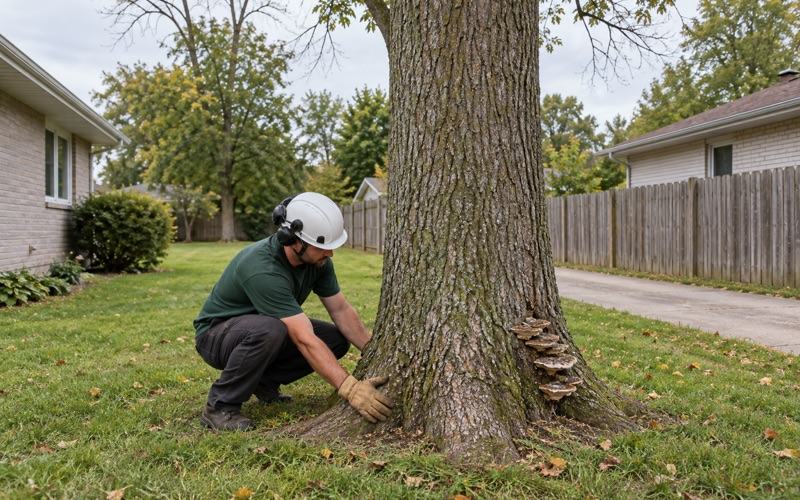
Every estimate starts with a free on-site look and a written condition assessment rather than a figure scribbled on the back of a card. You get proof of insurance before a crew sets foot on the property, and the number we quote is the number in writing.
We also say no to work that should not happen. We do not top trees, and if a stem can be held with cabling or corrected with pruning we will price that instead of a removal. When the tree does have to come out, we tell you where the wood and the brush are going before the saw leaves the truck.
One decade of building, one cohort of trees
The housing stock here has an unusual shape. Of 6,402 units, 2,421 of them - 37.82 percent - were built in the single decade from 2000 to 2009, another 19.34 percent have gone up since 2010, and only 2.81 percent predate 1960. A city built that fast does not have a scattered age range of trees. It has a planting cohort.
That matters because 3,786 of those units are owner-occupied one-unit detached houses, which is to say 3,786 yards where a failing tree is one household’s problem, one household’s driveway, and one household’s bill. Nobody is spreading that cost across a block.
Kansas State Research and Extension’s Johnson County brochure, Recommended Landscape Trees for Metropolitan Kansas City, is blunt about one of the species that cohort was planted with: “DO NOT plant Bradford cultivar; severe splitting occurs on 10-15 year old trees.” A tree put in the ground in 2004 passed that window years ago and is still standing over a roof.
Why a whole street calls in the same month
We are used to taking three calls from one subdivision inside a week after a wind event, and the homeowners usually assume it was bad luck with one gust. It is the calendar. The stems that split share a planting date, a nursery source and a form - co-dominant leaders with included bark at the union, which is the weakest joint a tree can build.
This is a first removal cycle on young ground, and it comes with a decision most people have not made before. Some of these trees are worth structural pruning and a cable; others are past the point where either buys enough time to be worth paying for. A written assessment is what separates the two, and we would rather tell you a tree has five good years left than sell you a removal you did not need.
What actually grows on these lots
A point query inside the city returns EPA Level IV ecoregion 40c, Wooded Osage Plains, inside Level III ecoregion 40, Central Irregular Plains. The potential natural vegetation the EPA lists for 40c reads “Little bluestem-sideoats grama prairie, big bluestem-Indiangrass prairie, cordgrass wet prairie, and oak woodlands.”
None of that describes what is in front of us on a service call. The canopy on a 2000s subdivision lot is nursery stock of a specific vintage, chosen for how fast it filled in and how it looked at closing, and the removals we run reflect the buying list far more than the ecology of the ground it sits on.
Looking for tree-service closer to Independence? See Tree-Service Services in Independence.
Callery and Bradford pear: splits at the union, sprouts at the stump
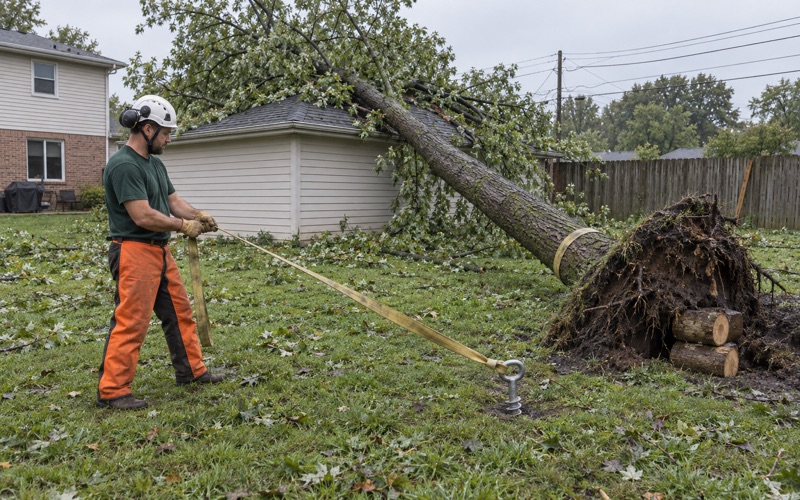
The Missouri Department of Conservation describes Callery pear as having weak crotches and being easily split or knocked over by wind, and that is the failure we are called out for most often on this stock. The tree does not blow over as a unit. It comes apart at the union and drops half a crown across a fence, a car or the corner of a garage.
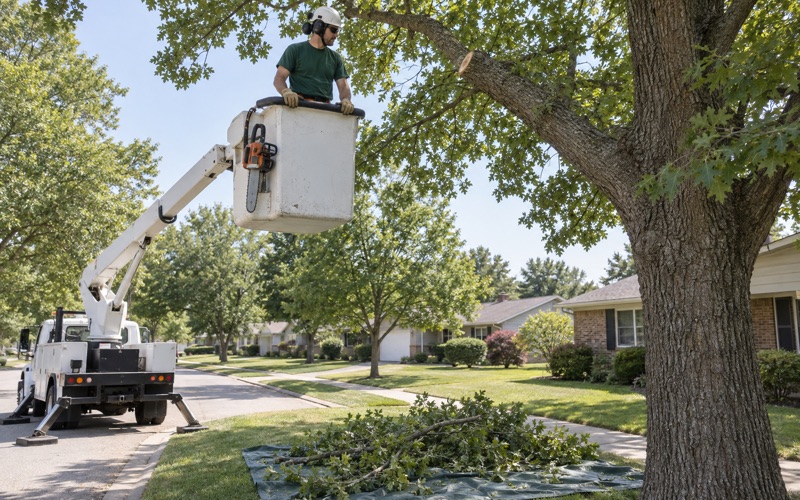
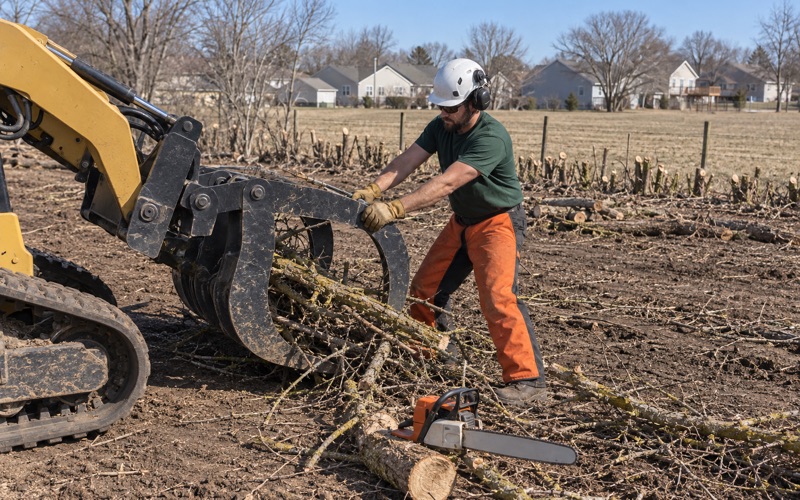
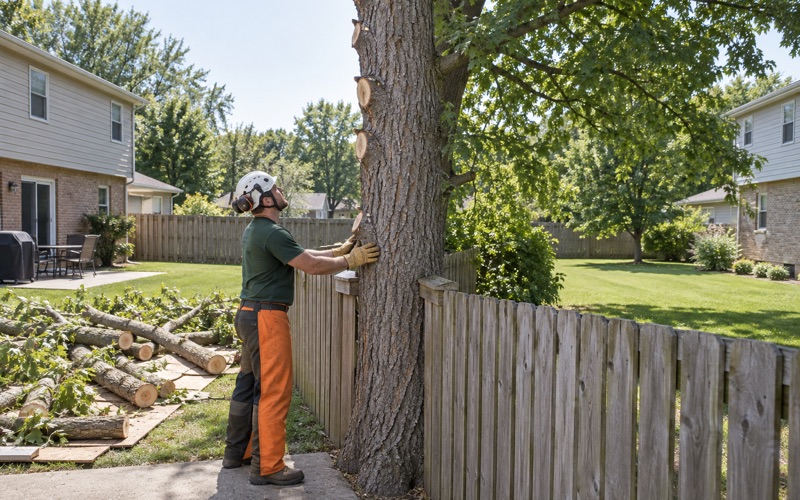
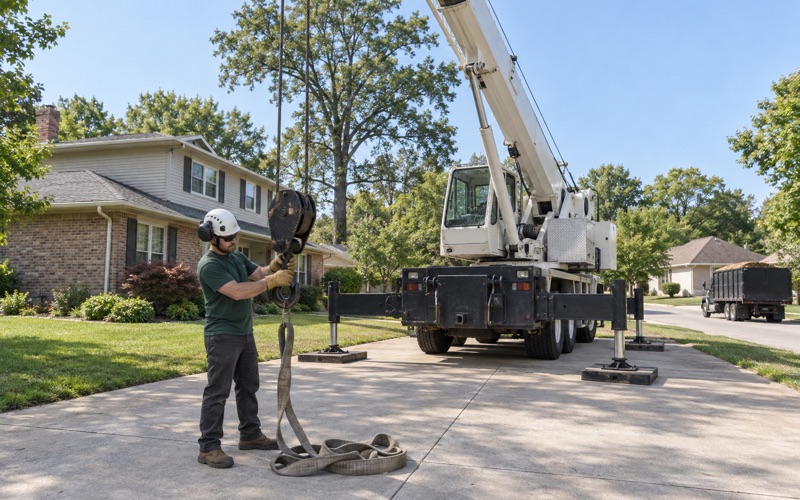
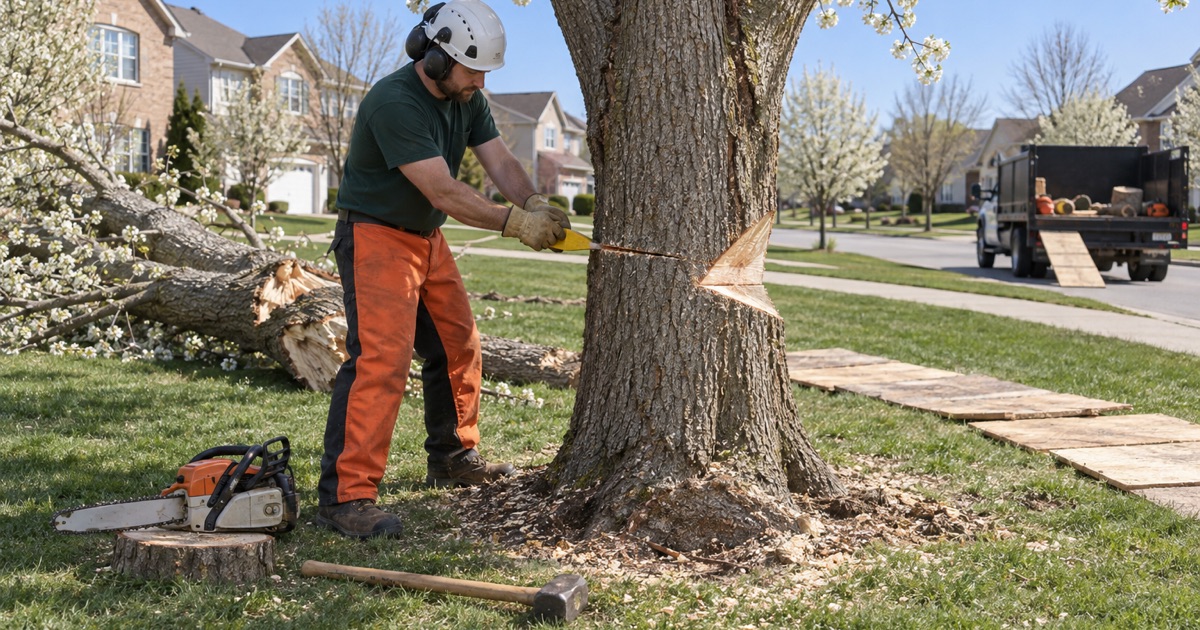
Removing one is rigging work rather than felling work, because there is usually nowhere to put a stem that size in a subdivision yard. We set a drop zone that accounts for the irrigation heads and the neighbor’s siding, take limbs down on a rope with a friction device rather than letting them run, and use the three-cut method on anything with a tear risk at the collar.
The stump is the job, not the cleanup
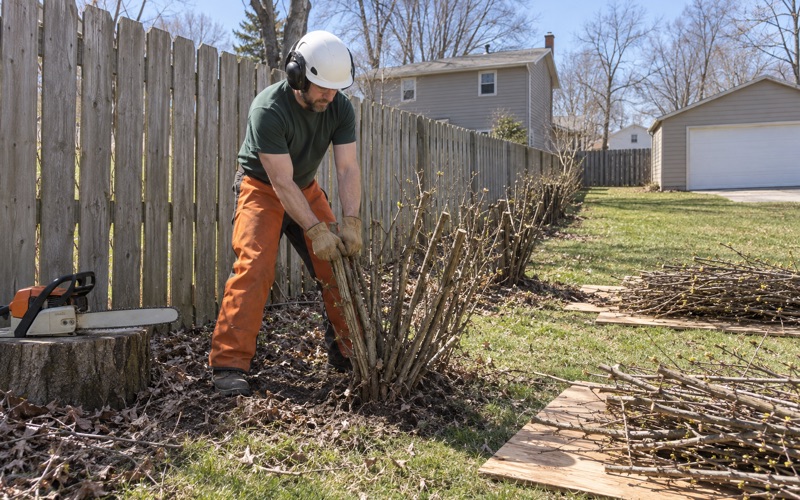
MDC also records that “vigorous sprouts appear at the stump” and grow back into the thorny invasive form of the species, which is why on this cohort the stump work is not optional finishing. The Kansas Forest Service and K-State publication MF3570, published in November 2025, is candid about the limits: “It is unlikely that any one control measure will be successful as a stand-alone treatment in the long term.”
The same publication records that cut-stump treatment “can be done any time of year” but “may be less effective in spring and more effective in fall,” that it “may be less effective after mowing/masticating (as opposed to a clean cut with a saw) due to reduced herbicide uptake on the crushed stems,” and that Kansas field assessments found that even with immediate and thorough chemical treatment after mechanical removal, a large number of resprouting pears and new seedlings should be expected. We work to that: a clean saw cut rather than a crushed stem, and an honest warning that you will be pulling seedlings out of the beds next season.
Herbicide applied for hire is the one part of this trade Missouri does regulate, through the Missouri Department of Agriculture’s Commercial Applicator certification, Category 3, Ornamental and Turf, under RSMo Chapter 281. It is also worth clearing up what the 2025 state legislation did and did not do. Senate Bill 105, signed on July 14, 2025, works through an affidavit condition on a nursery dealer’s registration certificate reaching Callery pear and burning bush on or after January 1, 2029. Nothing in it obliges you to take the pear in your front yard out.
Grinding in graded fill rather than in the mapped soil
The mapped soils of this part of Jackson County are deep loess-derived profiles. The Sibley series, whose USDA Official Series Description places its typical pedon in Jackson County, is a silt loam over silty clay loam with a solum “typically 50 to 60 inches but ranges from 46 to more than 65 inches.” On a profile like that there is no bedrock story and nothing to chew up a tooth wheel.
The complication on stock of this vintage is that the tree is frequently not standing in the mapped soil at all. A lot graded in the 2000s presents imported fill over compacted subgrade, and that changes two things at once: how the grinder cuts, and what shape the root plate took as the tree grew into ground that was never uniform. The soil survey does not describe a graded building pad, and no map will tell us which one we have.
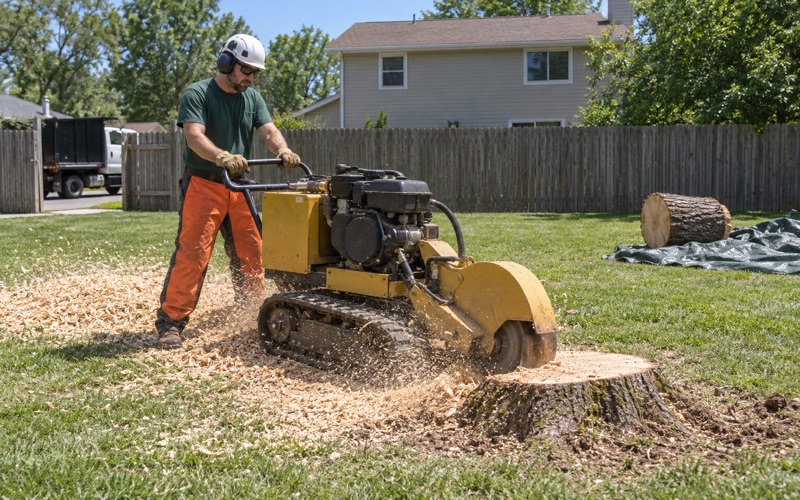
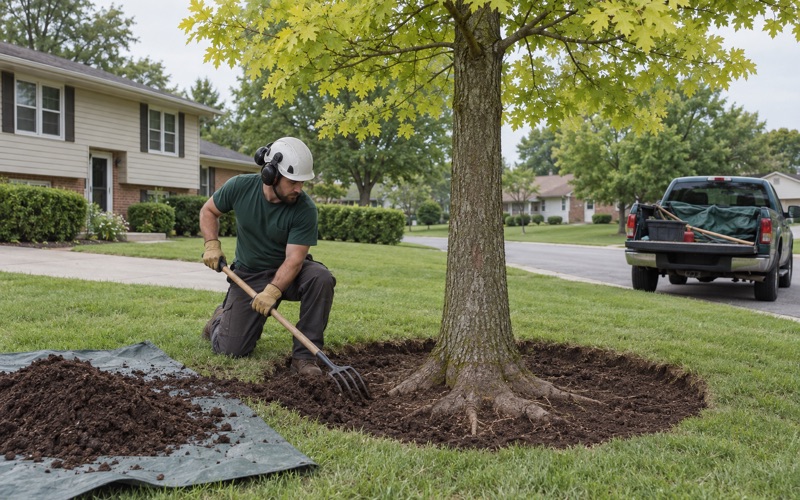
So we do not promise a grinding depth over the phone. We look at the root flare, probe what is around it, and quote the stump we can actually see - and we say up front how much of the grindings go back in the hole and how much leaves with us, because a large stump makes far more volume than homeowners expect.
Locates come before the wheel turns
Missouri law under RSMo Chapter 319 requires a locate request to Missouri 811, the old 1-800-DIG-RITE number, at least three and not more than ten working days before excavation begins. Stump grinding is excavation, and on lots this age the utilities are shallow and close to the house.
We file the ticket and wait the window out rather than treating it as paperwork, which is also why a grind is sometimes scheduled a few days behind the removal itself. If that gap matters to you, tell us at the estimate and we will sequence around it.
Permits, and where the debris actually goes
There is no tree removal permit in Grain Valley. There is no Trees chapter in the municipal code, and Chapter 225, Nuisances, carries no tree provision. What the code has instead is a planting rule: Section 400.280 requires a landscaping plan before a building permit, exempts single-family and duplex, sets a minimum of one shade tree and one ornamental tree per lot, and lists fifteen prohibited species, with no canopy target and no preservation credits. Chapter 405, the subdivision regulations, touches removal of trees and other vegetative cover when land is being subdivided.
Read together, that means a homeowner taking a tree out of a finished yard needs nothing from the city, and the only tree requirement a developer meets here is a requirement to plant.
The county gate is open one day a week, eight months a year
The city runs no municipal yard-waste collection and no yard-waste gate of its own. The Saturdays-only schedule, 8 a.m. to 4 p.m., that appears on the city’s waste and recycling page belongs to the Eastern Jackson County Yard Waste Collection Center at 37910 E Pink Hill Road in Oak Grove, which opens the first Saturday in April and closes the last Saturday in November. It takes cut-up logs, limbs and leaves, refuses sod, and prices by bag, by vehicle or by the cubic yard - no gate reached in this area prices yard waste by the ton.
The practical consequence is simple. A removal on a Tuesday, or any removal between December and March, has no public county gate available at all, so the load routes to a private composter instead. That is our problem rather than yours: the debris leaves with us on the same visit, and nothing gets stacked at the curb for a hauler to refuse.
It is worth knowing where that line falls with the power company too. Evergy Missouri Metro treats the drop from the pole to your meter as the customer’s responsibility, and where its own crews do assist work, that work “normally includes removal of overhanging branches and all limbs within ten feet of energized conductors” and “any debris is left at the worksite.” If a conductor is down, stay at least thirty feet back, touch nothing in contact with it, call 911 first and then Evergy at 888-544-4852, and do not pull a limb off a line yourself. When a tree is on a roof, a car or a line, we respond the same day.
- 20+ Years in the KC Metro
- Free On-Site Assessment
- Written Price, Insured Crews