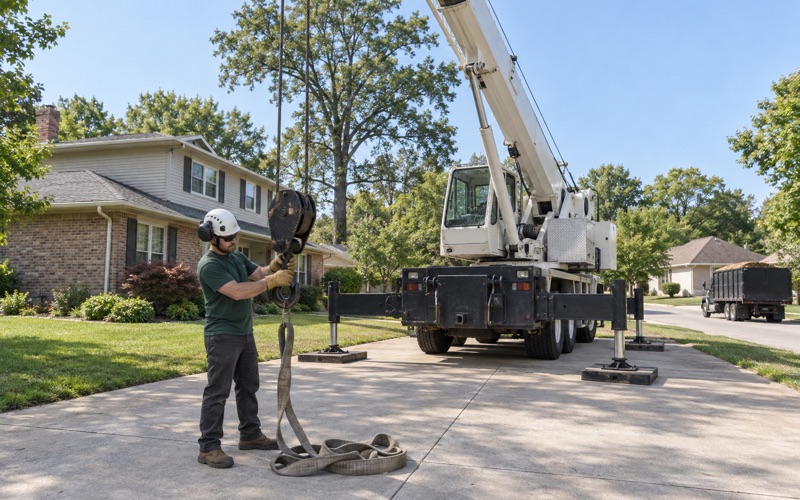
Blue Springs Tree Removal handles tree removal in Grandview, Missouri, and we have been taking down trees across this metro on both sides of the state line for more than twenty years. Most of the calls we take here start the same way: a tree that has been fine for fifty years is suddenly not fine, and nobody is sure who is supposed to deal with it. We answer that question on the phone before we ever quote the work.
Every removal starts with a free on-site assessment and a written condition report, so you get the reasoning and not just a figure on the back of a card. The quoted price is the price that appears in writing, proof of insurance reaches you before a crew sets foot on the property, and we tell you where the wood and the brush are going before the saw comes out of the truck. When a tree is on a roof, a car, or a line, we respond the same day.
We also say no to work that should not happen. We do not top trees, and if a stem can be held with cabling and bracing or corrected with a crown reduction, we price that instead of a removal and explain why.
Half a city planted inside twenty years, failing inside twenty more
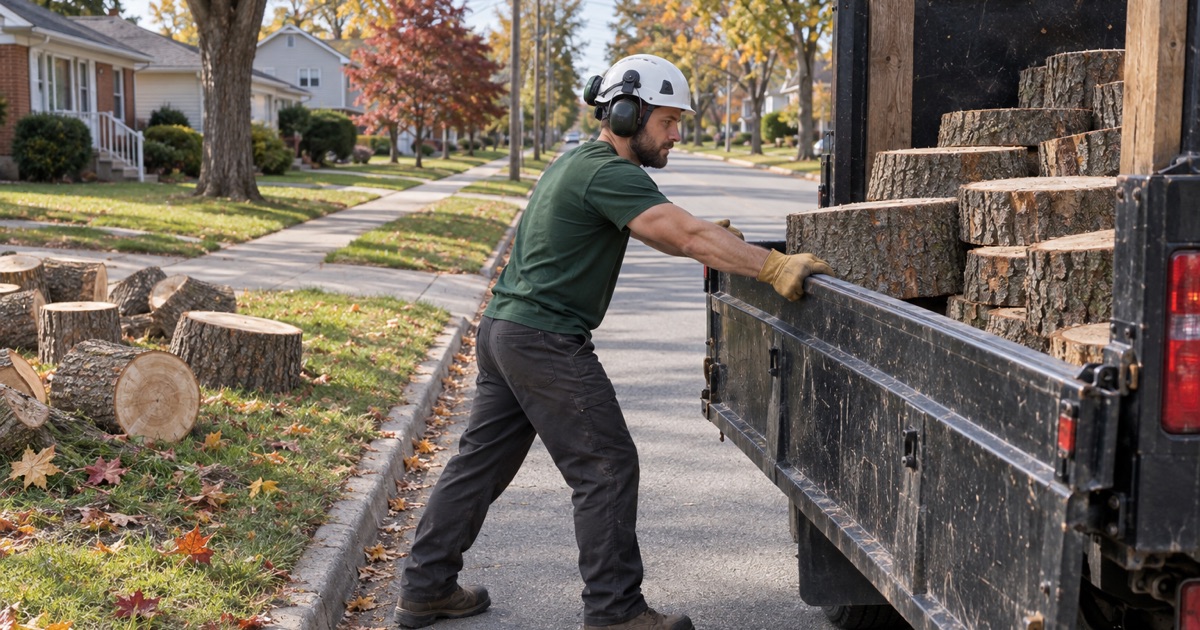
Grandview’s housing stock is unusually concentrated in time. Of the roughly 12,300 housing units here, 25.65 percent went up in the 1970s and 23.64 percent in the 1960s, which puts 49.29 percent of every house in the city inside two decades. Barely a fiftieth of the stock predates 1940.
That matters because the trees came with the houses. Shade species planted for fast canopy in the same fifteen-year window are now in their fifties and sixties together, and they reach structural failure age together too. The failures here arrive as a wave rather than one at a time.
What a synchronized cohort looks like on the ground
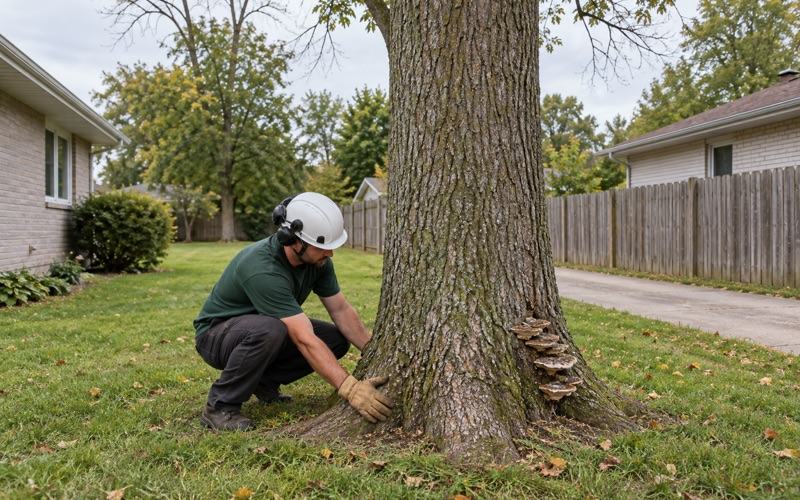
When we walk a block here we usually find the same defects on the same species within a few houses of each other. Co-dominant stems with included bark at the union, heartwood decay behind an old flush cut, a conk at the root flare, epicormic sprouts along a limb that lost its top years ago. One tree with those signs is a job; six of them on one street is a schedule.
That is why we measure DBH and write the condition down rather than eyeballing a price. A written assessment lets an owner stage the work: take the one that is going to fail first this season, prune and cable the two that can wait, and know which ones need looking at again next year.
Sixties platting works in your favor
The one advantage of this cohort is the plat. These are suburban lots with real setbacks and real driveways, not streetcar-era parcels served by a rear alley, so a chipper and a chip truck can usually get close enough to work from the driveway. Rear yards are generally reachable without threading equipment between two houses.
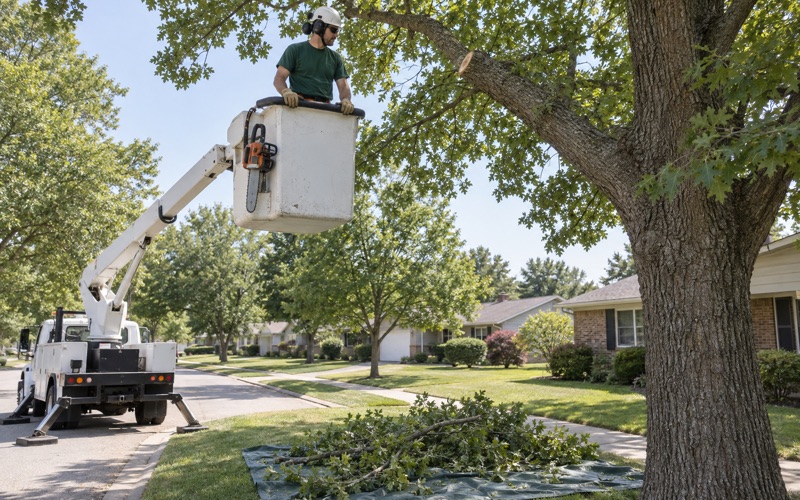
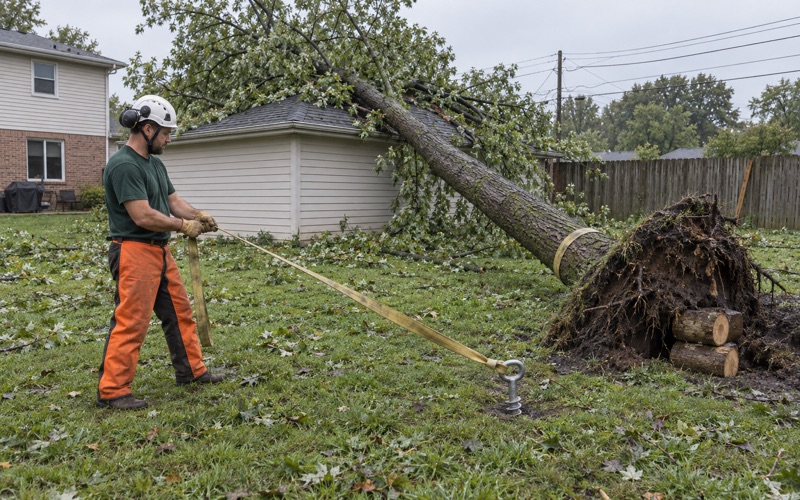
Access that good changes the method more than it changes the price. We can rig a stem down in controlled pieces with a bull rope and a Port-a-Wrap friction device and set a clean drop zone, instead of buying reach we do not need. Where a limb has to come off over a fence or a shed, the three-cut method and proper rigging beat brute force every time.
Looking for emergency-tree-removal closer to Kansas City? See Emergency-Tree-Removal in Kansas City.
Who actually signs off in a majority-renter city
Of 11,566 occupied units in Grandview, 50.91 percent are renter-occupied. That is a majority-renter city, and it changes who we are talking to. A large share of our removals here are ordered by a landlord, a property manager, or an out-of-town owner who has never seen the tree.
The other half of the market is still substantial: 5,275 owner-occupied one-unit detached houses, people living under their own canopy and making a decision about a tree they have watched for years. Those two buyers want different things from the same crew, and we have learned not to hand them the same paperwork.
What an absentee owner needs in the file
An owner who is not standing in the yard is buying certainty, not conversation. So the assessment goes out with the tree identified by location and diameter, the defect described, the scope written as what will be cut and what will be left, and the disposal route named. Proof of insurance goes with it, because a manager cannot approve a vendor without it.
It also matters that the tenant is usually the one who called. We coordinate access with whoever is living there while the authorization comes from whoever owns the parcel, and we do not begin cutting on a tenant’s say-so.
Property lines, and why we do not take a verbal assurance
Missouri follows the Massachusetts rule, settled by a 1985 Missouri Court of Appeals decision: there is no cause of action for damage from the roots or branches of a healthy neighboring tree, and the owner who is bothered may cut back to the property line at their own cost. Liability turns on condition, so an owner who maintains a tree in a damaged, decayed or diseased state is in a different position entirely.
State law is also why we survey the line before a boundary tree comes down. The statute gives treble damages for cutting down, injuring, destroying or carrying away a tree grown for use, shade or ornament, and the claimant does not have to prove negligence or intent. On a suburban plat where a fence was set by whoever built it first, a verbal assurance that the tree is yours is not worth the exposure.
The city writes the notice; it does not do the work
This is the part of Grandview that surprises new owners. The city’s own communications state that under city code dead trees and shrubs are considered a nuisance and can result in a notice from Neighborhood Services Officers, and that the city does not perform tree trimming or tree removal on private property. Both halves of that are true at once: the government will write the letter, and it will not send a truck.
The Neighborhood Services Division sits inside Community Development, and it is the code enforcement arm you will be dealing with. A dead tree in Grandview is therefore not a permit question. It is a code file with a private contractor at the end of it, and the person holding the letter is very often a landlord rather than the person living there.
Closing a code file, on paper
When a notice is what started the call, we write the invoice so it closes the file. The document names the tree, states the condition that made it a nuisance, and records the date the work was completed. That is also useful evidence in its own right, because a written notice documenting a damaged or decayed tree is exactly the condition state law cares about.
When it is a line, not a code letter
One triage order is worth knowing before you need it. A conductor on the ground or a limb bridging conductors is a 911 call first and the electric utility’s outage line second, and the city cannot de-energize anything, because it owns neither its electric system nor its water system. Grandview is served by Evergy Missouri West over most of its area and Evergy Missouri Metro over a small northern part, so it is worth confirming which operating company covers the address before you call.
Both are investor-owned companies, and that has a legal consequence people get wrong. The Missouri statute that gives a homeowner fourteen days’ notice before a utility removal, and a written right to demand removal at the supplier’s expense when a partially trimmed tree dies within three months, defines the supplier as a rural electric cooperative, a cooperative-plan corporation or a municipally owned system. An investor-owned company is none of those three, so those rights are not what a homeowner here is working with.
Street trees and the right-of-way
A tree between the sidewalk and the curb is a different question from a tree in the back yard, and Grandview handles it separately. The city code carries a Street Tree Ordinance as its own article inside the chapter on streets and sidewalks, and the section text is not something we will paraphrase for you, because we have not read it. What we can tell you is the shape of the process.
The instrument a homeowner or a contractor actually touches is a Public Works right-of-way permit, and the city’s permits page refers tree planting in the right-of-way to a separate City of Grandview Street Tree Policy rather than to the ordinance itself. The published trigger named there is planting; whether removing a right-of-way tree runs through the same permit is not something the city states on that page. We ask before we cut, and we recommend you get the answer in writing too.
No city yard waste route, so the haul is priced into the job
The city’s Clean-up and Disposal Programs page states it plainly: the City of Grandview does not provide curb pick-up of trash or yard waste. Residents contract their own hauler here, which means there is no municipal brush route to fall back on when a tree comes down.
In a city with a leaf and brush route at the curb, customers reasonably ask why they are paying us to haul what a city truck would take. That question does not arise in Grandview, and the answer is built into how we quote: the debris leaves with us, and nothing is stacked at your curb waiting for a collection that is not coming.
Where the wood and the brush actually go
Missouri law bars yard waste from a solid waste disposal area, which is why every outlet within reach of Grandview is a composter rather than a landfill. The nearest commercial gates sit outside the city limits and charge by volume: $10.00 per cubic yard for brush, $7.00 per cubic yard for lawn debris, and $2.00 for a lawn and leaf bag. Their free drop-off tier is keyed to a municipal identification a Grandview address does not satisfy, so a resident hauling their own brush to that scale house pays the posted commercial rate.
Those gates also refuse stumps with dirt and rock, along with brush over ten feet and tangled land-clearing debris. That single refusal decides more quotes here than anything else on the list, which brings us to the ground itself.
Grinding, not pulling, on Wooded Osage Plains ground
Grandview sits in EPA Level IV ecoregion 40c, the Wooded Osage Plains, inside the Central Irregular Plains. That is upland bench country rather than river bottom, alternating limestone and shale with the shallow residual soils this region carries over them. A series like that runs only ten to twenty inches to bedrock, which sits inside a stump grinder’s rated twelve-to-twenty-five-inch cut.
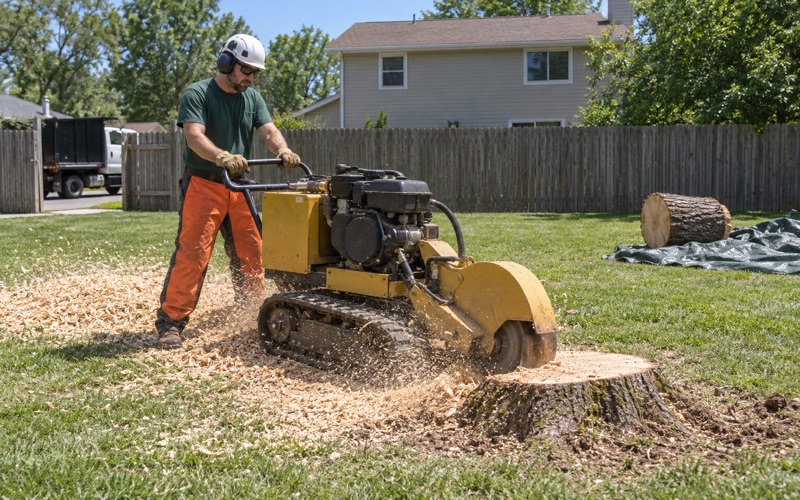
So we quote a below-grade cut depth as what we will usually reach, not as a guarantee on a lot nobody has opened yet. Grinding in place also keeps the stump out of the load that a composting gate would turn away, and the grindings stay on site to backfill the hole unless you want them gone. Before the tooth wheel touches soil, the locate goes in through Missouri One Call at 1-800-344-7483.
- 20+ Years in the KC Metro
- Free On-Site Assessment
- Written Price, Insured Crews