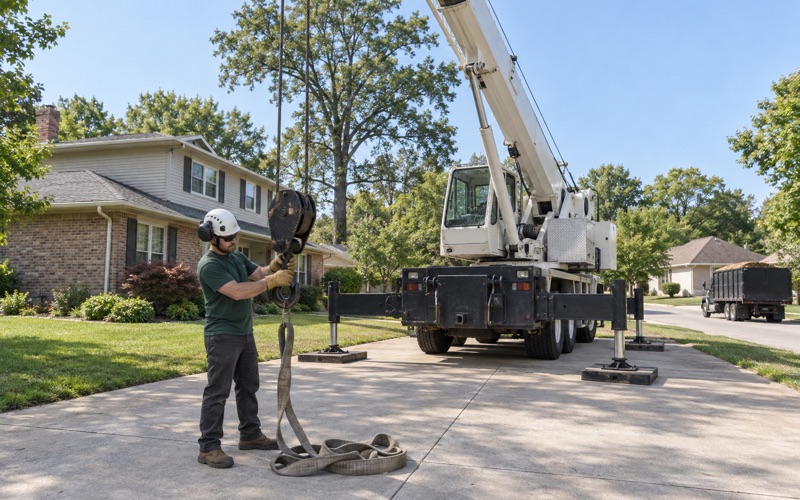
Blue Springs Tree Removal has handled tree removal in Greenwood for more than twenty years, on both sides of the state line and in every kind of yard the metro has. We take down trees that are dead, failing, or standing in the wrong place, and we grind the stump afterward rather than leaving you to find a second company for it. Every job starts with a free on-site assessment and a written condition report, not a number scribbled on the back of a card.
The quote you get is the quote in writing, and proof of insurance reaches you before a crew sets foot on the property. We tell you where the wood and the brush are going before the saw comes out of the truck, and the debris leaves with us instead of sitting at your curb waiting for a hauler to refuse it. If the tree can be kept with cabling or selective pruning, we say so and price that work instead of the removal.
We also do not top trees, and when someone else offers to, we are glad to explain what topping does to a trunk over the decade that follows. When a tree is down on a roof, a car, or a line, we respond the same day.
The city that put the tree care standard on its own books
Greenwood is unusual in a way most homeowners here have never had reason to notice: the city code carries a chapter titled Chapter 140, American National Standards for Tree Care Operations, sitting in the Government Code between Chapter 135, Boards and Committees, and Chapter 145, Volunteers. It got there by Ord. No. 2003-06-09-04, Section 1, adopted June 9, 2003.
That is an adoption by reference: the ordinance took the national arboricultural standard into the city’s own law, and the standard itself is held on file in the City offices rather than reprinted in the code. Missouri issues no license or certification for tree work at all, so a city of this size naming the industry’s own standard in its code back in 2003 is worth knowing about.
What the chapter says, and what it does not
Read on the code publisher’s own mirror, Chapter 140 contains no sections. Its entire content is an editor’s note recording the adopting ordinance and pointing the reader to City Hall for the text. There is no scope clause, no enforcement provision and no penalty anywhere in it.
That changes how the chapter should be read rather than whether it matters. Nothing in the codified text says whom the standard binds or what follows from not meeting it, so it is not a permit scheme and not a requirement you can hold a company to. It is a statement of what the city considers correct practice, which is thinner than an enforceable rule and still more than any city around it has put in writing.
Why nobody can name the edition
The editor’s note names no standard number and no edition year. Anyone who tells you exactly which published document Greenwood adopted, and which revision of it, is reading something into that note that is not there. The accurate account is the one the code gives: an adoption in 2003, with the document itself on file at City Hall for anyone who wants to read what the city actually took in.
Looking for tree-removal closer to Pleasant Hill? See Tree-Removal in Pleasant Hill.
Permits, search results, and how to compare bids
The question we hear most often here is whether the city has to approve a removal. We found no permit requiring city permission to take down a tree on a finished private lot. The vegetation provisions that do exist are on the nuisance side, at Chapter 215, Nuisances, with Section 215.070 covering weeds and overgrown vegetation, and that is aimed at a property left to go wild rather than at an owner removing a failing oak.
One warning before you go looking yourself. Search for Greenwood’s tree ordinance and high in the results you will find a real, confidently written provision saying that no person shall plant, remove or trim any tree or bush along any street or in parkways or in other public places without a permit, at Sections 6-344 and 6-346. That text is genuine, and it belongs to Greenwood, Indiana. Check the jurisdiction in the address bar before you act on anything a search turns up about tree rules in a city with a common name.
Standards as bid-comparison language
Because the state credential most people assume exists does not, the burden of telling one crew from another lands on the homeowner. Missouri’s only relevant state credential for this trade is the Department of Agriculture’s Commercial Applicator certification in Category 3, Ornamental and Turf, which covers pesticide application rather than removal or pruning. Chapter 140 hands you a better instrument than a credential search anyway.
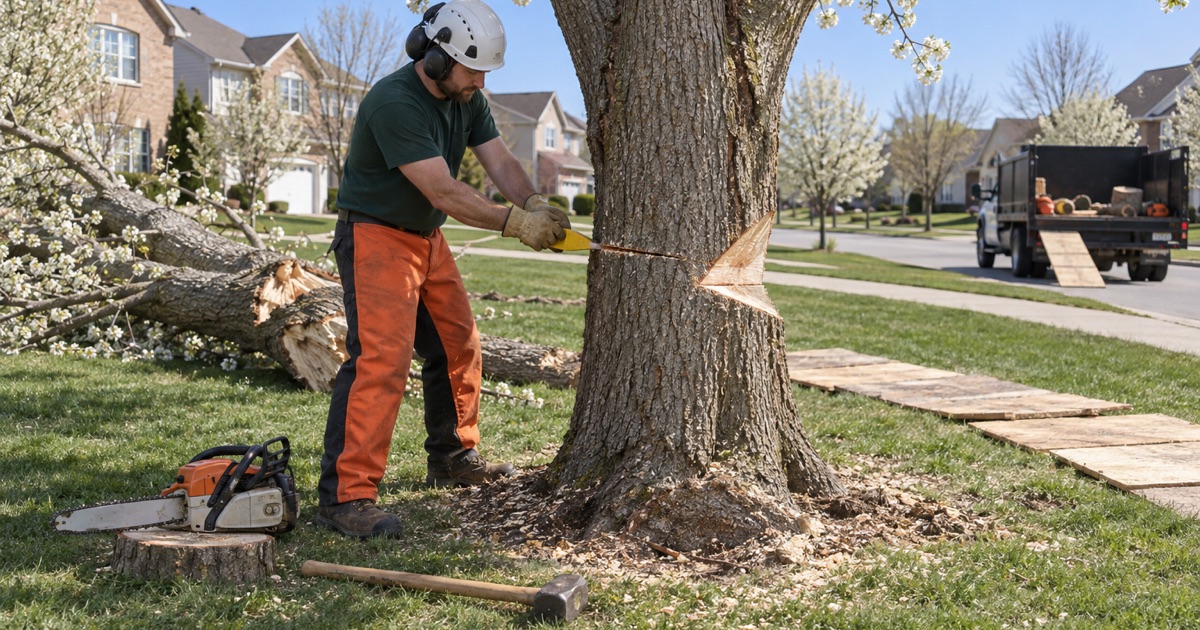
Ask each bidder to describe the job in the language of the national tree care standards: natural target pruning instead of stub cuts, a defined drop zone, a rated bull rope and a Port-a-Wrap friction device for anything coming down over a structure, and a three-cut method on limbs that would tear bark on the way out. A crew that works to those standards can describe them without notes; one that cannot will steer the conversation back to price. That is a fair test in a city whose own code says the standards are the benchmark, even though the chapter stops short of making anyone follow them.
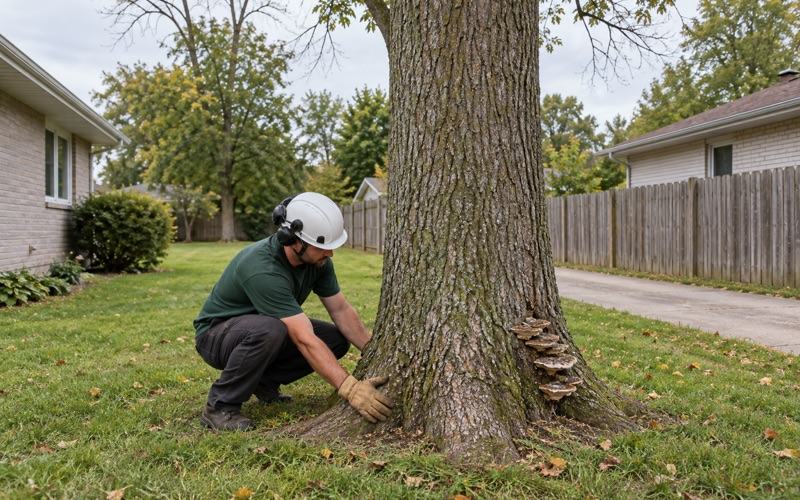
Our own written assessment is built the same way: the tree, its diameter at breast height, the defects we actually found, and the recommendation those defects support. Heartwood decay behind a conk, co-dominant stems with included bark, a root plate that has started to lift: those are the findings that decide a removal, and they belong on paper where you can show them to somebody else.
A subdivision cohort turning thirty
Greenwood’s housing stock is young and unusually uniform. Of the 2,263 housing units counted here, 42.86 percent, or 970 of them, were built between 1990 and 1999, and 98.98 percent are one-unit detached. Owner occupancy runs 92.13 percent, spread across 5.218 square miles at roughly 434 units per square mile.
Read that as a planting calendar rather than a census table. The trees on most of these lots went in with the houses, which puts a large share of the town’s canopy at roughly thirty years old: big enough now to stand over a roofline or a driveway, young enough that the owners still think of them as new.
What that cohort planted
Kansas State Research and Extension’s Johnson County brochure on recommended landscape trees for this metro area is blunt about a good deal of it. Its instruction on the Callery pear reads ‘DO NOT plant Bradford cultivar; severe splitting occurs on 10-15 year old trees,’ and a Bradford planted in 1995 is long past that window. Silver maple for weak wood, pin oak for soil problems, green ash for emerald ash borer, plus Austrian pine, Scotch pine, box elder, Lombardy poplar, Siberian elm and willow all sit on the same not-recommended list.
Pine wilt is the one removal on this list that carries a deadline. Extension records that Scots pine plantings in eastern Kansas have been devastated and that Austrian pines have been affected in recent years; symptoms show from August through December, and the guidance is to cut the tree as soon as possible, or by May 1 at the latest, with April 1 better. The tree goes to the ground with no stump left standing, the wood is chipped or burned immediately, and none of it is kept for firewood. On lots this size a pine windbreak along a back line is a common planting, and a dead one is a dated job rather than a someday job.
When a damaged tree is still worth keeping
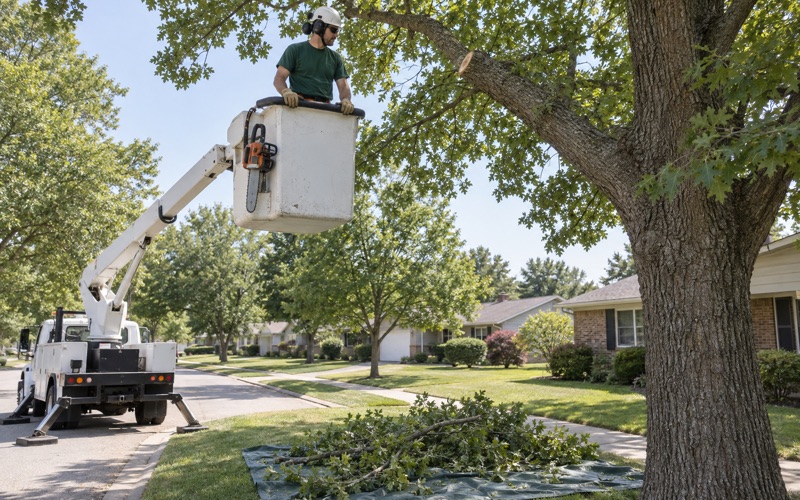
University of Missouri Extension’s guide G6867 sets thresholds with a Missouri owner behind them, which is why we work from those instead of the round numbers that circulate in this trade with no source at all. Its first question is whether at least 50 percent of the crown is still intact; past that point, in its words, the tree has lost its survival edge. It also holds that a 2- to 3-inch wound on a 12-inch diameter limb will seal over on its own, and that bent branches larger than 6 inches in diameter should be handled by someone with more experience. When the tree clears those bars we would rather cable or prune it than sell you a removal.
What changes about the work on a Greenwood lot
Stump grinding, and what the machine actually meets
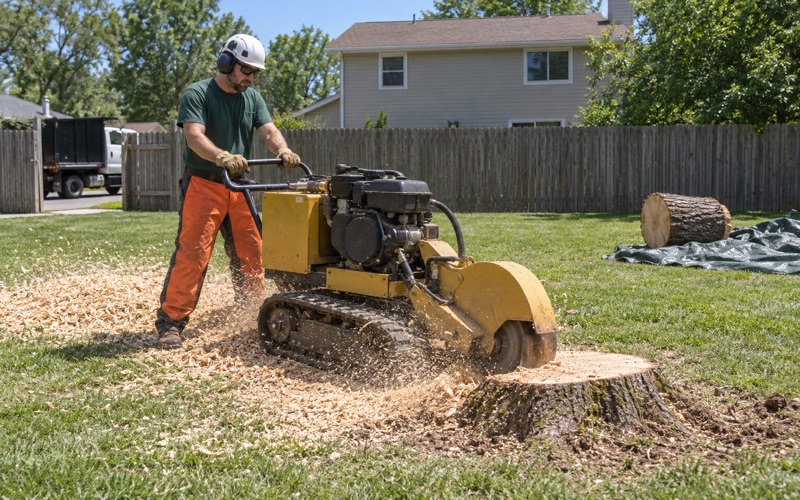
This part of Jackson County carries deep loess and loess-over-residuum profiles. The Sibley series, whose official series description places its typical pedon in Jackson County, has a solum typically 50 to 60 inches deep and ranging from 46 to more than 65, carrying 30 to 35 percent clay in the upper twenty inches of the argillic horizon. A stump grinder works 12 to 25 inches below grade, so the machine’s own reach runs out first by something like two to five times over, and there is no rock story to tell here: these are silt loam and silty clay loam profiles rather than cherty ones.
What loads the tooth wheel is clay, not stone. Snead is the one series shallow enough to change that answer, reaching a paralithic contact over gray shale at 20 to 40 inches, while Greenton sits on clayey shales below 40 inches and Higginsville on bedrock past 60. On ground graded in the 1990s the medium is often imported fill and compacted subgrade rather than the mapped soil, which is why we will not promise a below-grade cut depth sight-unseen. Before the grinder turns at all, Missouri law under RSMo Chapter 319 requires a locate request to Missouri 811 at least three but not more than ten working days ahead, and the legacy number is still 1-800-DIG-RITE.
Where the wood goes
Curbside yard waste here is collected under the city’s contracted trash service, and it goes out in tall brown paper sacks. A paper sack is a leaf-and-clipping instrument; it will not take a trunk section, a root ball or a heavy limb, so the wood off a removal leaves in a truck whatever the curbside rule happens to say. That truck is ours, and we tell you where the load is headed before we start cutting.
The calls, in the order they should go out
A conductor on the ground is not a tree job until the utility says it is. Stay at least thirty feet back, touch nothing that is in contact with the line, including poles, vehicles, fences, ladders, trees and the ground itself, then call 911 first and Evergy at 888-544-4852 after. A limb resting on a line gets the same treatment: do not pull a limb or any other object off a power line, because electricity travels through objects, wet ones especially.
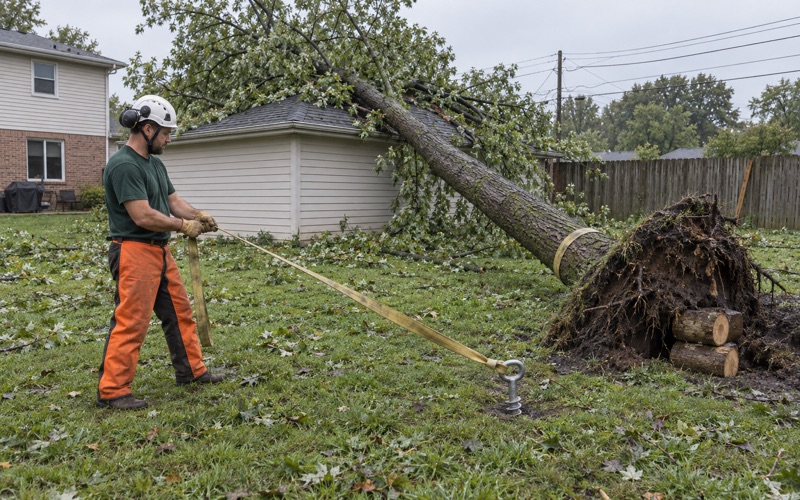
A tree across a city street is city hall during business hours and the police non-emergency line outside them. A tree across Route M-150 is not the city’s to clear, because that is MoDOT right-of-way and it is reported at 1-888-ASK-MoDOT, and the state route runs straight through town, so the instinct to call city hall sends the report to the wrong desk. Once the line is dead or the road is open, we are the same-day call for getting the tree off the roof, the car or the driveway, and for hauling every piece of it away afterward.
- 20+ Years in the KC Metro
- Free On-Site Assessment
- Written Price, Insured Crews