Blue Springs Tree Removal has been doing tree removal in Harrisonville for more than twenty years, and the first thing worth telling a caller here is that the electricity feeding the line over your driveway comes from a department the city itself owns. That single fact changes what you are owed when a utility crew cuts into your tree. It is the reason this page reads differently from the one for any other town we serve.
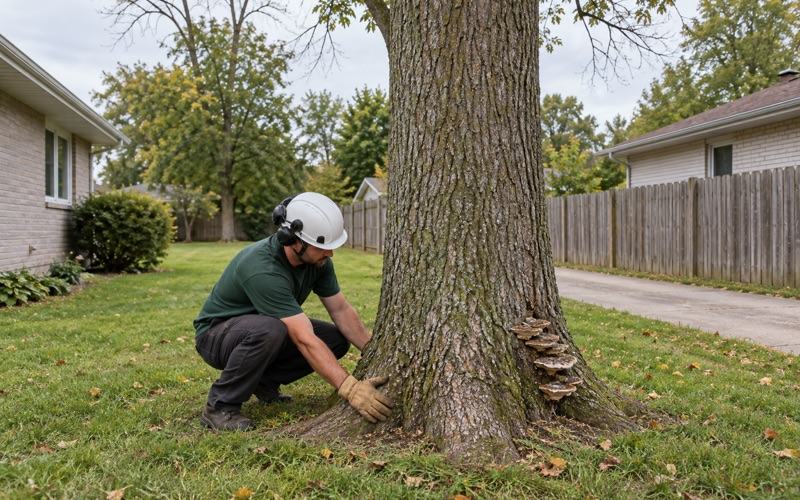
Every job we quote starts with a written condition assessment rather than a number scribbled on the back of a card, and the figure we put in writing is the figure you pay. The assessment on site costs nothing, and proof of insurance reaches you before a crew sets foot on the property. When a tree can be held with cabling or corrected with selective pruning, we say so and price that work instead of a removal.
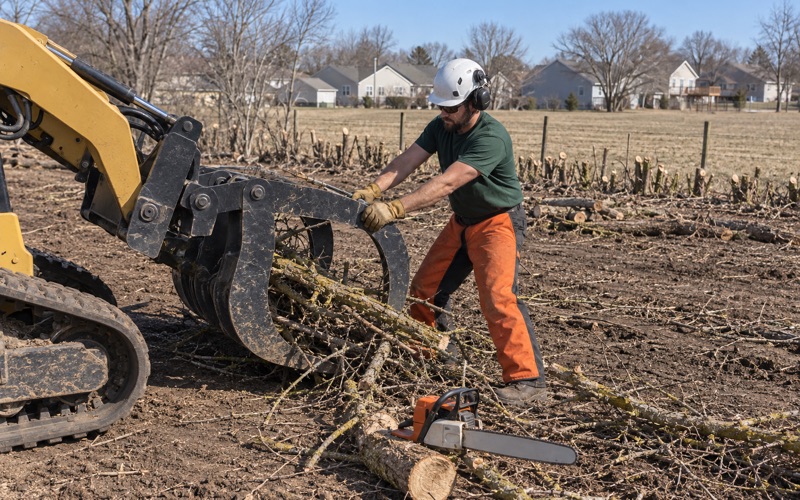
We also say where the wood and the brush are going before the saw comes out of the truck, and in this city that answer turns out to be less obvious than it sounds. The debris leaves with us, so nothing sits at your curb waiting for a hauler to refuse it. When a tree is on a roof, a car, or a conductor, we respond the same day.
The wires here belong to the city, and the law follows the owner
Harrisonville purchases wholesale electric power from the Missouri Joint Municipal Electric Utility Commission, and the city Electric Department distributes that power to retail customers inside the city limits. The city puts the count at roughly 4,744 electrical customers. Tree trimming and right-of-way management sit on that department’s own list of responsibilities, which means the crew working your overhead line answers to City Hall rather than to a utility headquartered somewhere else.
That ownership is not trivia. RSMo 537.340.3 defines an electric supplier to include, in the statute’s own words, any municipally owned or operated electric power system that is subject to the provisions of chapter 91, alongside chapter 394 rural electric cooperatives. A city-run distribution system sits squarely inside that definition, and the protections written into the rest of the section attach along with it.
Who to call when a tree is into a line
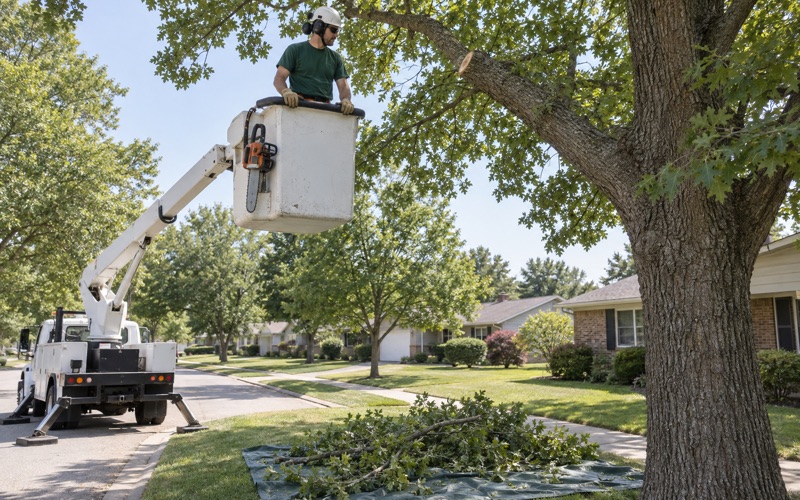
A tree touching an energized conductor inside the city is the Electric Department’s call, not ours and not yours: 816-380-8964 during business hours, and 816-380-8940 to report an outage after hours. No private crew, including ours, works near an energized conductor, and the ANSI Z133 safety standard we work to bars aerial work near lines during thunderstorms, high winds, snow and ice. We will stage, secure the drop zone and start the moment the department confirms the line is dead.
Past the city limit the supplier changes
On unincorporated Cass County ground outside town, the wires are usually Osage Valley Electric Cooperative, a member-owned utility running more than 17,500 meters across roughly 3,750 miles of line in this and neighboring counties. As a chapter 394 cooperative it is also an electric supplier under the same statute, so the rights below travel with you onto acreage, just from a different supplier. What does not travel is the county overlay near the public-use airport south of town, which reaches unincorporated parcels only and never a lot inside the city.
Looking for stump-grinding closer to Kansas City? See Kansas City Stump-Grinding.
Fourteen days of notice, and the tree that dies within three months
Two subsections of RSMo 537.340 do real work for a Harrisonville property owner. Under 537.340.2(6) the supplier must notify the owner or occupier of the land at least fourteen days before it removes a tree. The exceptions are narrow and sensible: removal that is immediately necessary for the safe and reliable operation of the lines, and work following a major weather event or other emergency situation.
Subsection 537.340.2(7) is the one almost nobody knows. Where a tree the supplier partially trimmed dies within three months as a result of that trimming, the owner or occupier may request in writing that the supplier remove the tree at the supplier’s own expense, and the supplier has ninety days to respond to the request. The mechanism is the written request; a phone call is not what the statute describes.
Reading a trimmed tree before the clock runs out
Three months is not long, and a hard directional trim does not always announce itself right away. What we look for is a canopy that has stopped putting on growth on the cut side, epicormic sprouts breaking along the trunk and scaffold limbs, dieback working back from the tips, and a flush of decay at the wound margins. A tree risk assessment written up with the diameter at breast height, the defects and the dates gives you something to attach to that written request.
The neighbor’s tree, and the line you should not cross
Missouri follows the Massachusetts Rule, so a branch or a root crossing the property line can be cut back to that line at your own cost and no further. Going past it is expensive: RSMo 537.340.1 gives treble damages for cutting down, injuring, destroying or carrying away a tree placed or growing for use, shade or ornament, and the claimant does not have to prove negligence or intent. We work both Missouri and Kansas, and the answer to a neighbor’s tree genuinely changes when you cross State Line Road, which is why we put the property line on paper before anyone climbs.
Where the brush goes, and why the free gate is closed to us
Twice a year the city opens a City-Wide Brush Drop Off in City Park at Bradley Avenue and Ash Street, and it is genuinely free. Crews ask that limbs be less than 10 inches in diameter, no yard waste is accepted, and a liability waiver must be completed and turned in first. The event is only for those living inside city limits, and contractors are prohibited outright.
Read that last clause carefully, because it is the whole point. The refusal here is not by material but by who you are, so the free gate that serves your neighbor is shut to any crew working for hire. Our disposal runs to the private composter on East 171st Street in Belton and to the Lee’s Summit Resource Recovery Park on Southeast Hamblen Road, both outside this city, and that cost is quoted before we start rather than discovered afterward.
Curbside will take the small stuff, on its own terms
Weekly curbside service in Harrisonville covers trash, recycling, yard waste and bulky item pickup. Clippings, leaves and other small plant material go in biodegradable paper bags or in a container marked as yardwaste, five containers per household per week, none over 40 pounds, and nothing may stand above the upper lip of the container. Brush and tree trimmings must be cut to lengths no longer than 4 feet and tied in bundles that also stay under 40 pounds. A single removal produces more than that on the first pass, which is why the debris leaves on our truck.
Grind the stump, do not pull it
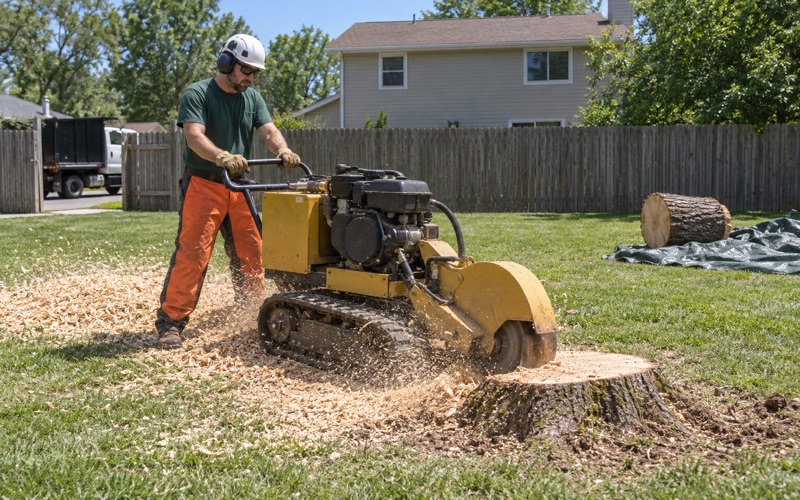
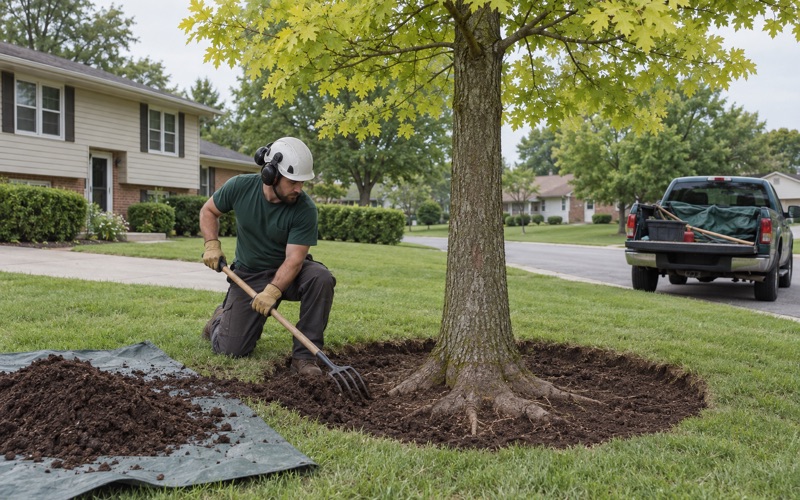
The Belton composter accepts brush and logs under 10 feet in length and logs up to 40 inches in diameter if they are under 5 feet long, but it refuses stumps with dirt on them. That single line in its published terms settles the method: grinding in place is the economical choice here, and a pulled stump becomes a piece of material with no outlet within reach. Missouri also bars yard waste from a solid waste disposal area under RSMo 260.250, which is why every destination in this county is a composter rather than a landfill. We call Missouri One Call before the grinder tooth wheel touches ground, and we tell you up front whether the grindings stay on site or go with us.
Burning is not the shortcut it looks like
Missouri’s open burning rule, 10 CSR 10-6.045, treats tree trunks, limbs, trimmings and yard waste as vegetative waste, and it conditions a commercial land clearing burn inside city limits on requirements that include a two hundred yard setback from the nearest structure. No lot inside this city can satisfy that. Cass County sits in no ozone nonattainment or maintenance area under any standard, so the seasonal air curtain incinerator condition does not reach here, but the setback still does. Ask the fire authority before lighting anything; we haul instead.
An old, close-packed town where the code compels removal
Harrisonville holds 4,015 housing units on 11.182 square miles of land, which works out to 359 units per square mile, and 55.84 percent of that stock was built before 1980. Old stock means mature trees planted close to the house and close to the line, on lots that were platted before anyone thought about crane access. 72.53 percent of the units are single-unit detached, so the typical job here is a full-canopy tree in a residential back yard with fences, a garage and a service drop inside the fall zone.
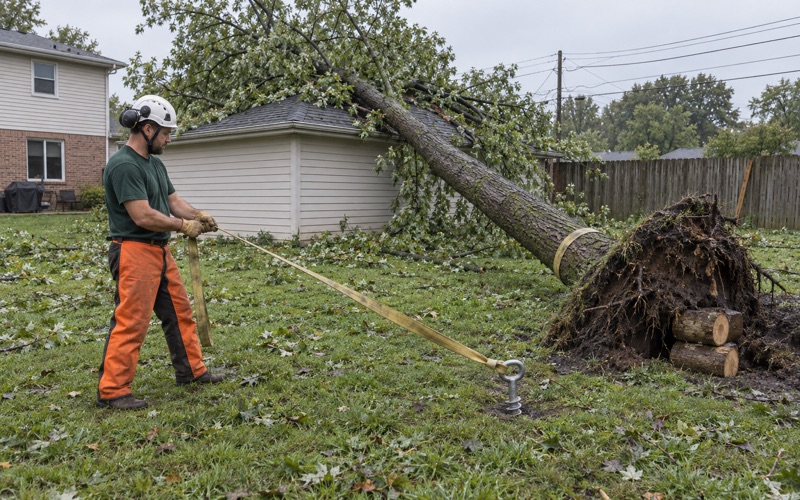
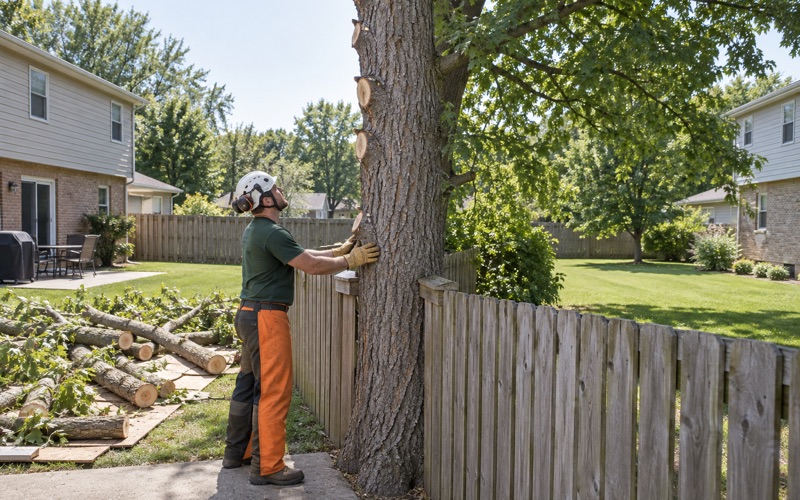
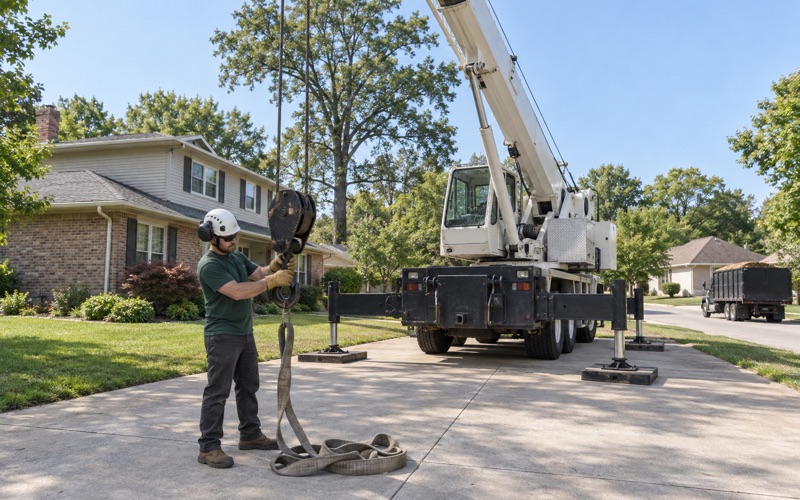
That is rigging work rather than felling. We set a bull rope through a crotch, run it to a Port-a-Wrap friction device at the base, and take the tree down in controlled pieces sized to the working load limit of the gear rather than to what the ground will absorb. Where the drop zone genuinely does not exist, crane-assisted removal costs less than the fence and the roof it saves.
No removal permit, but a nuisance code with teeth
There is no tree removal permit in Harrisonville. The city’s tree provisions live in Title II, Chapter 220, Article IV, Vegetation, and the section titles run the other way from a permit scheme: dead, dying and diseased trees, unsafe trees, interference with traffic, and notices to remove in each case. On notice from the City Administrator it becomes the property owner’s duty to have the tree removed or trimmed as the notice requires, and Code Enforcement works from the Property Maintenance Code and the Nuisance Code out of City Hall at 300 East Pearl Street.
Vacancy here runs 10.63 percent, which is high enough that an absent owner on a hazard tree is a routine problem rather than an unlucky one. When the tree threatening your roof stands on a lot nobody lives on, the nuisance route through Code Enforcement is the lever that exists, and our written condition assessment is what the file needs. Missouri licenses no arborist and issues no tree work credential, so what you are actually verifying is insurance, references and the standards a crew works to.
The species that keep us busy on this ground
Harrisonville sits in the Wooded Osage Plains, a prairie matrix carrying oak woodland rather than the continuous forest further southeast, and the removals follow the planting mistakes of past decades more than the native stand. Extension guidance for this metro area lists silver maple, pin oak, green ash, box elder, Siberian elm, willow, Lombardy poplar and Bradford pear among the trees not recommended, and warns specifically that the Bradford cultivar splits severely at ten to fifteen years old. Green ash carries the additional problem of emerald ash borer, which turns a maintenance decision into a removal decision quickly.
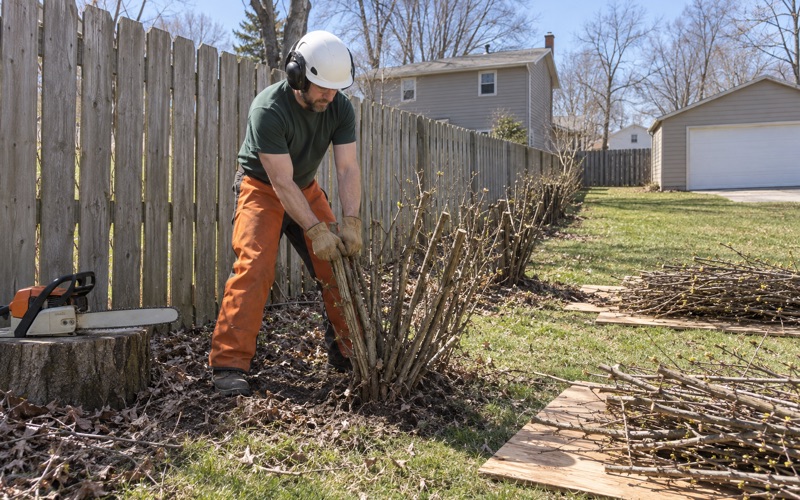
The oaks that remain are worth keeping where they can be kept. We prune to the ANSI A300 standard using natural target pruning, and we do not top trees; topping trades a season of clearance for a crown of weakly attached epicormic growth and years of failures. Co-dominant stems with included bark are the defect we cable rather than remove, and we will tell you which of the two your tree needs before we quote either.
- 20+ Years in the KC Metro
- Free On-Site Assessment
- Written Price, Insured Crews