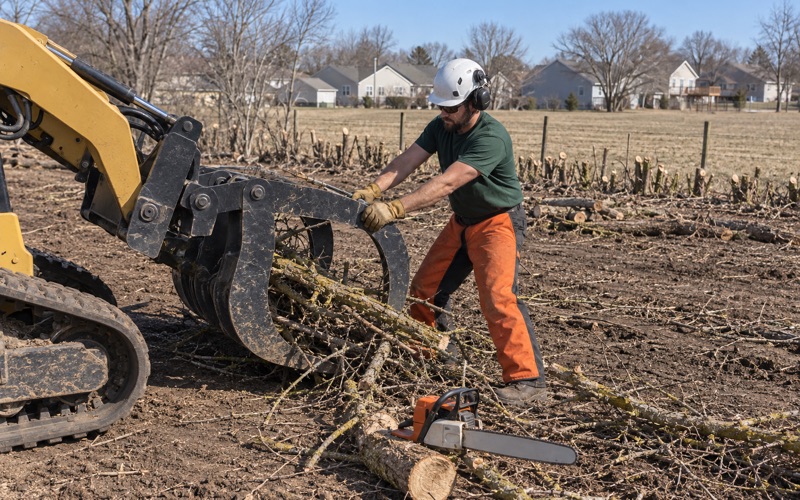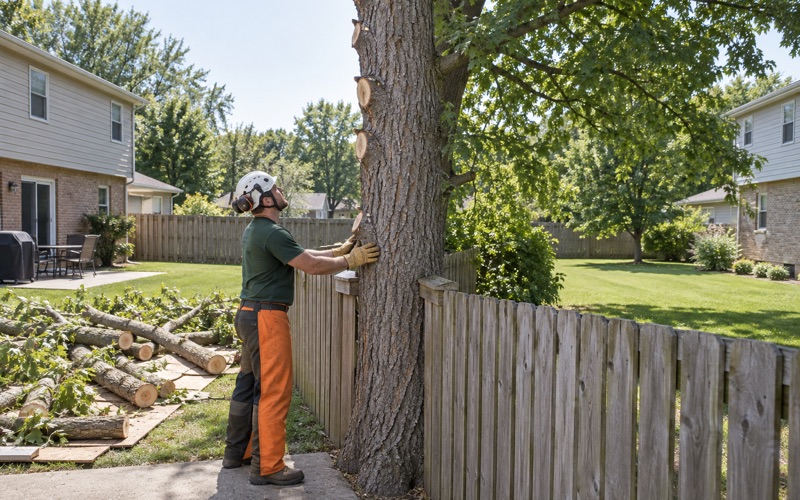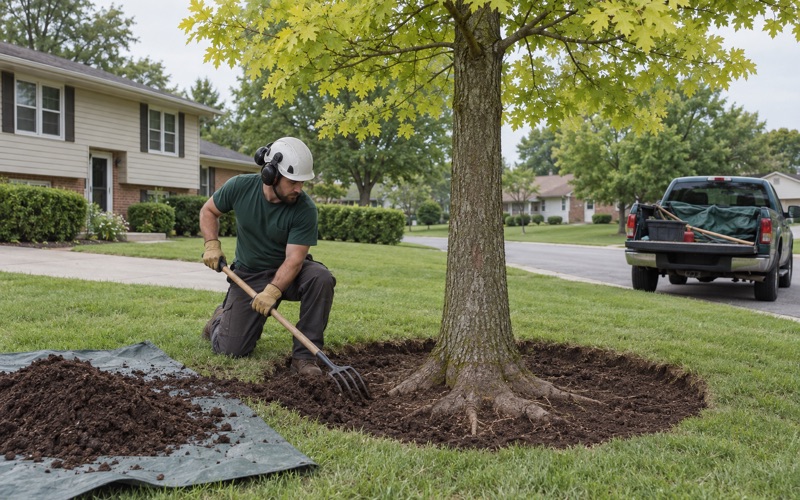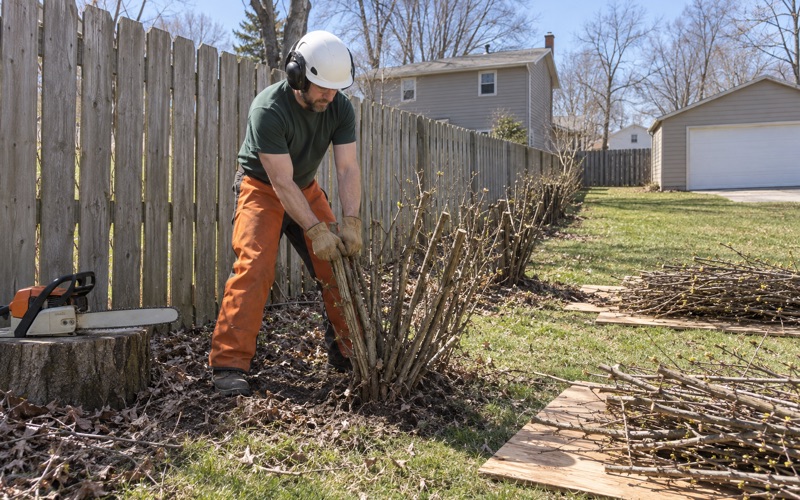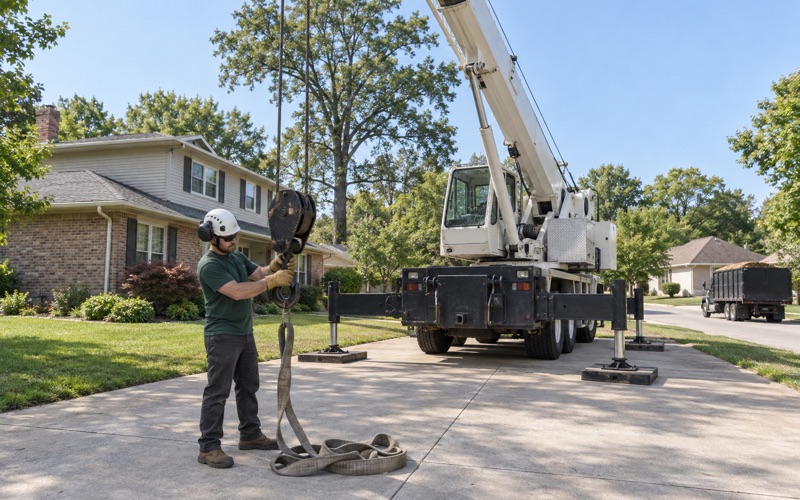
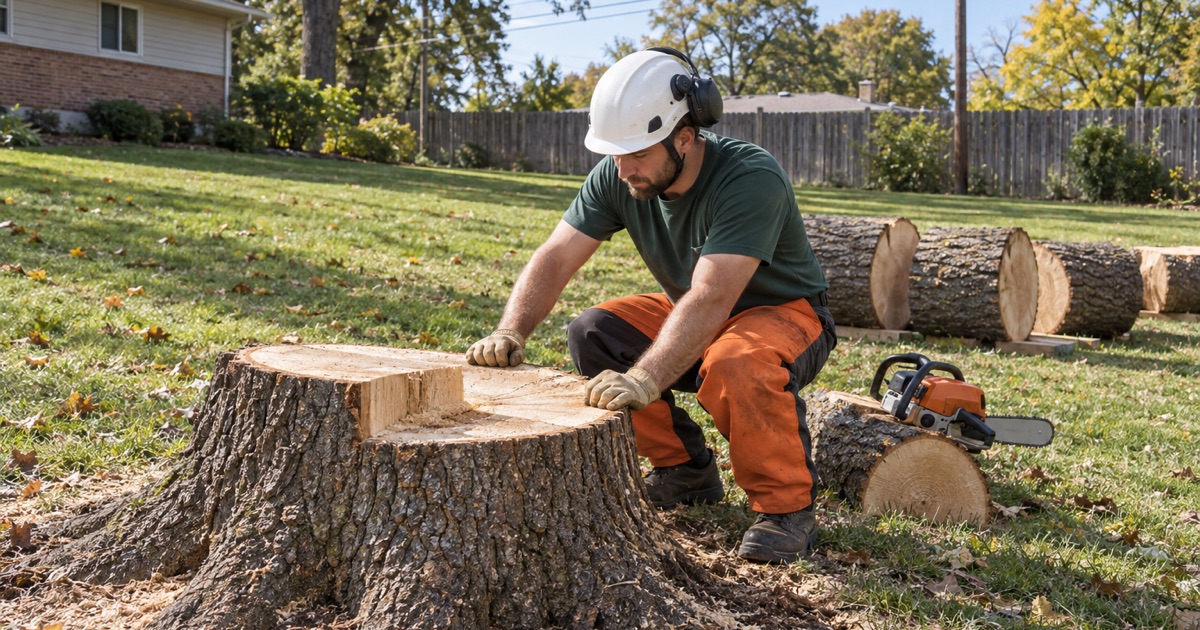
Blue Springs Tree Removal has handled tree removal and tree service in Independence for more than twenty years, working out of Blue Springs across both sides of the state line. Removals, storm damage, stump grinding, and the pruning that keeps a tree standing when taking it down is the wrong answer.
Every job starts with a free on-site assessment and ends with a written condition assessment, not a number scribbled on the back of a card. The figure we quote is the figure in writing, and proof of insurance reaches you before a crew sets foot on the property.
We do not top trees, and we will tell you why if somebody else offers to. If cabling, bracing or a proper crown reduction will hold the tree together, we say so and price that instead. And we tell you where the wood and the brush are going before the saw comes out of the truck, which in this city is a question with a specific answer.
Independence Power & Light is the city’s own utility, and that changes the rules
Independence Power & Light is a municipally owned electric generation and distribution system belonging to the City of Independence. That makes it the largest single vegetation-management operator inside the city limits, and it changes the legal answer for a homeowner, not just the phone number.
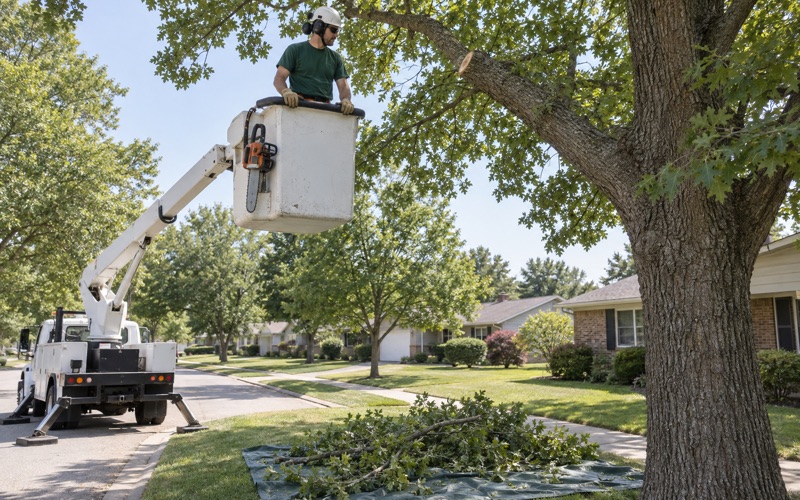
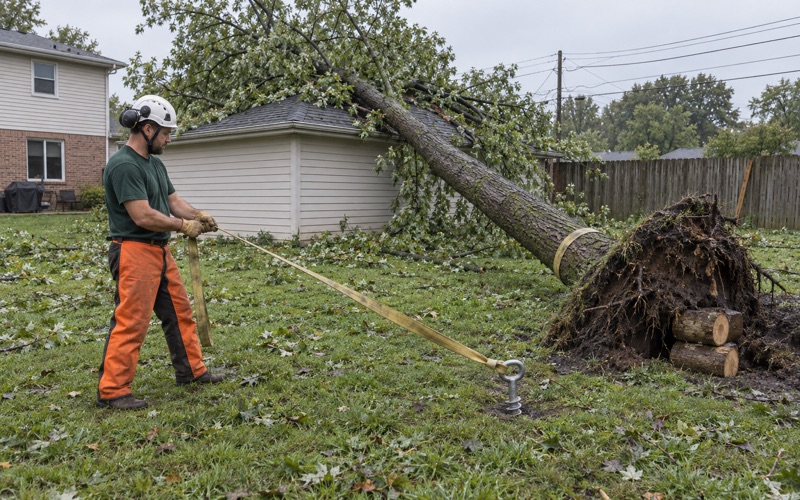
IPL keeps trees trimmed away from the main transmission and distribution lines at no cost to the customer, on a cycle it describes as not more than every three to five years except in emergencies. Two of its other published sentences produce most of the residential work we see. Trimming near the service line running from the pole to the house is the homeowner’s responsibility, and “During emergencies IPL will clear the lines of outage related trees and will leave the debris.” The power comes back on and the tree stays in the yard.
Non-emergency clearance around IPL facilities goes to its tree trimming department at 816-325-7557, and that work is free — we would rather point you there than bill you.
The fourteen-day notice a supplier owes you
Because the system is municipal, it falls inside the definition of an electric supplier in RSMo 537.340.3, which reaches “any municipally owned or operated electric power system that is subject to the provisions of chapter 91” alongside rural electric cooperatives and two narrower classes. On its face it does not reach an investor-owned electrical corporation.
The consequences favor the homeowner. Subsection 2(6) requires at least fourteen days’ notice to the owner or occupier before a supplier removes a tree, unless the supplier deems the removal immediately necessary or is working after a major weather event. Subsection 2(7) reads: “If any tree which is partially trimmed by an electric supplier dies within three months as a result of said trimming, the owner or occupier of land upon which the tree was trimmed may request in writing that the electric supplier remove said tree at the electric supplier’s expense. The electric supplier shall respond to such request within ninety days.”
Read plainly, a homeowner here whose tree was cut back for the lines and died within three months can ask in writing for the utility to pay for the removal, and a neighbor on investor-owned lines has no such hook. That reading has not been tested by a Missouri court or the Public Service Commission, so we tell people what the statute says and let them decide whether to send the letter first. Sometimes the honest answer is that you should not be paying us at all.
Looking for tree-removal closer to Oak Grove? See Oak Grove Tree-Removal.
Where the statutory rights stop
The supplier’s authority is a corridor, not a blanket. Inside a city, RSMo 537.340.2 sets clearance for lines at or below 34.5 kilovolts at ten feet plus half the length of any attached cross arm from either side of the centerline, against thirty feet for the same lines outside any city. The utility’s reach shrinks sharply at the city limit, which is why a tree cleared for free on a county road may be entirely yours here.
Outside that corridor Missouri hands the problem back to the property owners. In Hasapopoulos v. Murphy, 689 S.W.2d 118 (Mo. Ct. App. 1985), the court found no cause of action for damage from the encroaching roots or branches of a healthy tree, leaving the complaining owner a right of self-protection by cutting at the property line. You may trim back to the line at your own expense; you cannot compel a neighbor to take down a healthy tree. Liability changes when an owner keeps a tree in a damaged, decayed or diseased condition, which is what a written hazard assessment documents.
RSMo 537.340.1 runs the other way just as hard: treble damages for cutting down or injuring a tree growing for use, shade or ornament on someone else’s land, and a claimant “need not prove negligence or intent.” So we establish who owns the trunk before anything near a boundary comes down.
The calls that come before ours
A conductor on the ground, arcing or smoking, is a 911 call first and then IPL at 816-325-7550, the same number that takes outages. A tree across a city street or a blocked sidewalk belongs to the city, whose crews own right-of-way clearance.
Before any stump grinding or root work we notify Missouri 811. RSMo 319.026 asks for notice at least two working days and not more than ten before excavation, while Missouri 811 itself asks for three full working days; the two do not agree, so we schedule to the center’s number. Nobody works near energized conductors during a thunderstorm, high wind or ice storm either — the ANSI Z133 safety standard says so in terms, and that is the honest limit on any same-day promise, ours included.
Bur-oak ground: 47f Rolling Loess Prairies and the species that fail
Independence sits in EPA Level IV ecoregion 47f, the Rolling Loess Prairies, inside Level III 47 Western Corn Belt Plains: thick loess, about 25 feet of it, over clay loam till. The potential natural vegetation EPA records for 47f is “Big bluestem-Indiangrass prairie, and bur-oak woodland,” which is the accurate description of what this ground grows.
It also settles an argument with copy written somewhere else. Bur oak is not known for fall color — K-State Research and Extension in Johnson County says so plainly, and the Missouri Department of Conservation credits it with none either. Red oak runs russet to bright red and white oak an outstanding claret red, but a page promising an oak display here is describing a different woodland.
The species that generate the calls
Most of the removals we quote here are species the land-grant authority never recommended. The Johnson County K-State list of trees not recommended for the Kansas City area names silver maple for weak wood, pin oak for soil problems and green ash for emerald ash borer, along with Austrian pine, Scotch pine, box elder, Bradford pear, Lombardy poplar, Siberian elm and willow. The Department of Conservation adds that silver maple “easily loses limbs in strong winds and in ice storms.”
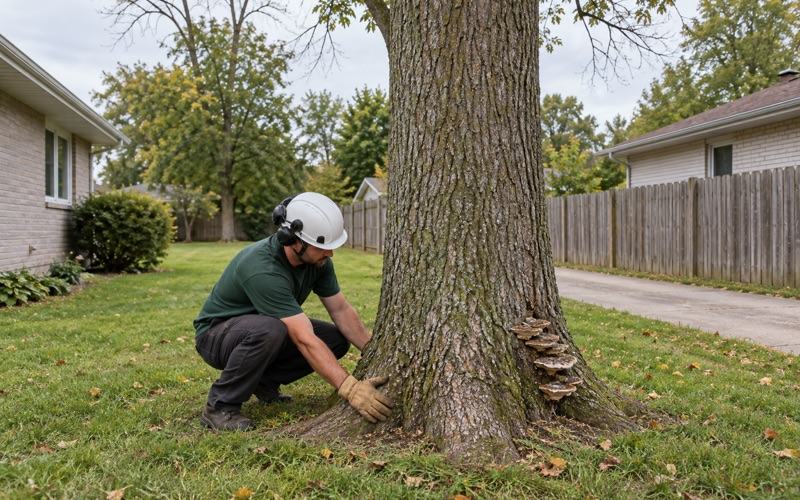
What we look at on those trees is structure: co-dominant stems with included bark, a split leader, epicormic sprouts on a stressed trunk, a conk at the root flare that reads as heartwood decay. A two-stemmed silver maple over a driveway is a rigging job with a defined drop zone, not a hinge cut and a shout.
What the soil does to a stump grinder
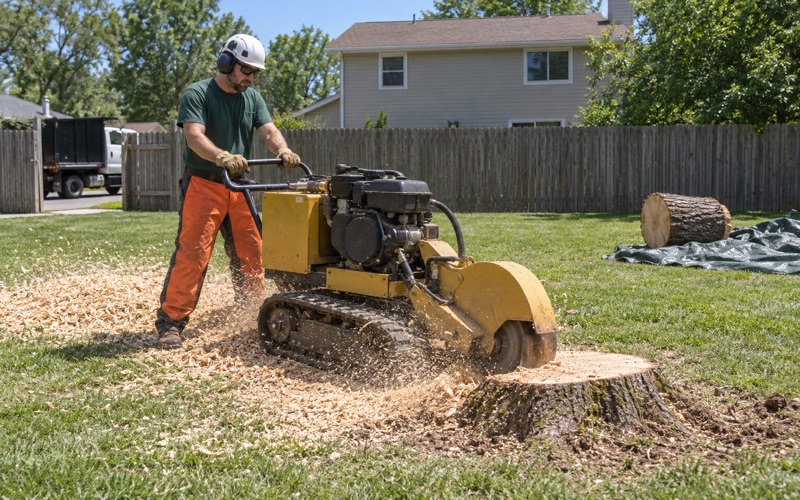
The soil series EPA lists for 47f include Sibley, type-located here in Jackson County with a solum of 46 to more than 65 inches, and Higginsville, whose bedrock sits deeper than 60 inches. A stump grinder’s rated below-grade cut runs from roughly 12 inches on a narrow-access machine to about 25 inches on a larger one, so the machine’s own stop binds long before anything geological does. There is no shallow rock here and no chert chewing the tooth wheel.
That is why we will not promise a grinding depth over the phone: the depth is set by the machine that can reach the stump, and a 35-inch grinder goes to 56 inches wide with the dual-wheel option — the difference between clearing a four-foot gate and taking out a fence panel.
Three decades of housing, and why we read the plat before the build year
Independence holds 56,084 housing units across 77.989 square miles, roughly 719 to the square mile, and 70.81 percent of them are single-unit detached. The figure that describes our actual work is 29,418 owner-occupied single-family detached houses, each with its own trees and its own way in.
The build years overlap rather than cluster: 35.87 percent of the stock predates 1960, the peak decade is 1960 through 1969 at 18.97 percent, 69.89 percent was standing before 1980, and only 4.26 percent has gone up since 2010. Three overlapping cohorts means the plantings around them reach failure age in waves rather than all at once.
Age is not the same as tight, though. At 719 units per square mile this is not a dense city: a 1955 house may sit on a lot with a clean crane pick and a wide drop zone while a newer parcel two streets over has neither. We walk the access and read the plat before committing to a method, rather than letting the build year settle it.
The debris, and where it actually goes
The city runs no curbside brush collection; trash and yard waste here are private subscription. What it runs instead is a paid Drop-Off Depot, open 8:00 a.m. to 3:00 p.m. on the second Saturday of the month from April through October and priced by vehicle rather than volume, from $30 for a car to $60 for a trailer over eight feet. It takes limbs, firewood, bushes and stumps, which is unusually generous for this metro.
It is also closed to us, and not because of a contractor clause. The depot is for Independence residents only, proved at the gate, and no commercial waste is allowed; a tree crew’s truck is not a resident. So your brush leaves on our trucks for a private or county composter — a composter rather than a landfill, because RSMo 260.250 has barred yard waste from Missouri disposal areas since January 1, 1992. Nothing gets stacked at your curb for a service that will not take it.
Permits, the Tree Commission, and the word “licensed”
No permit is required to remove a tree on a finished private lot in Independence — no private-tree permit, no diameter threshold and no landmark-tree provision in the city’s code as read. The Independence Tree Commission, five members serving three-year terms appointed by the Mayor with Council approval, is chartered over street trees: it studies and recommends to Parks and the Council rather than approving anything in your back yard. The city has held Tree City USA designation for 25 consecutive years, so an ordinance exists. What reaches a homeowner instead is the right-of-way, where the city holds property owners responsible for private trees adjacent to it.
One last thing, because the word is on every yard sign in this trade: neither Missouri nor Kansas licenses tree work, so there is no such credential to hold in either state. What carries weight instead is ISA certification, work performed to the ANSI A300 pruning standard and the Z133 safety standard, and insurance coverage you can read for yourself. Ours reaches your inbox before our truck reaches your driveway.
- 20+ Years in the KC Metro
- Free On-Site Assessment
- Written Price, Insured Crews