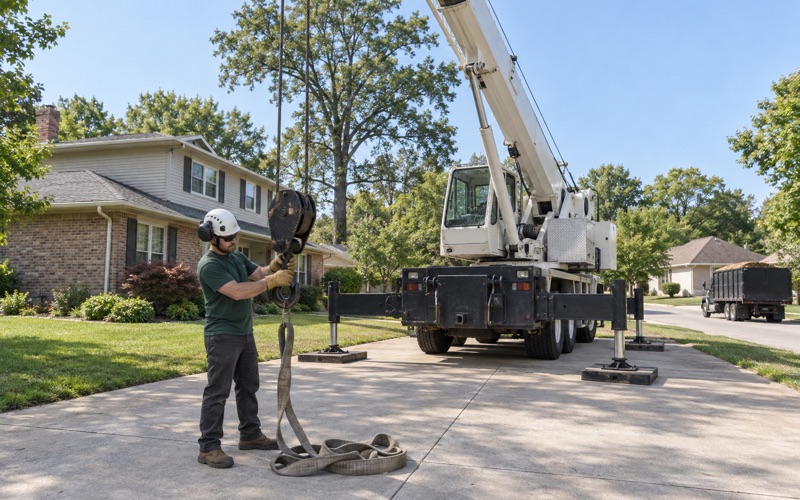
Blue Springs Tree Removal has been grinding stumps in Kansas City, Kansas for more than twenty years, and this is one of the few places in the metro where the paperwork behind a stump grinding job is written into the code by name. The Unified Government of Wyandotte County and Kansas City, Kansas licenses tree work twice over, in two separate chapters, with two separate filing points. Most homeowners here have never heard of either one, and neither appears on the list of business categories the city publishes.
That matters to you for one practical reason. Both ordinances set the same insurance floor, so the standard the city wrote down is a standard you can ask any crew to meet before it puts a grinder on your lawn. We send proof of insurance to the customer before anyone sets foot on the property, and we do it in writing.
The rest of a stump grinding job here is ground and disposal. The ground under a stump varies across this city more than it does in most, and where the grindings end up is decided before the saw comes out of the truck.
Two licenses, two filing points, one stump
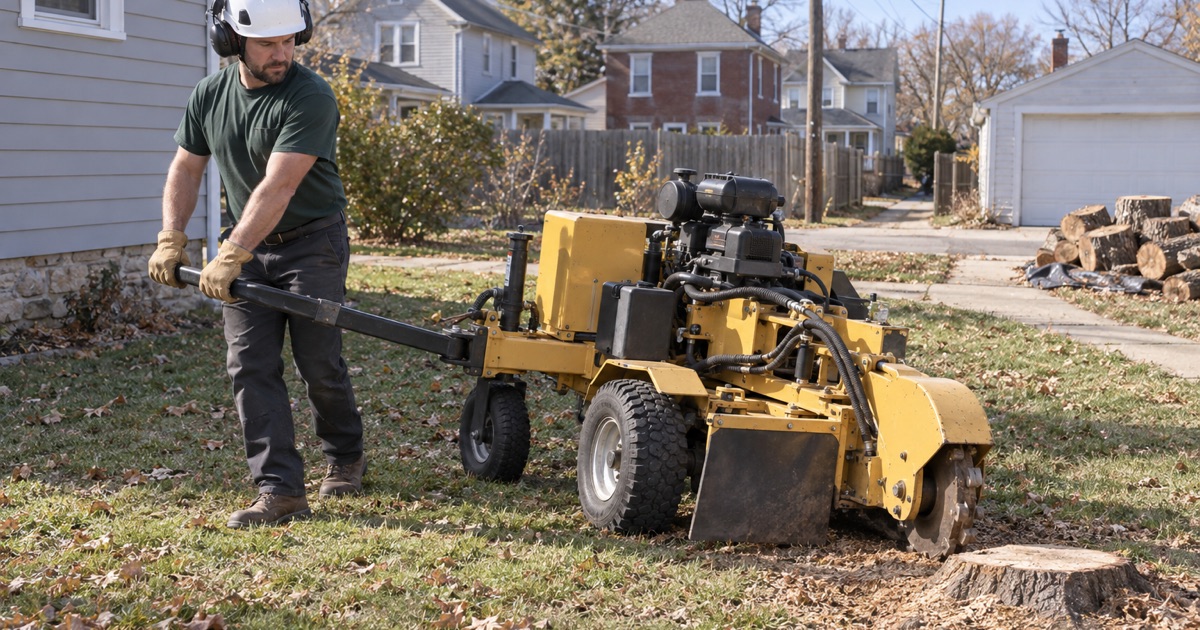
Kansas issues no state tree-work license and no state arborist license. The only relevant state credential is a live plant dealer license, which is a nursery license and has nothing to do with taking a stump out of a front yard. Inside these city limits the answer flips completely, and it flips because of the Unified Government’s own code.
The arborist license under Chapter 32
Chapter 32, Article VII, section 32-371 creates an annual arborist license. It carries one million dollars in bodily injury cover and five hundred thousand dollars in property damage cover, and it makes it unlawful to engage in the business of pruning, treating, or removing trees without one. The reach is the part people miss: it applies within the city limits, not merely in the right-of-way, so a stump in a back yard is inside it. Certificates file with the License Division.
The tree trimmer’s license under Chapter 19
Chapter 19 covers licenses, permits and miscellaneous business regulations, and its Article VI is headed Tree Trimmers. Sections 19-161 through 19-164 came out of Code 1964 section 38-1 and Ordinance 44736, adopted on 12 January 1965. Section 19-161 says that no person shall engage in the tree-trimming business or use trucks or vehicles in such business without first obtaining a tree trimmer’s license from the license administrator, with one license covering all employees of a firm and the fee set by the county administrator.
Section 19-162 sets the same insurance limits as the arborist license, but the certificate goes to the City Legal Department for approval before issuance rather than to the License Division. That is a genuinely different filing point for two licenses that cover one job, and it is the sort of detail that only shows up when someone reads the chapters rather than the counter handout. Section 19-163 adds office requirements on top.
Vehicle lettering, and what the license page never lists
Section 19-164 reaches the truck itself. Every vehicle used in the business, or in soliciting the business, must display the business name in letters at least one and one-half inches high, and the address and telephone number in letters at least one-half inch high. It is a small rule with a useful side effect for a homeowner, because a chipper truck parked at your curb is either carrying that lettering or it is not.
A third layer sits above both: the occupation tax license under Chapter 34, Article III. None of the tree categories appears on the Unified Government’s public business license page, which enumerates no tree trimmer category at all. They exist only in the code, which is why a homeowner checking the published list comes away thinking nothing applies. The Business License Division can be reached at (913) 573-8780.
Looking for tree-removal closer to Parkville? See Tree-Removal in Parkville.
What sits under the stump changes across this city
A stump grinder is rated for a below-grade cut somewhere in the range of twelve to twenty-five inches, and on most of this city that rating is the only thing that stops the wheel. The bottoms are deep river alluvium, and the bluffs and older neighborhoods above them sit on loess with carbonates more than one hundred eighty centimeters down. Neither of those brings rock anywhere near a grinding depth.
The upland benches are the exception
The western upland is why we say usually rather than always. This ground is Osage Cuestas, alternating limestone and shale benches, and eastern Kansas carries two shallow residual series over them. The Vinland series runs twenty-five to fifty-one centimeters to bedrock, roughly ten to twenty inches, over interbedded sandy and silty shale; the Oska series runs fifty-one to one hundred two centimeters over limestone and shale residuum.
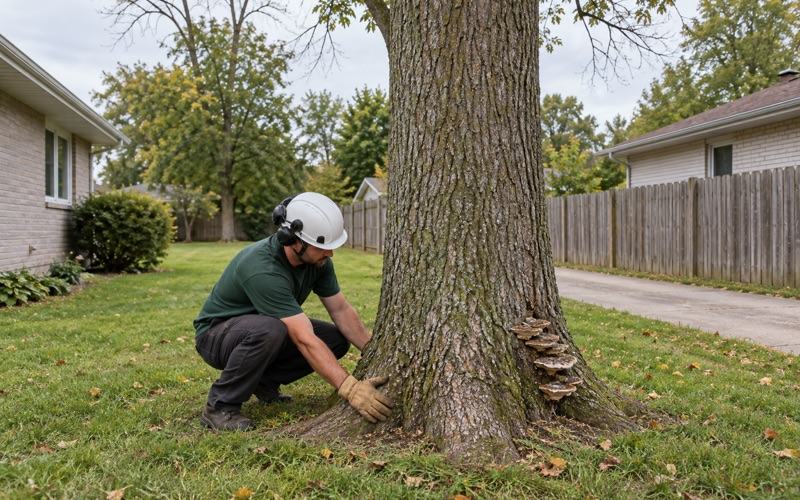
On Vinland the rock stops the machine before the machine’s own limit does; on Oska it brackets it. Which series is mapped under any given address across a city of roughly one hundred twenty-five square miles, spanning two floodplains, a bluff line and a rural-edged western third, is not something anyone can tell you from a desk. That is why we will not promise a below-grade depth sight unseen, and why the written condition assessment we hand you says what we found at that stump rather than a number we use everywhere.
Access, old lots and what the wheel has to reach
About forty-eight percent of the housing here predates 1960 and about seventy-six percent predates 1980, with roughly twenty-one percent built in 1939 or earlier. That is real mature canopy on genuinely tight streetcar-era platting, which means big root plates, close houses, overhead service drops and rear yards reached through a side gate rather than around a wide setback.
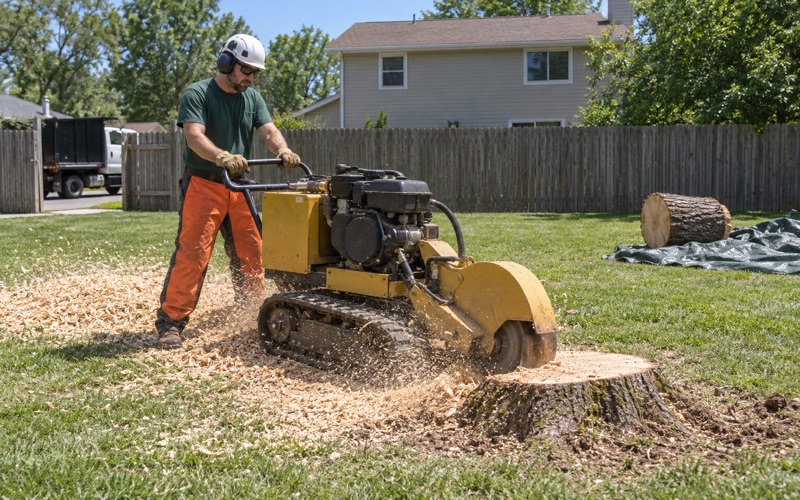
We size the machine to the gate, not to the stump. Where a walk-behind grinder will not clear a fence line, or where a manufactured-home lane leaves no room to turn, we say so at the assessment instead of at the curb on the morning of the job.
Where the grindings, the wood and the brush go
Grinding produces volume. A stump that looked small at the flare turns into a mound of grindings, and every job here has to answer the disposal question before it starts rather than after. We tell you where the material is going as part of the quote, and it leaves with us unless you have asked to keep it.
The free county gate you can use and we cannot
The Wyandotte County Recycling and Yard Waste Center at 3241 Park Drive accepts grass clippings, garden trimmings, leaves, branches up to four feet in length, and stumps not exceeding twelve inches in diameter. It runs Thursday through Saturday, 10 to 3, from 20 March to 20 December, at no charge with proof of residency. A twelve-inch stump cap is generous for a free public gate, since municipal programs commonly cap well below that and many refuse stumps outright.
The catch is the residency requirement, and it is the residency requirement rather than any commercial exclusion clause that closes the gate to a contractor’s truck. You can haul your own material there in your own vehicle and pay nothing. That is a real economic choice here rather than a symbolic one, and we will price a job both ways if you want to see the difference.
Curbside limits, and why the commercial outlet decides the method
Curbside collection is narrow by design. Leaves and grass must be bagged at not more than fifty pounds per bag, and tree limbs must be tied in bundles not more than four feet long and under fifty pounds, with limbs four inches or less in diameter. Nothing off a stump job fits that, which is why we do not stack material at your curb for the city to refuse.
Our own outlet is private. Missouri Organic Recycling runs a yard at 2827 South 12th Street inside this city, taking brush at ten dollars per cubic yard and lawn debris at seven dollars per cubic yard, and accepting logs up to forty inches in diameter if they are under five feet long. It refuses stumps with dirt in them, and that single line is the clearest argument for grinding a stump out rather than pulling it: a ground stump becomes clean grindings, while a pulled one becomes a dirt-packed ball nobody will take.
One government, one municipal utility, and the calls that come first
The Unified Government of Wyandotte County and Kansas City, Kansas is a consolidated city-county, so the city authority and the county authority are the same body. For a stump job that removes a step from the usual runaround: there is no question of whether a street tree or a right-of-way obstruction belongs to a city department or a county one, because there is one department either way.
Kansas 811 before the wheel turns
Every stump grind is an excavation, and the only reason it is not treated as one is that it is shallow. Kansas 811 is the state one-call notification center, reached at 811 or 1-800-DIG-SAFE. We locate before any grinding, excavation or root work, because a service lateral running under a front yard stump does not care that the cut is only fifteen inches deep.
The service drop and the Board of Public Utilities
Electricity here comes from the Board of Public Utilities, a municipal utility of the Unified Government rather than an investor-owned company. That distinction is worth money to you on the right job. The Board publishes a Line Drop Service that will lower the service line before you trim, reached at 913-573-9535, for what it describes as a small fee; it is not free, and the current figure is worth confirming when you call.
The Board also states plainly that the owner is responsible for trimming trees around the service line, and that it will not top or round over trees directly under electrical lines. We do not top trees either, and we will tell you why when someone else offers to.
No removal permit on a private lot, and no owner removal in the right-of-way
There is no tree removal permit for a private tree on a finished lot here, so the stump in your yard is yours to grind out whenever you want it gone. The right-of-way is the opposite. Section 32-365 gives a property owner the right to plant a conforming street tree but no right to remove one, and removal there is vested in the Unified Government and its utility, which means a right-of-way stump is a call to the Unified Government rather than a job you can order.
If you are replanting where the stump was and the new spot falls in the right-of-way, the same chapter governs what goes back. Silver maple, Bradford pear, sycamore, cottonwood, green ash, white ash, mulberry, tree of heaven, boxelder, willow, Siberian elm and edible fruit trees are all prohibited there, and nothing may be planted under or within twenty-two feet of overhead wires.
Callery pear, and why one grind is rarely the end
Grinding also settles a species problem the state is about to make formal. The Kansas Department of Agriculture has a permanent statewide Callery pear quarantine taking effect on 1 January 2027 that prohibits sale and the movement of all seeds, plants, or parts, and Callery pear is already on this city’s prohibited street tree list. Field assessments in Kansas show that even with immediate and thorough chemical treatment after mechanical removal, a large number of resprouting Callery pears and new seedlings should be expected, so we plan the follow-up rather than pretending one grind ends it.
- 20+ Years in the KC Metro
- Free On-Site Assessment
- Written Price, Insured Crews