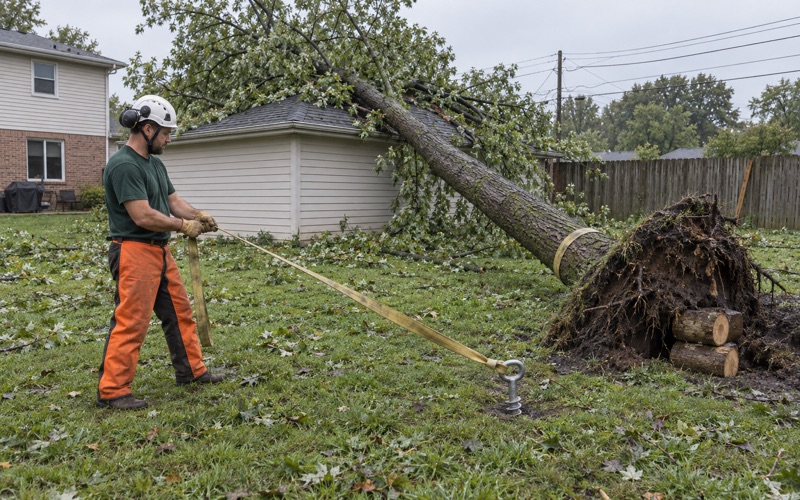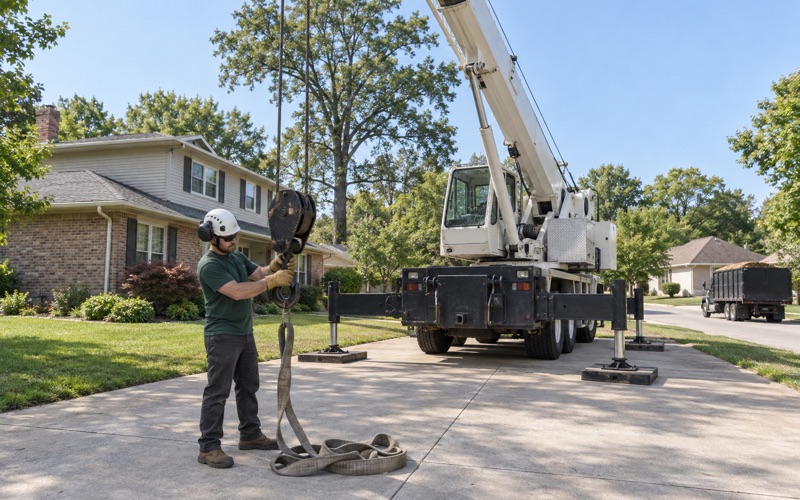
Blue Springs Tree Removal handles emergency tree removal in Kansas City, Missouri, and we have been doing this work across this metro for more than twenty years. When a trunk splits over a bedroom at midnight, nobody is thinking about paperwork; they are thinking about whether the rest of the tree is coming down next. Our answer to that is a same-day response when a tree is on a roof, a car, or a line, and a crew that sets a drop zone before anyone starts a saw.
What we do differently on storm calls is put the record in your hands first. You get proof of insurance before a crew steps onto the property, a written condition assessment of what failed and what is still holding, and a quoted price that does not move once the work starts.
The rest of this page covers how emergency removal actually runs inside these city limits. That means what the city’s tree ordinance reaches and what it plainly does not, where the wood and brush are allowed to go, and why an address on one side of town is a different job from an address on the other.
When a tree comes down tonight, the calls go in an order
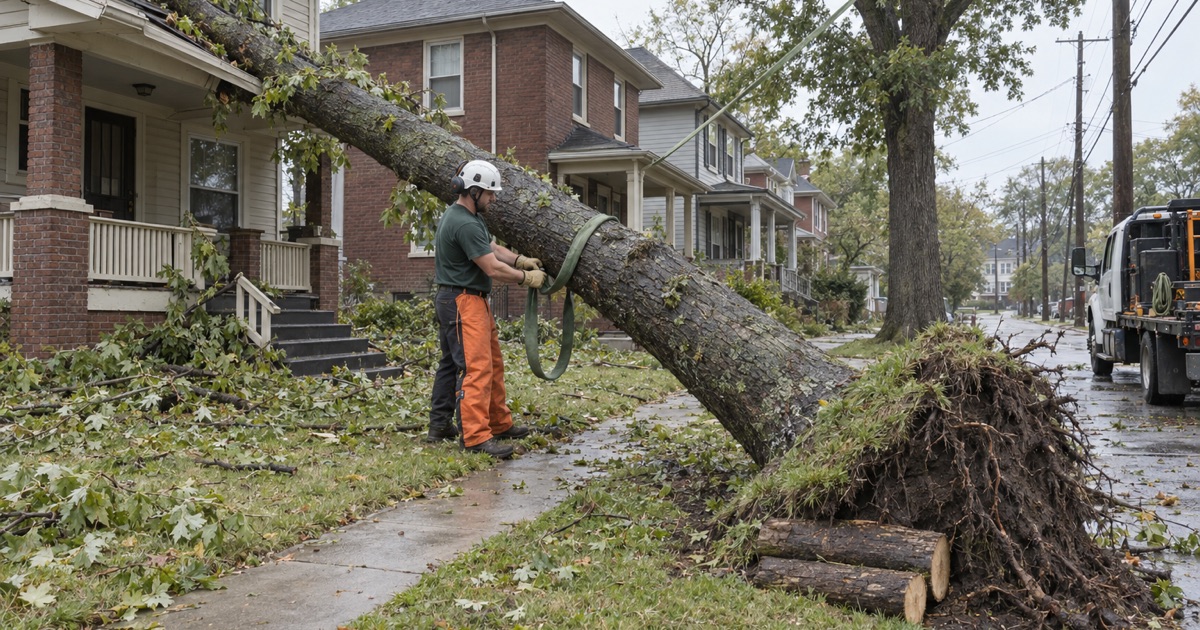
Storm damage in this city has a sequence, and getting it wrong costs hours. If a conductor is on the ground, arcing, or a limb is bridging two lines, that is 911 first and then the electric utility’s outage line. Which utility depends on where you live: the eastern part of the city is served by Evergy Missouri West and the rest by Evergy Missouri Metro, two separate operating companies inside one municipal boundary. The city does not run the electric system and cannot de-energize anything for you.
If the tree is blocking a public street, a limb is hanging over a sidewalk, or you believe the tree belongs to the city, that is a 311 request. The city’s own guidance is that a resident can request a tree removal through 311 and that the City Forester reviews the request and recommends next steps, and that when a sidewalk block is scheduled for repair the trees on that block get inspected by the Parks and Recreation Forester’s Office. Neither route is a fast lane for a tree sitting on your own roof.
Why your address decides which warning you were under
This city sits in four counties, and National Weather Service zones follow those county lines rather than the city name. A point at the city center falls in forecast zone MOZ037 and county zone MOC095, while ground inside the northern portion of the same city falls in MOZ029 and MOC047, all under one weather service office. A severe warning can be in force over part of this city and not over the rest of it, which is why two customers a few miles apart describe the same night completely differently.
The regional record is convective wind and ice rather than anything more exotic. Forecasters titled the July 14, 2023 event a wind storm through Kansas City with widespread power outages and roughly 200,000 customers dark, logged a squall line on May 19, 2024 that crossed the northern and eastern counties with four brief tornadoes, and recorded the February 5 to 7, 2019 ice storm at an eighth to a quarter inch of accretion. Wind loads a leaning trunk from one side; ice loads every limb at once, which is why an ice event takes down trees that looked sound in July.
Looking for tree-removal closer to Raymore? See Tree-Removal Services in Raymore.
No private removal permit here, and no diameter threshold
Search results for this city are thick with claims that a homeowner needs city approval before taking down a tree above a certain trunk diameter. That rule exists, but it belongs to the code of a different Missouri municipality that happens to rank well on searches for this one. Nothing resembling it appears in the ordinance that actually governs trees here.
What Ordinance 220961 actually reaches
Ordinance No. 220961, passed as a third substitute on March 16, 2023, added Sections 88-424-01 onward to Chapter 88, the Zoning and Development Code, under the heading Tree Preservation and Protection. Section 88-424-02 applies it to any permit for land or site disturbance involving clearing, cutting, grubbing or grading on one acre or more, to development plans, project plans, special use permits and preliminary plats, and to a building permit that disturbs more than 10,000 square feet of property where no development plan is otherwise required.
Every one of those triggers is a development trigger. Section 88-424-03-A then exempts an application for a building permit for a single family detached house on a single previously platted lot outright, and Section 88-424-03-E exempts emergency tree removal due to storm damage, accidental causes, or to ensure public safety when pruning is impractical, as determined by the city forester. On a finished residential lot there is no removal permit to pull and no trunk diameter that changes the answer.
Who signs the plan when the job is bigger than a yard
When a job does cross into development scope, the credential question stops being marketing. Section 88-424-02-A withholds the permit until the tree preservation and protection plan is approved and certified by an SAF certified forester, an ISA Certified Arborist, a professional landscape architect, or a professional engineer registered in the State of Missouri. Section 88-424-06-A requires one of those same four to prepare the plan, and Section 88-424-08 requires a sealed letter from one of them before a final certificate of occupancy, confirming the trees are in place and in vigorous growing condition.
The flip side is worth saying plainly: neither Missouri nor Kansas licenses tree work at all, so a company advertising a state tree license is describing something that does not exist. What the city code does instead is name the credentials whose signature it will accept on development work, and we will tell you which of them a given job actually needs.
The code defines pruning against topping, in terms
The same ordinance amended Section 88-810 to define pruning as the removal of tree limbs to standards set forth by ANSI A300, adding that at no time shall topping, tipping or flush cutting be deemed a form of pruning. Topping is defined separately as cutting limbs back to stubs within the crown, or back to laterals less than half the diameter of the limb being cut. We do not top trees, and when someone else offers to, that definition is the short version of why.
Where the storm debris actually goes
State law bars yard waste from a Missouri solid waste disposal area, which is why every outlet within reach of this city is a composter rather than a landfill. Missouri Organic Recycling operates sites inside the city limits, including a main office on East US Highway 40 and a Northland yard on North Main Street.
Published gate rates run $10.00 per cubic yard for brush and $7.00 per cubic yard for lawn debris, with lawn and leaf bags at $2.00 each. The gate accepts brush and logs under 10 feet in length, and logs up to 40 inches in diameter if they are under 5 feet long, which is a real constraint on how a large trunk gets bucked in your driveway. It refuses stumps carrying dirt and rock, tangled land-clearing debris, brush over 10 feet, landscape timbers and yard waste in plastic bags.
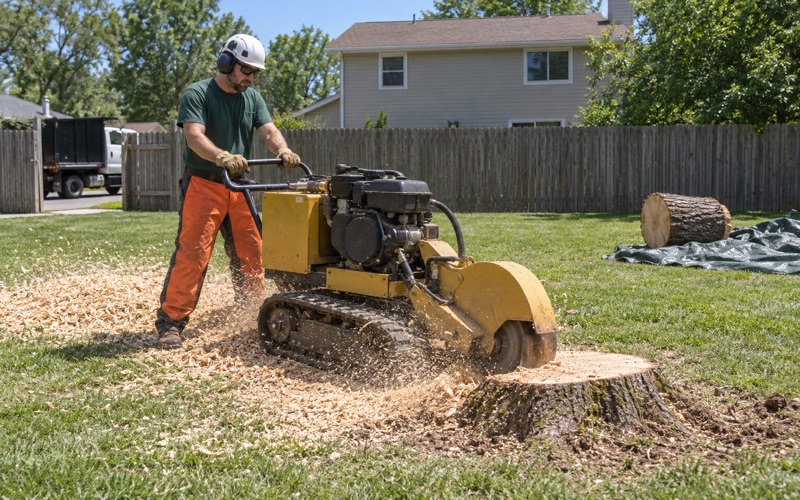
That last refusal is the practical argument for grinding a stump rather than pulling it. A pulled stump comes out wearing soil and rock and has nowhere cheap to go, while grindings either stay on site or leave clean in the truck. The same operator runs a free Saturday drop-off at its city locations for residents who present a valid Kansas City, Missouri identification, closed seasonally from December 16 through March 14, which is useful for a homeowner’s own limb pile and not something a loaded contractor truck qualifies for.
We would rather you never had to price any of that. Our debris leaves with us, and we tell you where the wood and the brush are going before the saw comes out of the truck, so nothing sits at your curb waiting on a collection rule it does not meet.
Read the neighborhood, not the city
This is the largest city in Missouri by area, and it is not one piece of ground. Point queries against the EPA Level IV ecoregion mapping put the city center in the Missouri Alluvial Plain, the northern portion near the airport in the Rolling Loess Prairies, and the southern part of the city in the Wooded Osage Plains. In working terms that means deep river alluvium in the bottoms, loess on the bluffs and northern uplands, and limestone-and-shale bench country to the south, where rock can plausibly reach the depth a stump grinder tooth wheel is rated to cut.
So we do not promise a below-grade cut depth sight unseen anywhere in this city. The machine that takes a stump out cleanly in the bottoms can find rock a foot down on a southern upland lot, and which of the three grounds you are standing on is a question about your address rather than about the city.
The prewar core and the newer edges are different jobs
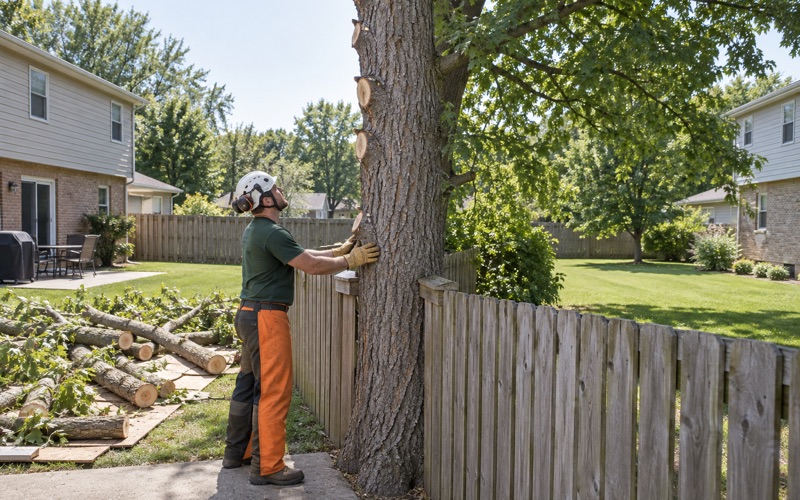
The housing stock tells the same story. Of 245,346 housing units here, 52,273 were built in 1939 or earlier, which is 21.31 percent of everything standing, and 111,217 of the occupied homes are owner-occupied single-unit detached houses. Those prewar blocks carry the mature canopy that makes them worth living on along with the access problems that come with it: narrow drives, close setbacks, lines running through the crown, and often no clear drop zone at all.
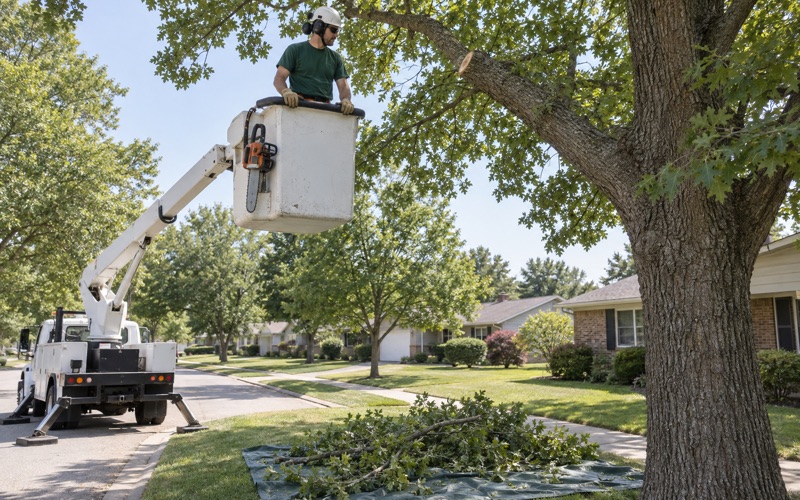
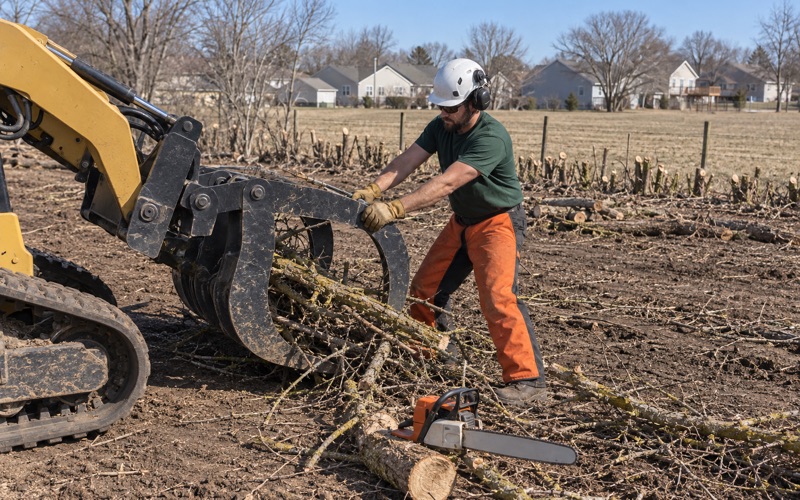
That is where the equipment decision gets made. A tight prewar lot usually means a crane-assisted removal, or piece-by-piece rigging with a bull rope and a friction device at the base, bringing the tree down in controlled sections against a working load limit. A lot on the newer edges of the city will often take machinery straight to the trunk, and those are not the same day of work or the same price.
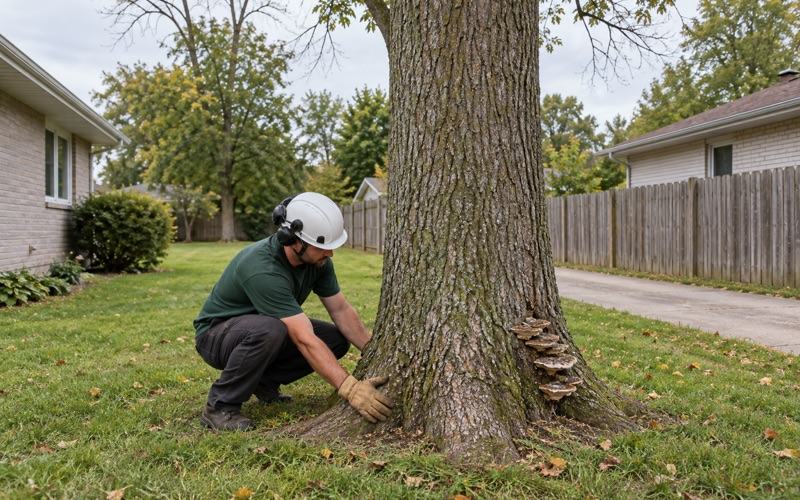
Not every storm-damaged tree has to come out, either. If a split leader or a pair of co-dominant stems with included bark can be held with cabling and bracing, or if crown cleaning clears the deadwood and leaves a sound tree standing, we will price that instead and tell you what the follow-up inspection should be looking for.
- 20+ Years in the KC Metro
- Free On-Site Assessment
- Written Price, Insured Crews