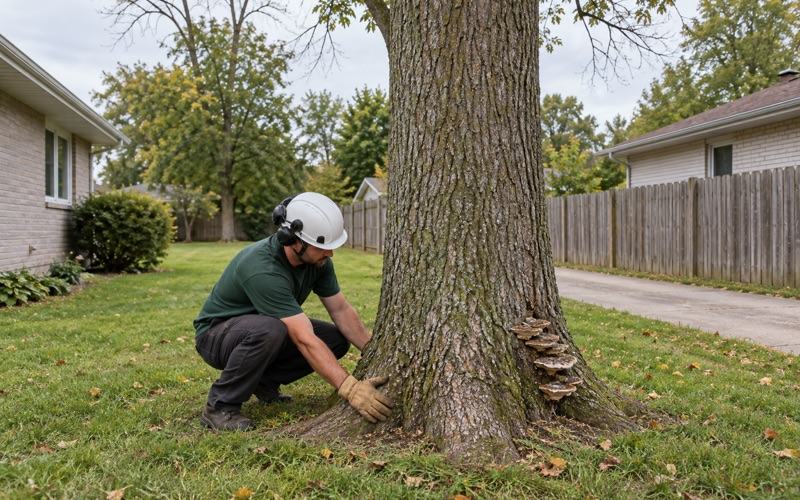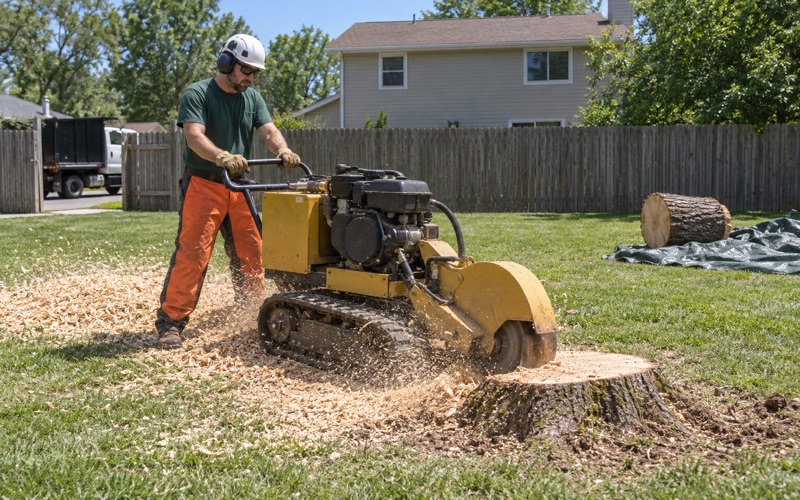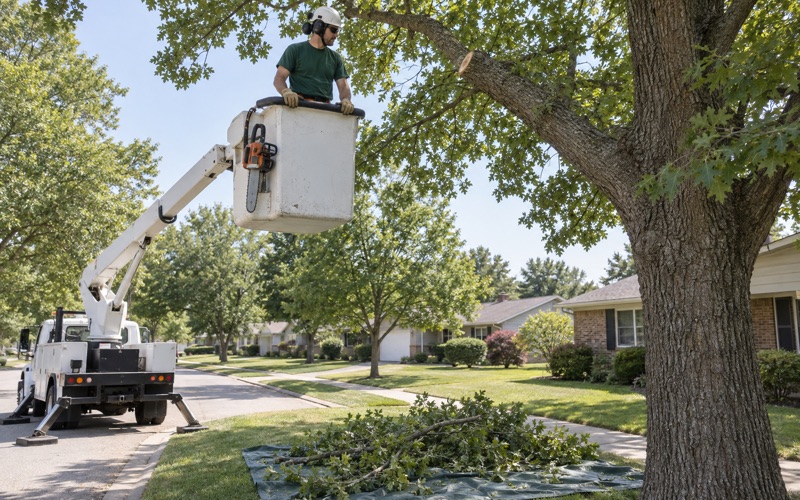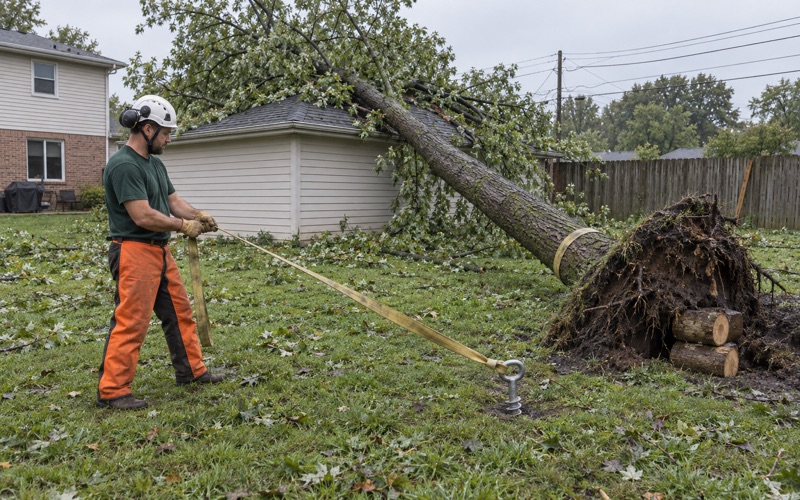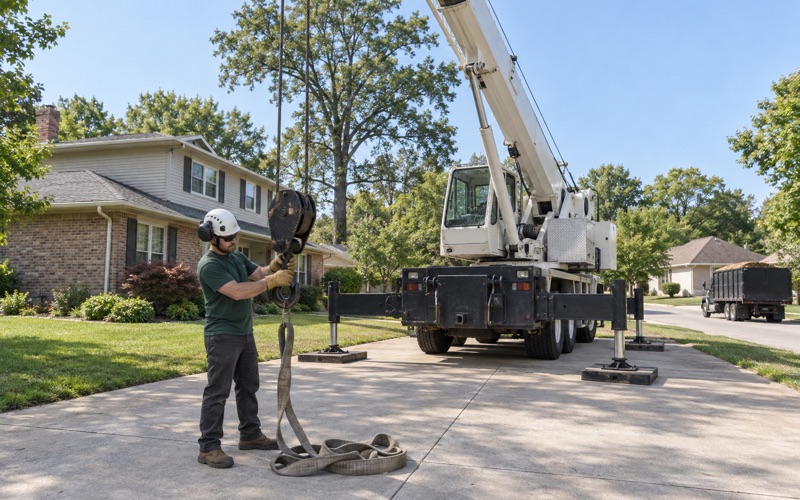
Blue Springs Tree Removal has been taking down trees in Kearney and across the Kansas City metro for more than twenty years, on both sides of the state line. Every job starts with a free on-site assessment and a written condition report rather than a number scribbled on a card. The price we quote is the price in writing, and proof of insurance reaches you before a crew sets foot on the property.
Tree removal in Kearney carries one wrinkle almost nobody in this trade writes about. The city publishes two electric providers for one municipality, Ameren UE and Platte Clay Electric, so the statutory rights a homeowner holds over a tree near a line here depend on which company sends the bill. That single fact changes how we scope a job within sight of a conductor.
What follows is how we read this Clay County city before quoting a removal. It covers who holds authority over which tree, what the utility split changes about notice and cost, and where the wood and the brush go once the truck leaves the driveway.
Which line feeds your meter decides which rights you have
Two providers listed on one city page
The city’s own services page lists Ameren UE and Platte Clay Electric side by side, with the cooperative’s published number, 816-628-3121, next to it. Service inside the city limit is therefore split, and no map on our side of the transaction settles it. We ask homeowners to check the bill, because that answer decides the rest of this section.
What RSMo 537.340 gives a cooperative member
RSMo 537.340.3 defines an electric supplier narrowly. The definition reaches a chapter 394 rural electric cooperative, an electrical corporation bound by its bylaws to the not-for-profit cooperative business plan while serving a majority of its customers in third-classification counties, a chapter 91 municipally owned or operated electric power system, and a municipally owned utility whose service area is fixed by state statute, service agreement or other authority. Platte-Clay Electric Cooperative is a chapter 394 cooperative and lands inside that first limb.
Two rights follow for a member served on that line. The supplier owes at least fourteen days of notice before removing a tree, except in an emergency, and subsection 2(7) lets the owner ask in writing that a partially trimmed tree which dies within three months be removed at the supplier’s expense, with a response owed inside ninety days. The cooperative publishes that its trimming crew will cut down trees in the rights of way because trees growing into the lines are a safety, reliability and budgeting problem, asks members not to plant there, and treats regrowth with an EPA-registered herbicide applied to the foliage.
Investor-owned line runs on a different rulebook
Ameren Missouri is Union Electric Company, an investor-owned electrical corporation, and it matches none of the four limbs in that definition. The fourteen-day notice and the free-removal right therefore attach at some addresses in this city and not at others, which is why we never state them as a blanket local rule. What governs the investor-owned side instead is the Missouri Public Service Commission vegetation management rule at 20 CSR 4240-23.030, filed annually, so the trim cycle, the scheduled miles and the clearance guideline sit on the public record. Separately, RSMo 537.340.1 carries treble damages for cutting down, injuring or destroying a tree kept for use, shade or ornament, and the claimant need not prove negligence or intent.
Looking for arborist closer to Overland Park? See Overland Park Arborist.
Chapter 232, the vision triangle, and the corner lot
The city keeps a real tree chapter
Kearney’s code carries Chapter 232, Public Tree Care, running from Section 232.010 through Section 232.110. That is eleven sections and a genuine tree ordinance rather than a stray clause buried in a nuisance chapter. Its stated purpose is to protect public health, safety and general welfare by regulating the planting, maintenance and removal of trees, and to keep the city’s urban forest in a strong, healthy condition.
The right the chapter asserts runs to trees and other woody vegetation within the right-of-way lines of all Kearney streets and on public park grounds or areas the City owns or maintains. Appeals under the chapter route into Chapter 215, Nuisances, where a nuisance left unabated for ten days may be abated by the City and the cost assessed against the property. We do not quote the eleven sections to a customer and we do not guess at what they say about a tree standing on private ground; that question goes to Community Development at 100 East Washington Street before we schedule anything.
Section 405.685 names vegetation outright
The zoning ordinance adopted in 2008 carries a vision triangle at Section 405.685, and it is the provision most likely to reach an ordinary homeowner. On all corner lots in all districts, no use of land may commence and no structure or vegetation may be constructed, structurally altered, extended, enlarged or moved unless it conforms to that triangle. In residentially zoned districts the two sides forming the lot line intersection must run at least thirty feet from the center of that intersection, twenty feet in all other districts, with no vision triangle requirement at all in the Central Business District. The section states those distances and no clearance height, so on a corner lot we measure the legs and prune to sight lines rather than to a number nobody published.
One more provision matters if a builder is involved. Section 405.755 requires a landscape and screening plan with the site plan application for new construction or structural alteration in every zoning district except single-family and duplex structures, so the landscaping article does not reach an existing house. Its Existing Trees subsection is a preservation credit rather than a prohibition: preserved trees earn additional plant units, and where a tree meant to be preserved has to come out during construction, more trees are planted to make up the count.
A young canopy entering its first removal cycle
The housing numbers set the tree work
54.93 percent of the housing stock here was built in 2000 or later, and 28.69 percent has gone up since 2010, against 17.41 percent that predates 1980. Of 3,137 owner-occupied single-family detached homes, most carry trees that were planted with the house rather than inherited from a woodlot. Writing this market as old growth would be false on the face of those numbers, and it would sell the wrong service.
What first-cycle failure looks like
First-cycle removals have their own signature. Callery pear cultivars split at the co-dominant stems and included bark they were bred to grow, screen conifers planted on centers far tighter than their eventual spread crowd and shade each other out, and street trees outgrow the strip somebody set them in. Storm damage on young stock arrives as whole-tree failure and split leaders rather than as limb shed from a hollow veteran, and the convective wind and ice this part of Clay County sees is what produces it.
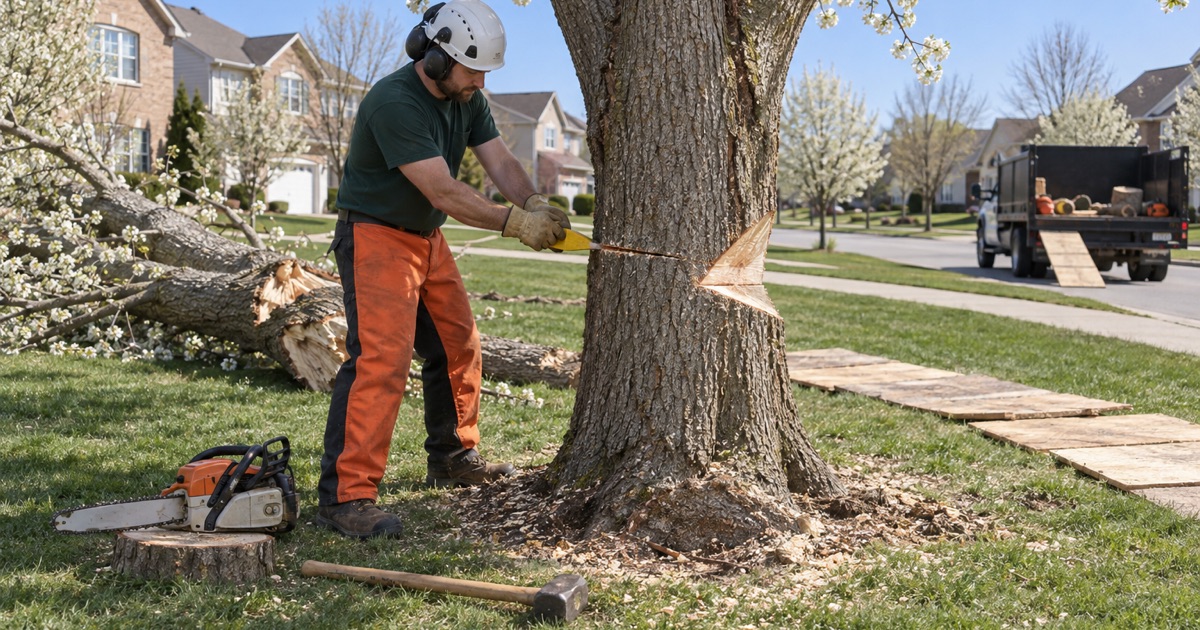
We do not top trees, and on young stock the temptation is highest because the fix looks cheap. Where the union is still sound we would rather price a crown reduction cut to the ANSI A300 pruning standard, or a cabling and bracing job, and say so in the written assessment. Where the leader has already failed, the tree comes down, and the crew rigs it out under ANSI Z133 with a defined drop zone rather than dropping it and hoping.
Gates, machine width and below-grade cut
At 80.32 percent detached housing and roughly 330 units to the square mile, the constraint on these lots sits in the back yard and the drop zone rather than at the curb. Compact grinders and tracked lifts are built to gates in the 25 to 35 inch class, while a chipper is seven to eight feet wide and around ten thousand pounds and never goes through a gate at all. Narrow and shallow are not the same thing: some 35 inch machines still cut 25 inches below grade, and a dual-wheel option can take the same machine much deeper, so we quote the machine as it will actually be configured on your lot. Before any grinding we place the utility locate through Missouri One Call, because 811 is cheaper than a buried service line or an irrigation main.
Loess ground, hedge rows, and where the brush goes
Rolling Loess Prairies, and what stops the grinder
Kearney sits in EPA Level IV ecoregion 47f, Rolling Loess Prairies, inside the Level III Western Corn Belt Plains. That is prairie-derived ground rather than closed forest, which is the deeper reason the canopy on a residential lot here reflects nursery and developer choices more than it reflects what grew before the town did. It also matters for the stump: the characteristic soil of this country is deep loess, and the Marshall series that typifies it is described as very deep, with its typical pedon carried to 203 centimeters, roughly 80 inches.
Set that against a stump grinder rated 12 to 25 inches below grade and the machine’s own stop binds long before anything harder does, so bedrock does not enter the job through the grinder on this ground. Rock reaches the work through the root plate and through excavation instead. We have not seen a soil survey pinned to your particular lot, so we name that depth relationship rather than promising a series or a below-grade figure on ground we have not walked.
Osage orange and redcedar on acreage lots
Rural Residential is a named district in the city’s own code, so acreage-shaped parcels exist inside the limit and the work on them changes shape entirely. Osage orange fencerows, which most people here call hedge, and eastern redcedar colonizing pasture nobody has grazed in a decade are not takedowns at all. That is forestry mulching and lot clearing, quoted by the acre and the stem density rather than by DBH, and we price it that way instead of pretending it is thirty removals.
The disposal leg is priced, not assumed
The city runs a Recycling Center and Leaf and Brush Dropoff at 504 East 19th Street, and its published rule is that it serves city residents only, with no commercial or business use. That exclusion is the operative fact for anyone hiring a crew: a homeowner doing their own yard work has a free local outlet, and loses it the moment a contractor is on the invoice. Our brush from a job here leaves the city, and we tell you where the wood and the grindings are going before the saw comes out of the truck.
Under RSMo 260.250 yard waste may not go into a Missouri solid waste disposal area at all, which is why every outlet in reach is a composter rather than a landfill, and why diameter caps differ from gate to gate. Burning is not the shortcut it looks like either. Missouri’s open burning rule conditions a commercial land clearing burn inside a city limit on setbacks of 200 yards from the nearest structure, sunrise to sunset, constant supervision and prior notice to the local fire control authority, and no in-town lot can meet that setback. A homeowner burning their own yard waste on a residential premises of four units or fewer is on different footing, which is exactly the distinction most callers have backwards.
- 20+ Years in the KC Metro
- Free On-Site Assessment
- Written Price, Insured Crews