Blue Springs Tree Removal has been doing tree removal in Leawood for more than twenty years, and the first question we settle on a Leawood property is not how the tree comes down but who owns it. Since the summer of 2025 the city has answered that in writing, and the answer is the property owner next to it or the homes association, never the city.
That one line in the code decides the shape of the whole job. A tree with any part of its trunk in the right of way is a street tree here, its removal has to meet a stated condition, and it needs a permit and a replacement plan before a saw touches it. We price that paperwork into the quote instead of discovering it on the morning of the work.
A tree standing wholly inside your lot lines carries none of that, and we say so plainly rather than padding an estimate with permits nobody needs. The free on-site assessment tells you which of the two you have, and you get the condition of the tree in writing next to the price.
Who the code makes responsible for the tree at the curb
Ordinance 3179, passed by the Governing Body and approved by the Mayor on June 16, 2025, rewrote three sections of the municipal code at once. The one that matters most to a homeowner is Section 13-405(1): it shall be the responsibility of the adjacent landowner and/or homes association, the Responsible Party, to plant, prune, maintain and remove street trees. There is no city crew coming, and there is no city budget behind the tree in the strip in front of your house.
What makes a tree a street tree
The definition is broader than most people expect. Section 13-401 counts any tree with any portion of the trunk within the right of way, and it defines the tree lawn as the ground from the back of the curb to the edge of the sidewalk, or to the right-of-way line where there is no sidewalk. On a Johnson County residential street that right of way commonly runs well behind the curb, so the maple a homeowner has mowed around for thirty years can sit inside it. We measure where the trunk actually stands before we call the tree one thing or the other.
The two conditions a removal has to meet
Section 13-405(2) does not let a Responsible Party take a street tree down on preference. Either the tree is hazardous, dead, diseased or dying, and so a threat to healthy trees, property or safety, or the removal is required for construction, development or redevelopment. The construction route carries a three-part test: reasonable efforts to avoid removal through comparable alternative design, an undue financial burden from keeping the tree, and no other reasonable accommodation that would preserve it. Most of what we take out in this city qualifies on the first ground, and the written condition assessment is what documents it.
The rule changes at State Line Road
Leawood’s eastern boundary is also the state line, and the law on a neighbor’s overhanging limb is not the same on both sides of it. Kansas follows the nuisance rule: you may cut branches back to your own line but you may not step onto the neighbor’s ground to do it, and where a tree does substantial harm or creates an imminent danger the neighbor can be compelled to abate it. Missouri, one street east, gives no cause of action over the branches or roots of a healthy tree and leaves the cutting at the complaining owner’s expense. We have worked both sides of that street for two decades and we tell you which set of answers your address falls under.
Looking for tree-removal closer to Mission? See Tree-Removal in Mission.
The permit, the replacement plan and the stump
Section 13-405(3) is the mechanism, and it runs per tree rather than per property. A Responsible Party who wants a street tree removed applies for a right-of-way permit for each tree, and supplies a tree removal and replacement plan for each affected tree. The permit covers the tree, the stump and the planting of the replacement, so a quote that answers only the first of those three is not a complete answer under this code.
The replacement species is constrained rather than chosen freely. The code says only that the replacement may not be a species on the city’s list of prohibited street trees, and that list is on file with the Public Works Department rather than printed in the ordinance. We read the current list before we put a species on a plan, because the list is the document that governs and a nursery recommendation is not.
Where the replacement can go
Ordinance 3179 also tightened the geometry, and the geometry is why some trees cannot come back where they stood. A new street tree wants a tree lawn at least 10 feet wide, or 5 feet from the curbline where there is no sidewalk; a tree planted before 2015 in a strip between 6.5 and 10 feet can be replaced in the same spot, and one in a strip narrower than 6.5 feet only in a location the Director of Public Works approves, with an appropriate species and root barriers properly installed. Nothing goes within 35 feet of a corner, within 10 feet of a hydrant, or within 20 lateral feet of an overhead distribution line for a medium tree or 30 for a large one. We take those measurements while the old tree is still standing, because they change what the plan can say.
Sixty days for the stump, and no topping at all
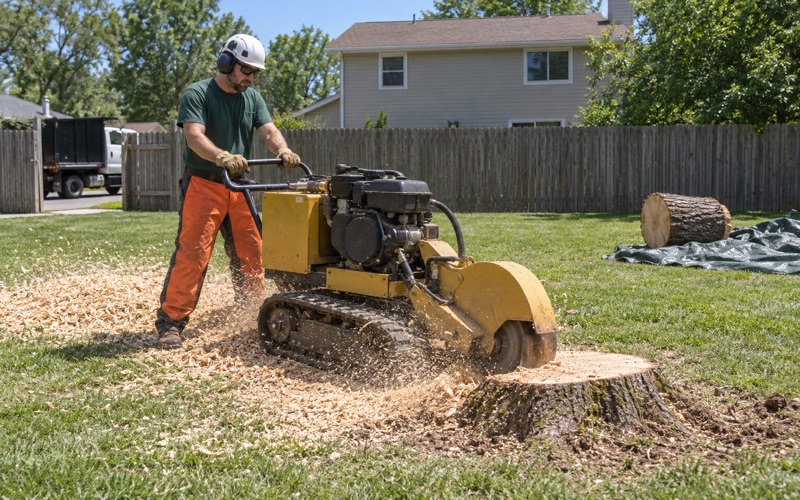
Two more code lines shape the work itself. Section 13-410 gives 60 days from a street tree removal to get the stump out below the surface of the ground, which is why we grind on the same visit whenever access allows rather than leaving a second appointment for the homeowner to chase. Section 13-406 makes topping a street tree unlawful outright, with a narrow exemption the Superintendent of Parks can grant for storm-damaged trees or trees under wires; we do not top trees anywhere, and in this city the practice is also an offense carrying a fine of not less than $100 and not more than $1,000.
First removal cycle: the tree was planted with the house
Leawood’s housing stock explains most of what we get called out for. Only 16.18 percent of it predates 1960, while 57.99 percent went up between 1980 and 2009, and there are 11,135 owner-occupied one-unit detached houses in the city. The trees that came with those houses are now 25 to 45 years old, which is exactly the age at which a fast-growing landscape species starts shedding limbs.
What fails first, and why
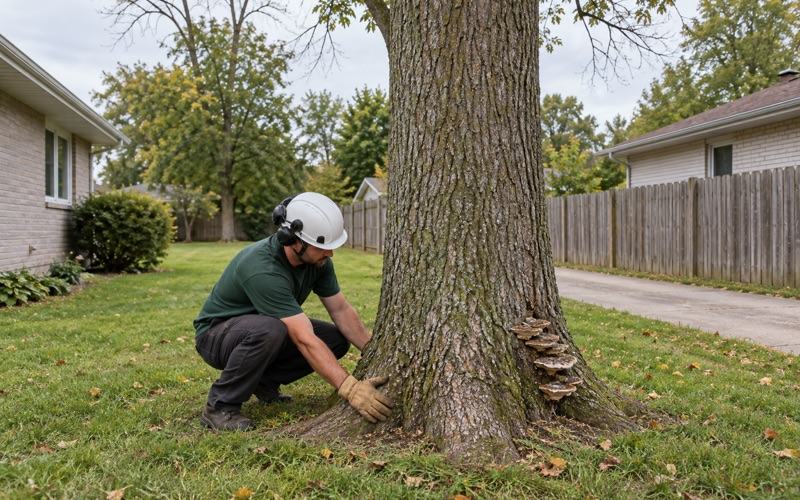
The Johnson County K-State Research and Extension Master Gardeners publish a recommended landscape tree list for this metropolitan area, and its own summary of the problem is that many fast growing varieties are brittle with narrow crotch angles that can lead to severe breakage during storms. The brochure declines to recommend silver maple for weak wood, pin oak, green ash, box elder, Siberian elm, Lombardy poplar and willow, and its Bradford pear entry says not to plant the cultivar because severe splitting occurs on 10-15 year old trees. That is a planting recommendation from the county extension service, and it is a separate document from the city’s prohibited list. What we look for on site is the mechanism behind it: co-dominant stems, included bark at the union, a split leader, epicormic sprouts, a conk at the root flare.
The storms that find those unions
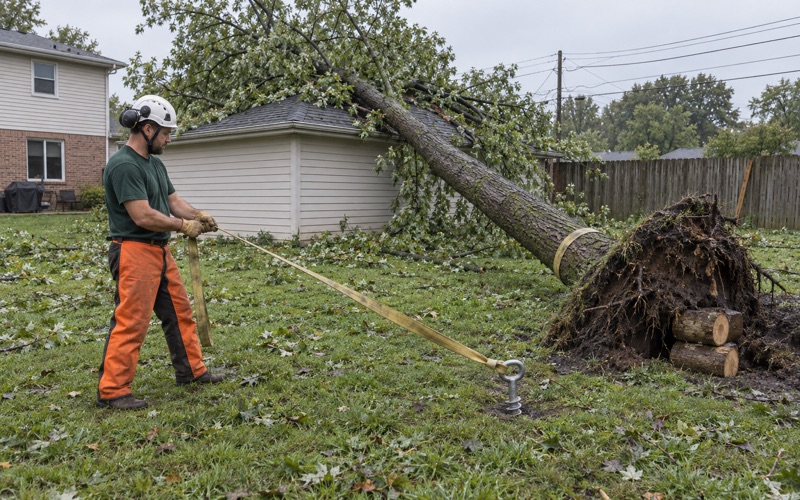
The regional record is convective wind rather than one famous event. The National Weather Service office covering this county titles the July 14, 2023 event a wind storm with widespread power outages, records a squall line across Johnson County on May 19, 2024 that produced four brief tornadoes, and logs an ice storm across all of eastern Kansas in February 2019 at an eighth to a quarter inch of accretion. An eighth of an inch is enough to bring down a limb already carrying included bark. We measure DBH and read the union before we quote, because a tree that failed in a squall line usually shows why it failed.
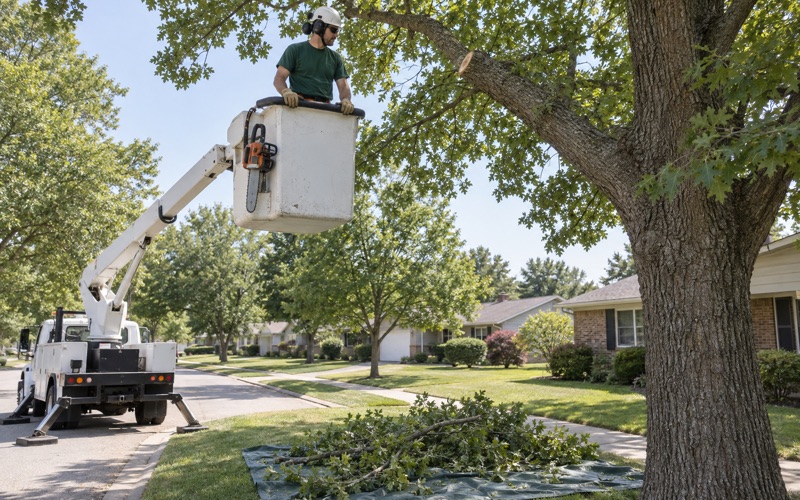
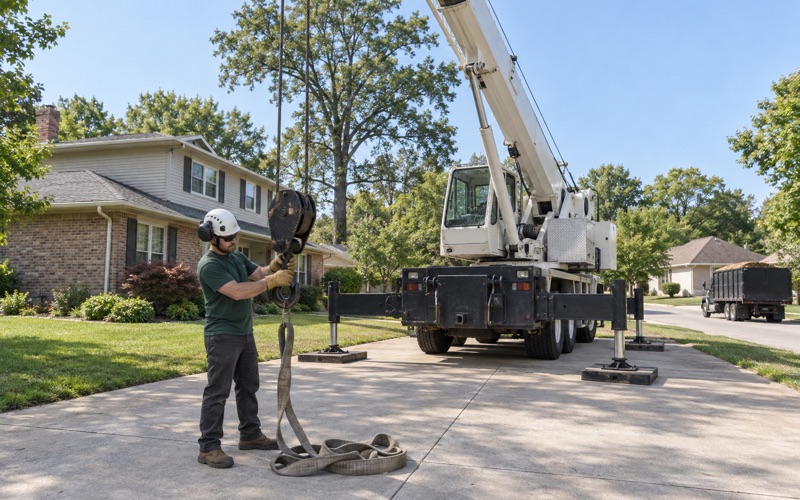
Not every one of these is a removal. Where the union is sound enough to hold, cabling and bracing or a crown reduction cut to the ANSI A300 pruning standard buys years, and we price that instead and say why. When it does come down, the rigging plan matters more than the saw on a large-lot street: a bull rope and a Port-a-Wrap within its working load limit, a drop zone laid out from the setback, and crane-assisted removal where the drop zone is not there.
Homes associations, and where the wood goes
The ordinance names homes associations alongside the individual owner, and it gives them a bulk route: homes associations or neighborhoods may submit one application for up to 50 permits, with fees charged under the current fee schedule. That turns a street of failing first-cycle trees into one signature and one schedule instead of fifty separate conversations. The city has since removed the fee for the street tree removal permit to reduce the burden on homeowners, which is a fee schedule change rather than anything in the ordinance text, so any association document still quoting a dollar figure for it is out of date.
The debris leaves with us
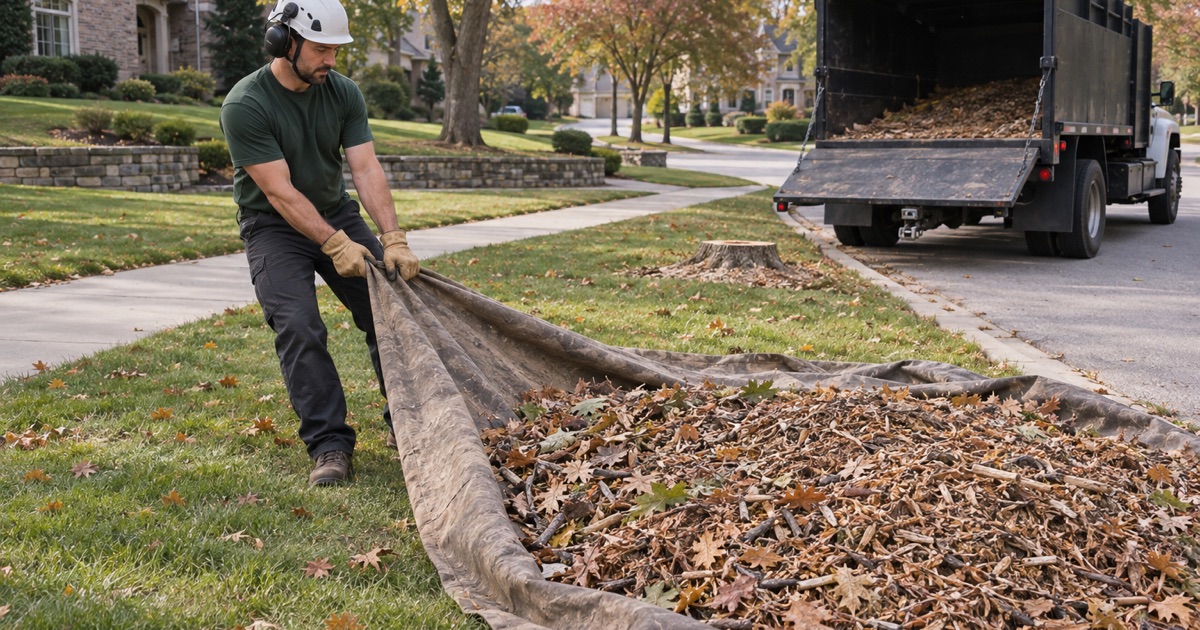
Leawood runs no city collection and no city yard-waste gate; residents contract with private haulers the city permits. At the curb the code takes limbs under four inches in diameter, tied in bundles no larger than 48 inches long and 18 inches across, with a container and contents capped at 75 pounds. Nothing off a removal fits that, and Johnson County operates no public yard-waste gate of its own while the county landfill caps landscape waste at 3 inches. So the wood and the brush leave on our truck to a private composter, and we tell you where before the saw comes out.
Nobody in Kansas licenses this work
Johnson County Contractor Licensing issues eleven classes covering construction, alteration, repair or demolition of structures, and not one of them reaches tree work, arboriculture or landscaping; the state does not license it either. So we do not call ourselves licensed here, because there is nothing to be licensed by. What the Kansas Forest Service points homeowners toward is certification, naming the International Society of Arboriculture and the Kansas Arborists Association, and what we hand you before a crew sets foot on the property is proof of insurance and a written price that does not move.
On a tree down on a roof, a car or a line we respond the same day, and the order on an energized line is not ours to change: call 911 first, then Evergy at 888-544-4852, and nobody approaches the wire until it is confirmed dead. Before any grinding we call Kansas 811 for the locate. Everything after that is the part we can promise in writing.
- 20+ Years in the KC Metro
- Free On-Site Assessment
- Written Price, Insured Crews