Blue Springs Tree Removal has handled tree-trimming in Lee’s Summit for more than twenty years, and the work here has a shape to it. Most of what we put a saw into went into the ground when the house did, so the question on the ground is rarely whether a tree comes down. It is which limbs it keeps for the next thirty years.
Every job opens with a free on-site assessment and a written condition report rather than a number scribbled on the back of a card. The price you are quoted is the price in writing, proof of insurance reaches you before a crew sets foot on the property, and we tell you where the wood and the brush are going while the saw is still in the truck.
We do not top trees. If a limb can be kept by pruning, or a union held with a cable, we say so and price that instead of the removal. Twenty years across the Kansas City metro, on both sides of the state line, is long enough to know when taking a tree down is the honest answer and when it is only the fast one.
Trimming the trees that were planted with the houses
Lee’s Summit’s housing stock runs to 42,240 units, and 58.96 percent of it was built between 1980 and 2009: 22.50 percent in the 1990s and 20.17 percent in the 2000s. Of that total, 27,250 are owner-occupied one-unit detached houses. Put those two numbers side by side and you have the canopy we work in, which is builder planting somewhere between twenty and forty-five years old, standing in private back yards and going through its first real pruning and removal cycle.
Almost none of it belongs to the ground it stands in. The city falls inside EPA Level IV ecoregion 40c, the Wooded Osage Plains, whose potential natural vegetation reads as little bluestem-sideoats grama prairie, big bluestem-Indiangrass prairie, cordgrass wet prairie and oak woodlands. What is failing in the yards is nursery stock a developer picked for fast shade and a tidy shape.
The 1990s cohort, and what it is doing now
The 9,503 houses finished between 1990 and 1999 carry the planting list of that decade, and the land-grant authority for this metro is blunt about a good part of it. Kansas State Research and Extension’s Johnson County guidance for the Kansas City area instructs: “DO NOT plant Bradford cultivar; severe splitting occurs on 10-15 year old trees.” The trees standing in these yards are two and three times past that window. The same brochure marks silver maple down for weak wood, pin oak for soil issues and green ash for emerald ash borer, along with Austrian pine, Scotch pine, box elder, Lombardy poplar, Siberian elm and willow as not recommended for this area.
That refused list is most of our call volume on a 1990s street. A Callery pear that has already dropped a leader is a removal, and there is no argument to have about it. One that has not is a structural pruning job with a deadline attached.
The 2000s cohort, where trimming still buys something
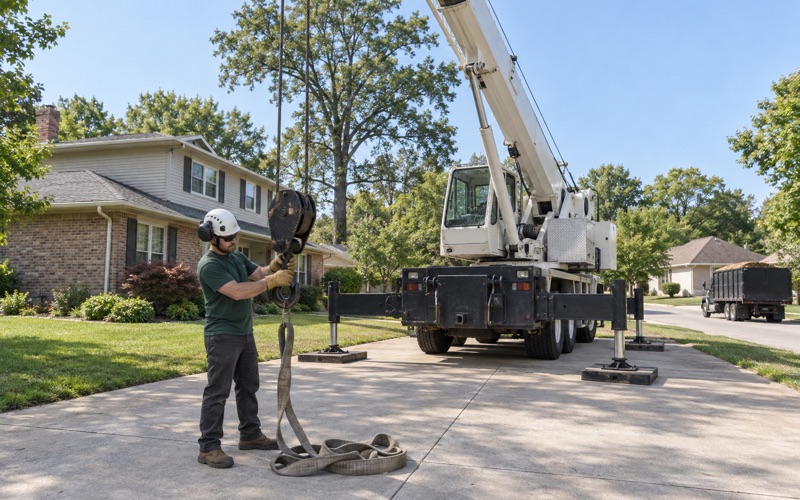
The 8,521 houses built from 2000 through 2009 stand over younger stock, and that is the whole difference. A tree in its twenties still answers a cut. Take weight off the wrong leader this year and the tree spends the next decade building the right one instead. Wait until that union is carrying forty feet of limb over a roof and the tools left are a crane-assisted removal and a bull rope.
We work the two cohorts differently on purpose, and the written assessment says which one your yard is in before anything is quoted.
Looking for tree-removal closer to Raytown? See Tree-Removal Services in Raytown.
Structural pruning before the union fails
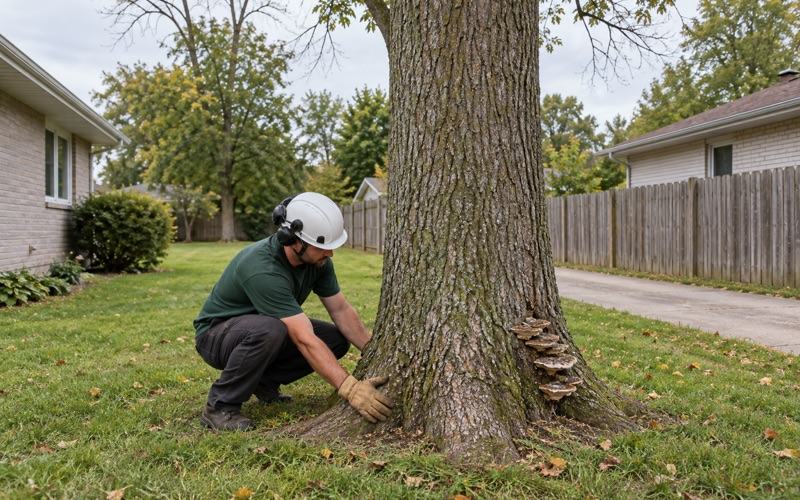
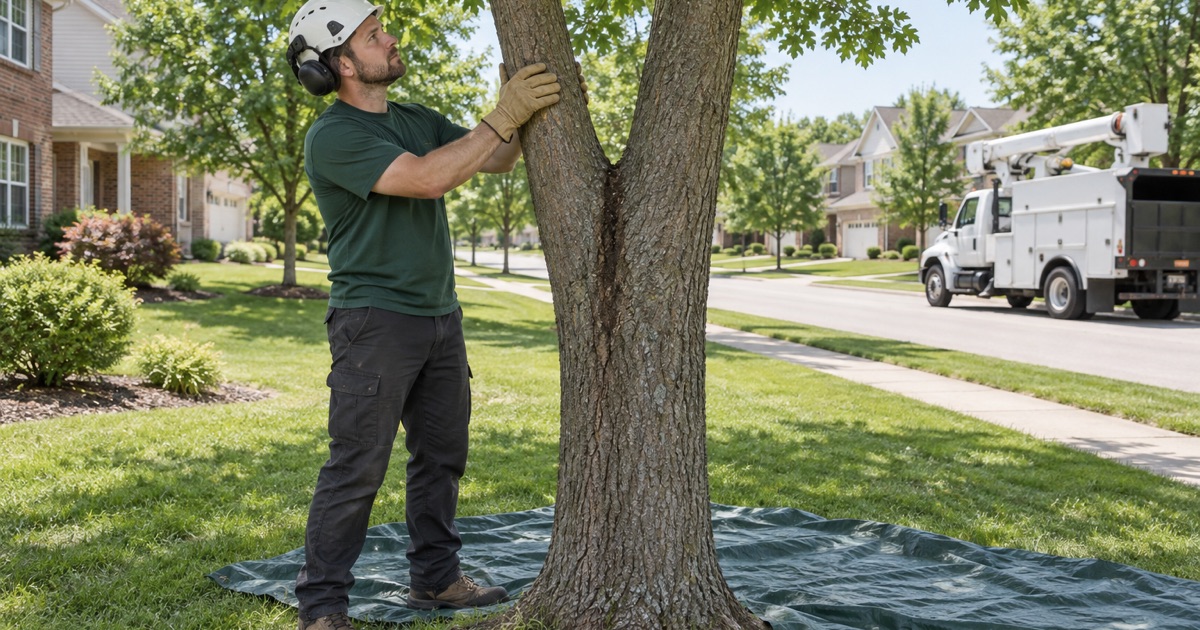
A tree planted in 1996 and never touched has usually made a decision nobody asked it to make: it grew two leaders instead of one. Where those stems meet, bark folds inward rather than knitting together, and that included bark makes the union weaker every year it gets heavier. Co-dominant stems are the most common failure we are called to on this stock, and they are also the most preventable one.
Structural pruning is the fix, and it is a subtraction problem. Working to the ANSI A300 pruning standard with natural target pruning cuts, we take weight off the subordinate leader across a season or two instead of removing it outright, so the dominant stem builds diameter while the union underneath stops gaining leverage. At this age the cuts stay small, which is the point: University of Missouri Extension puts a 2- to 3-inch wound on a 12-inch diameter limb inside what a tree will seal over on its own.
Crown cleaning, raising and reduction, and no topping
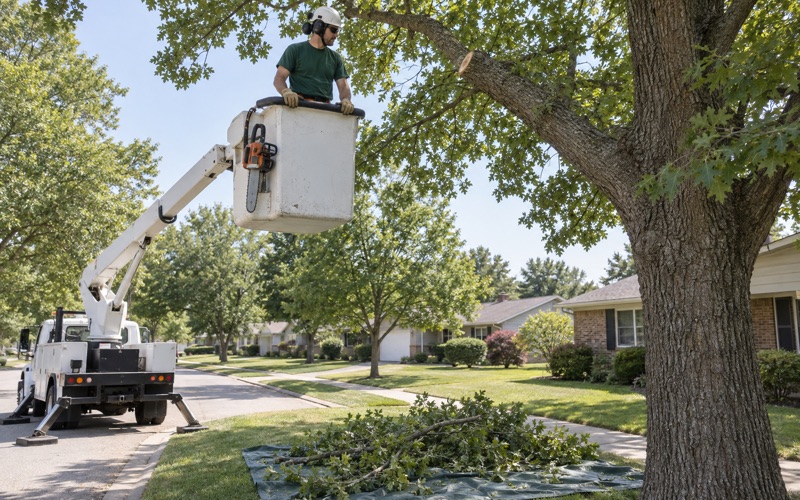
Crown cleaning pulls the dead, broken and crossing wood out of the interior. Crown raising lifts the low limbs off a roofline, a driveway and the mower. Crown reduction shortens the long, end-heavy limbs that catch wind on an open corner lot. Crown thinning gets used less often than homeowners expect and more carefully than some crews use it.
None of that is topping. Topping means heading cuts through wood too large to seal, and what grows back is epicormic sprouts anchored to the outside of a decaying stub, which is a heavier and weaker tree with a bill attached three years later. We will not do it, and we will explain why when somebody else offers to.
When a cable is the cheaper answer
Not every bad union is a removal. Where the stems are sound and the tree is worth keeping, cabling and bracing puts hardware where the wood cannot hold itself, whether that is extra-high-strength cable in the upper crown or a Cobra dynamic system when we want the tree to keep moving and building its own reaction wood.
That judgment belongs in writing. Our tree risk assessment records DBH, the defects we found, what we recommend and what we deliberately do not, so you read the reasoning rather than take a verdict on trust. Missouri Extension’s own threshold is a useful check on it: with more than 50 percent of the crown gone, the tree has lost its survival edge, and no hardware puts that back.
Graded fill, compacted subgrade and the stump underneath
The soil across this part of Jackson County is deep. The Sibley series, whose official series description places its typical pedon in Jackson County, Missouri, carries a solum typically 50 to 60 inches thick and ranging from 46 to more than 65 inches, with 30 to 35 percent clay through the upper twenty inches of the argillic horizon. These are loess-derived silt loam over silty clay loam profiles, so there is no chert grinding away at a stump grinder tooth wheel. The one profile in this association shallow enough to change an answer is Snead, which reaches a paralithic contact at 20 to 40 inches over gray shale.
On a subdivision lot none of that is the whole story. Across a large share of the houses built in the 1980s through the 2000s, the working medium is graded fill and compacted subgrade rather than the mapped profile: material scraped, moved and rolled during construction, which the soil survey does not describe at all. Two streets apart, in the same series, the ground can behave nothing alike.
Why we do not promise a cut depth over the phone
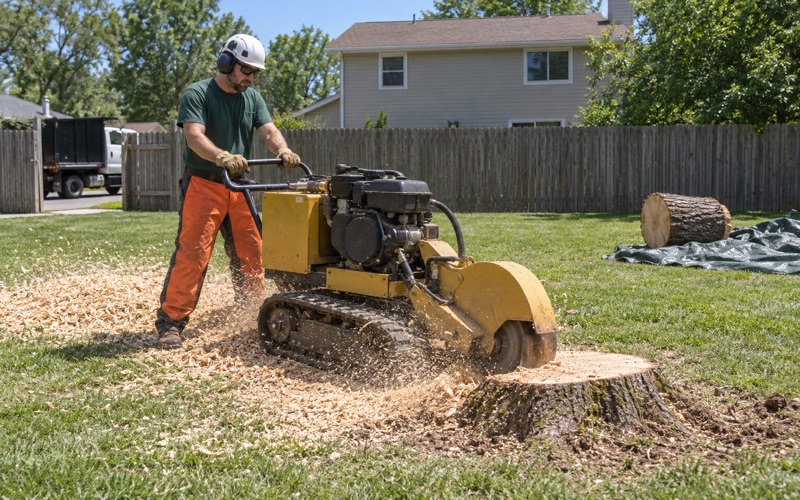
Below-grade cut depth gets set on the lot, after we have found the root flare, opened the root plate and seen what the first pass brings up. Wet clay loads a machine differently than the same clay in August, and fill hides construction debris nobody remembers burying. Quoting a depth sight unseen is how a crew ends up either stopping short of what you were promised or hitting something that was never theirs to hit.
The locate ticket comes first
Stump grinding is excavation, and Missouri law under RSMo Chapter 319 requires a locate request to Missouri 811 at least three but not more than ten working days before work begins, on the legacy 1-800-DIG-RITE number. A public locate covers public facilities. It does not cover the irrigation line, the low-voltage lighting or the invisible fence a previous owner ran across the back yard, so we walk the ground with you before the wheel turns and mark what you know about.
Where the brush goes, and the calls that come before ours
Lee’s Summit runs its own public disposal, household hazardous waste and yard waste site at the Resource Recovery Park on SE Hamblen Road, and the city’s rule is that there is no fee for Lee’s Summit residents. Contractors are not shut out of that gate the way they are in most of this metro; they are priced. The published schedule prices by volume and vehicle rather than by weight, from two dollars a bag and $6.50 per cubic yard up to $35 or $45 for a full-size pickup.
That is why the conversation about leaving the wood or hauling it can be an honest arithmetic one here. You can haul your own limbs for nothing, and when we haul them the disposal is a quotable line item rather than a hidden one. Our default is that the debris leaves with us, and nothing is stacked at your curb for the city to refuse.
The permit answer, and where the tree rules actually live
No permit is required to take a tree down on a finished private lot in Lee’s Summit. The tree provisions sit on the development side of the Unified Development Ordinance, in Article 8’s subdivision on landscaping, buffers and tree protection plans, and they are triggered by land disturbance rather than ownership. A tree conservation plan goes to the department before grading, bulldozing or clearing existing vegetation, and replacement trees carry a minimum caliper of three inches. None of that reaches a homeowner taking down a dead pin oak in a finished back yard.
When the wire is involved
Evergy Missouri Metro serves the city, and the line matters more than the tree. Vegetation on the service drop, the wire running from the pole to your meter, is the customer’s responsibility. Evergy’s own assist work is evaluated by inspection first and normally covers overhanging branches and limbs within ten feet of energized conductors, with any debris left at the worksite; ten feet is also the published minimum clearance for conductors carrying 600 to 50,000 volts.
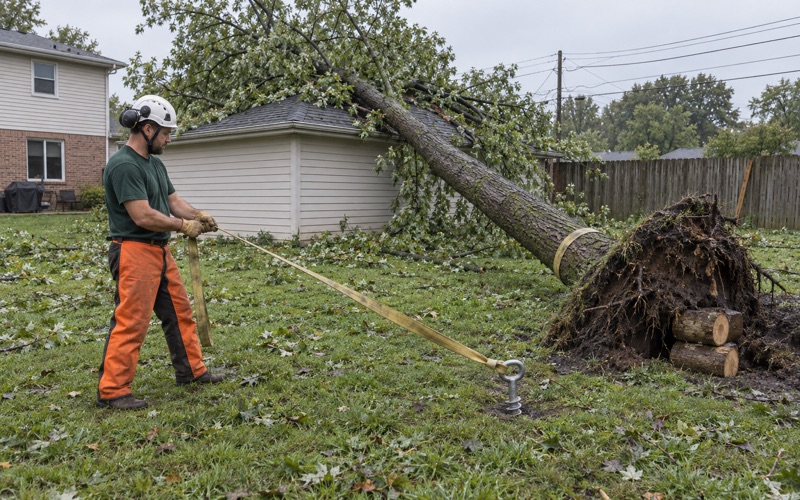
If a conductor is down, stay at least thirty feet back, touch nothing in contact with it, call 911 first and then Evergy at 888-544-4852. Do not remove a tree limb or any other object from a power line, because electricity travels through objects and does it best when they are wet. For a tree across a city street or a nuisance vegetation question, Neighborhood Services answers at 816-969-1200. Missouri issues no license or certification for tree work at all, so what you can ask any company for is the insurance certificate and the written assessment. Both reach you before a saw starts. When a tree is on a roof, a car or a line, we respond the same day.
- 20+ Years in the KC Metro
- Free On-Site Assessment
- Written Price, Insured Crews