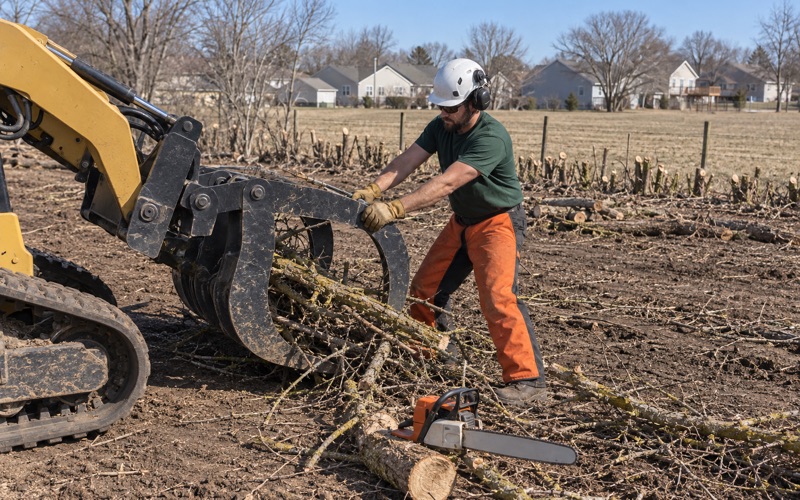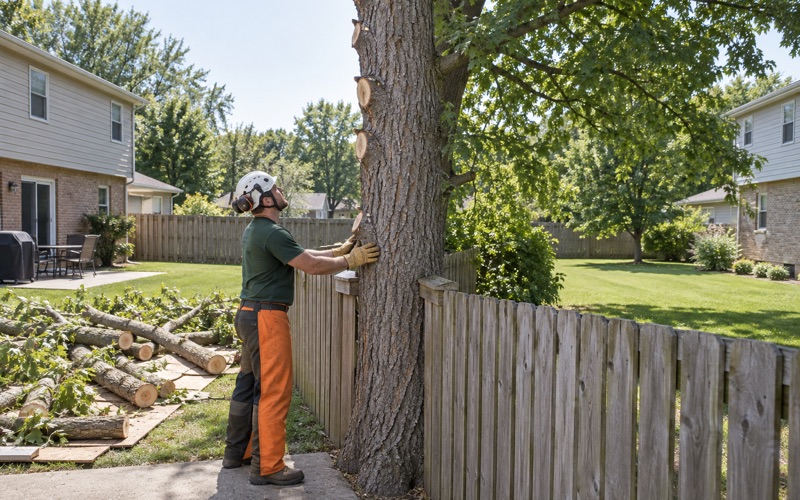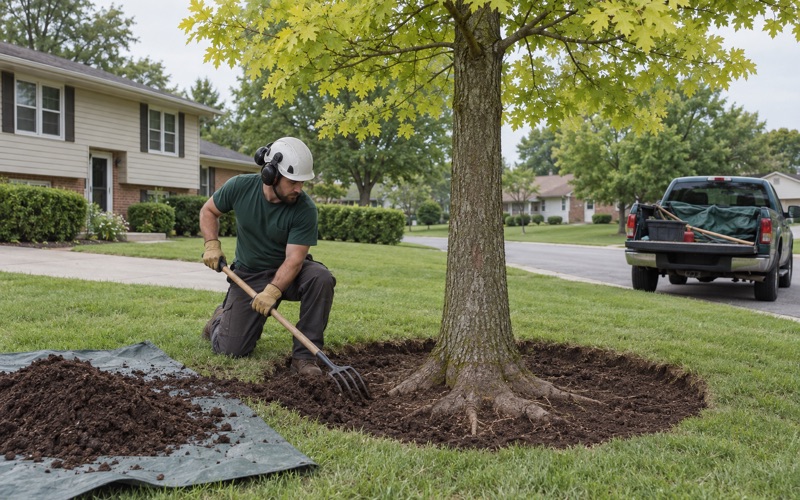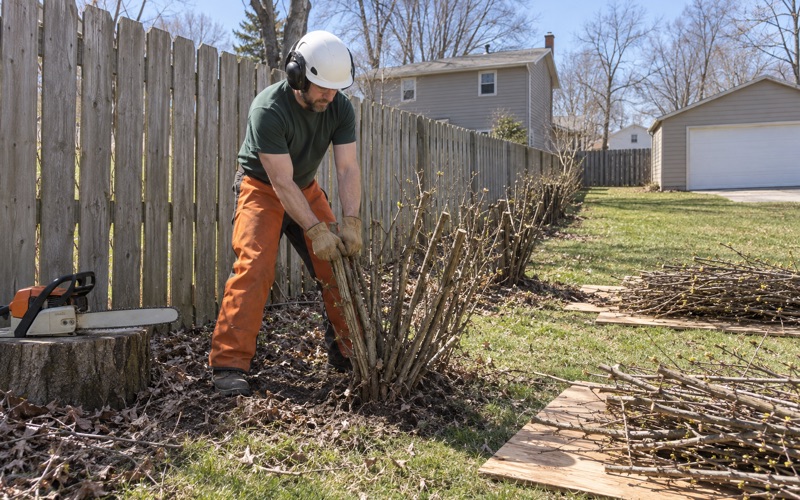
Blue Springs Tree Removal handles tree removal in Lenexa with a crew that has been taking trees down across the Kansas City metro for more than twenty years, on both sides of the state line. That second part matters more here than most homeowners expect. The rules that decide who owns a tree, who has to replace it, and who pays for the wood to leave change the moment you cross into Johnson County.
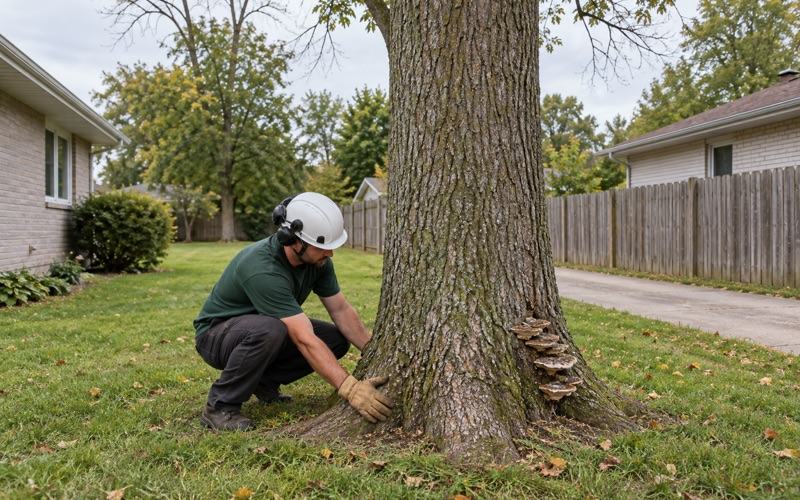
Every job starts with a free on-site assessment and a written condition assessment of the tree itself, not a number scribbled on the back of a card. You get the diameter at breast height, what we found at the root flare, and what we think the tree does over the next few seasons. The price we quote is the price in writing, and proof of insurance reaches you before a crew sets foot on the property.
We also tell you where the wood and the brush are going before the saw comes out of the truck. In a city where trash and yard waste collection is private subscription hauling, that is not a small detail. Nothing gets stacked at your curb for someone else to refuse.
The street tree is yours, and Lenexa asks for nothing back
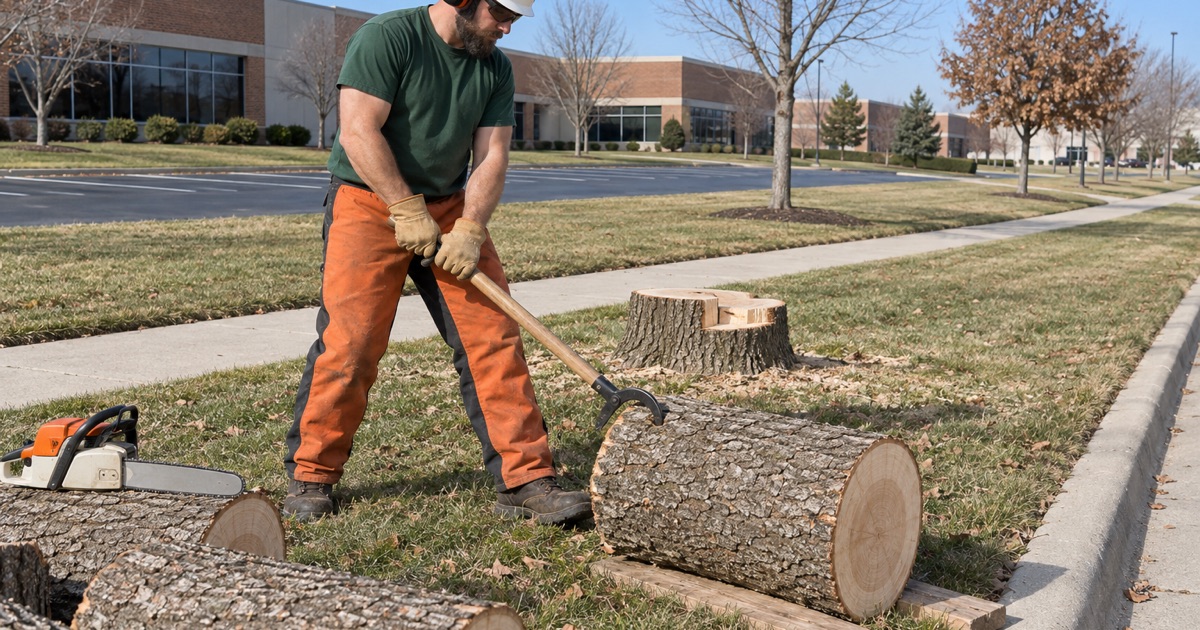
Lenexa answers the right-of-way question in the homeowner’s own terms, and the answer is unusually direct for this part of Johnson County. The city states that trees on your property and located in the public right of way are your responsibility as the homeowner, and that the right of way typically extends approximately 11 to 15 feet from the back of the curb. That strip in front of your house is almost certainly wider than you think it is.
The sentence that separates this city from its neighbors follows right after it. You are not required to replace a street tree if you remove one. There is no replacement plan to file, no mitigation to calculate, and no list of substitutes to choose from once the stump is ground and the grindings are raked back.
What the city will and will not touch
The city names two conditions under which it trims in the right of way on its own: trees causing a sight, sign or sidewalk obstruction, and trees with low-hanging or broken branches over the roadway or walkway causing a safety concern. Everything outside those two triggers stays with you. The city is equally plain about the dead one in the back yard, stating that if you have a dead or dying tree on your property it is your responsibility to remove it before it becomes hazardous.
Its advice on who to call is worth reading closely, because it directs residents to contact insured contractors with certified arborists on staff. Kansas does not license tree work at the state level and Johnson County does not license it either, so certification through the International Society of Arboriculture or the Kansas Arborists Association is the credential that actually means something here. Insurance is the other half, and ours arrives before the work does.
When the tree sits on the property line
Kansas and Missouri answer a neighbor’s overhanging tree in opposite directions, which is the single most useful thing we carry across the state line. Kansas follows the nuisance rule, settled as a case of first impression by the Court of Appeals in 1985 in Pierce versus Casady. You may trim what overhangs your side, you may not enter your neighbor’s land to do it, and where a tree does substantial harm or creates an imminent danger it becomes a nuisance the neighbor can be compelled to abate.
On the Missouri side of the metro the same facts produce no cause of action against a healthy tree at all, and the complaining owner pays for the trimming. So a written condition assessment does different work depending on which side of the line you live on. Here it is leverage, and that is why we put the findings in writing rather than describing them at the curb.
Looking for tree-removal closer to Grain Valley? See Tree-Removal in Grain Valley.
The Unified Development Code is aimed at development, not at your finished lot
Lenexa’s landscape and tree rules sit in the Unified Development Code at Title 4, Chapter 4-1, Article 4-1-D, in Section 4-1-D-2, Landscaping, Buffering and Site Design. The applicability clause is the whole answer for a homeowner: the standards of that section apply to all new development and to expansions and modifications of existing development as specifically outlined in the Code. A finished, occupied lot is none of those things.
The tree-preservation subsection reads the same way. Section 4-1-D-2-I opens by requiring that site plans and plats shall be designed to preserve existing trees and vegetation to the greatest extent possible, and its stated intent is to recognize the need to alter the landscape during site development activities while setting standards for preservation. Both sentences describe a plan under review, not a yard with a house already on it.
You will find pages online calling this a city with minimal tree regulation. Half of that is right and half of it is badly misleading. The homeowner half is accurate, including for the right-of-way tree, but the regulation itself is real and elaborate and it is pointed squarely at the developer.
What a builder or an association redevelopment runs into
On the development side the numbers are specific. Trees measuring from 2 to 10 inch caliper are credited on a one-for-one basis and trees greater than 10 inches on a two-for-one basis, with the award weighing health, function and the ability of the tree to withstand the impacts of construction. At final plan application a tree survey has to locate every tree greater than 10-inch caliper and identify it by common name, and protective fencing goes no closer to a saved tree than its drip line for the length of the construction period.
Street trees themselves are the city’s job rather than the builder’s. In single-family and duplex subdivisions with average lot sizes under one acre the City provides and plants them, the Parks and Recreation Director determines what species goes in, and the landowner pays into the Lenexa Street Tree Fund by a frontage formula at final plat approval. That is why the removal conversation on a finished lot has no replanting obligation attached to it: the planting decision was made and paid for years earlier, by somebody else.
Two building waves, and a quiet stretch in between
Lenexa’s housing does not sit in one age band, and that shapes what a removal here actually looks like. The 1970s account for 20.01 percent of the stock and the 1980s for 19.69 percent, while the 2010s add another 18.18 percent. Only 3.58 percent of it predates 1960, so the trees that come down are rarely the oldest kind, and 13,077 owner-occupied one-unit detached houses make up the residential core of the work.
The practical effect is two different jobs under one city name. Trees planted with houses in the 1970s and 1980s are 40 to 55 years old and squarely into a first removal cycle, where co-dominant stems, included bark and heartwood decay decide whether a tree is a rigging job or a candidate for cabling and bracing. On the newer side the canopy is young, the ground is engineered fill, and the work is lot clearing, builder protection and drop-zone management.
The species that fail first
The first-cycle half fails on a predictable roster. The Johnson County extension service brochure for this metro refuses silver maple for weak wood, pin oak for soil problems and green ash outright, warns that many fast growing varieties are brittle with narrow crotch angles that can lead to severe breakage during storms, and tells readers plainly not to plant the Bradford cultivar because severe splitting occurs on 10 to 15 year old trees. It attaches storm caveats even to trees it recommends, including river birch, lacebark elm and sweet gum.
Pine is the failing screen conifer here, and pine wilt is the one removal in this trade that carries a published deadline. K-State Research and Extension reports that Scots pine plantings in eastern Kansas have been devastated and that Austrian pines have been hit in recent years, and its instruction is to cut an infected tree down as soon as possible and by May 1 at the latest, with April 1 the better deadline. Cut it to the ground rather than leaving a stump, chip or burn the wood immediately, and do not save it for firewood.
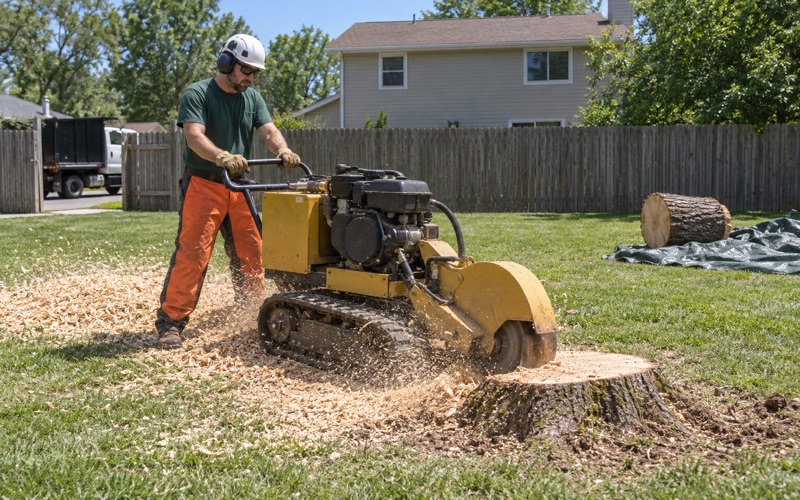
Grinding depth is the other thing we will not promise sight unseen. Eastern Kansas carries shallow residual series formed over interbedded limestone and shale, and on the shallowest of them bedrock sits somewhere between 10 and 20 inches down, which is inside a stump grinder’s rated cut. On lots built since 2010 the working medium is often imported fill and compacted subgrade instead, which no soil survey describes, so we set below-grade cut depth after the tooth wheel finds out what is there.
Business parks, storm work and where the debris goes
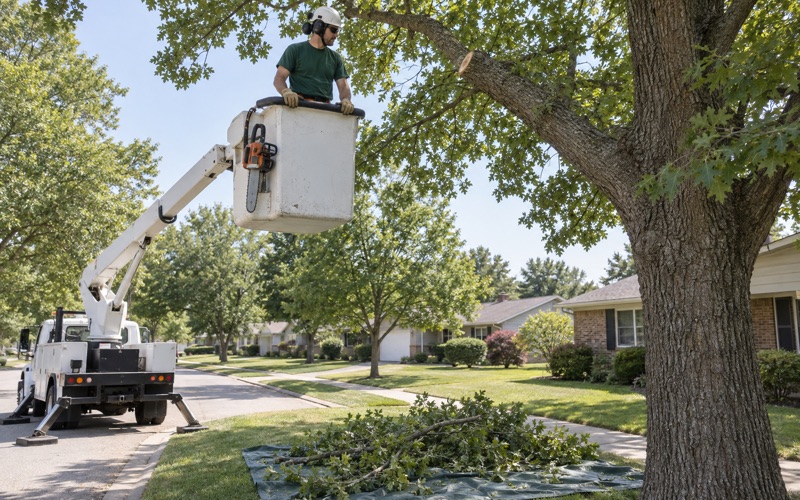
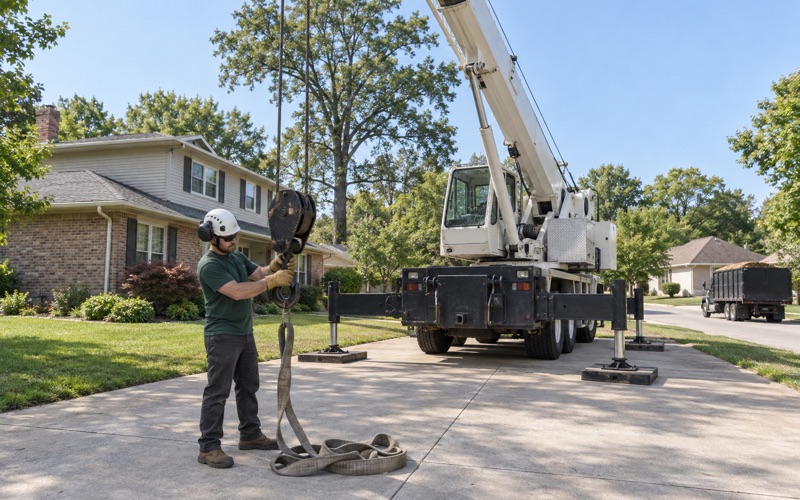
Attached and multifamily housing is 43.64 percent of the stock, and the city carries one of the metro’s larger warehouse and business-park concentrations, so a large share of our calls here come from property managers and commercial landlords rather than homeowners. Those sites bring their own constraints: parked fleets, loading aprons that cannot be blocked, and drop zones measured against a building rather than a lawn. Crane-assisted removal and controlled rigging on a bull rope and Port-a-Wrap friction device usually cost less than the downtime of closing a dock for a day.
When the line and the roof are involved
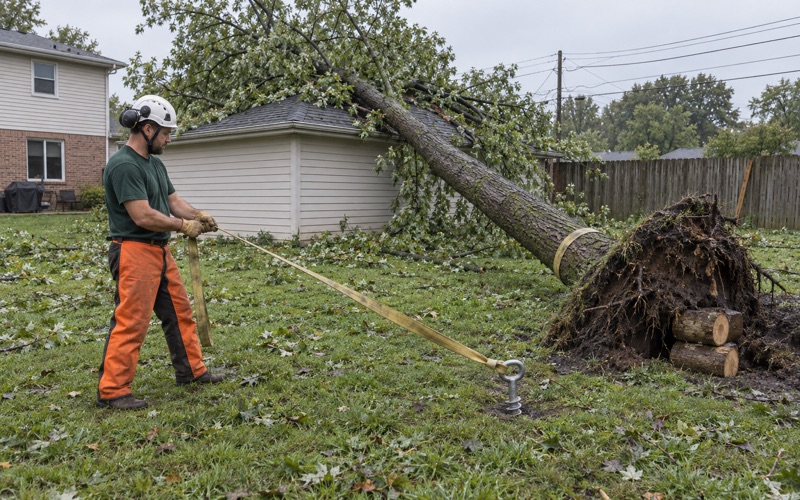
Storm work here is not theoretical. The National Weather Service office at Kansas City and Pleasant Hill titles the July 14, 2023 event a wind storm with widespread power outages, and 89 mph was measured just west of the city while roughly 200,000 customers lost power and about 60,000 were still out the following day. We answer the same day when a tree is on a roof, a car or a line.
If a conductor is down or a limb is bridging conductors, call 911 first and then Evergy at 888-544-4852, and nobody works the site until the utility has cleared it. The span running from the pole to your meter is the customer’s responsibility under Evergy’s own published rule, so that work gets planned around an energized service drop at ANSI Z133 clearances. Evergy also leaves its clearance debris at the worksite, which is where the disposal question starts rather than ends.
The debris leaves with us
Curbside collection cannot absorb a removal. Lenexa’s rule bundles limbs and brush at no longer than 48 inches, no more than 18 inches in diameter and no heavier than 65 pounds, caps a pickup at six bags or bundles, and drops to monthly collection from December through February, which is exactly when storm limbs are most likely to be on the ground. Because hauling is a private subscription, the terms you are actually bound by are your hauler’s rather than a public rule you can look up. Ours is the simpler answer: the debris leaves with us, and we tell you before the saw starts whether the wood is going out as brush, as logs, or as grindings left behind.
- 20+ Years in the KC Metro
- Free On-Site Assessment
- Written Price, Insured Crews