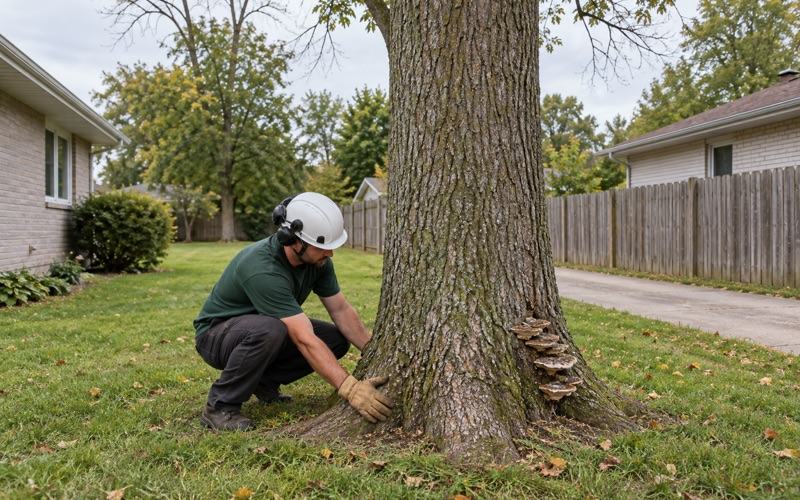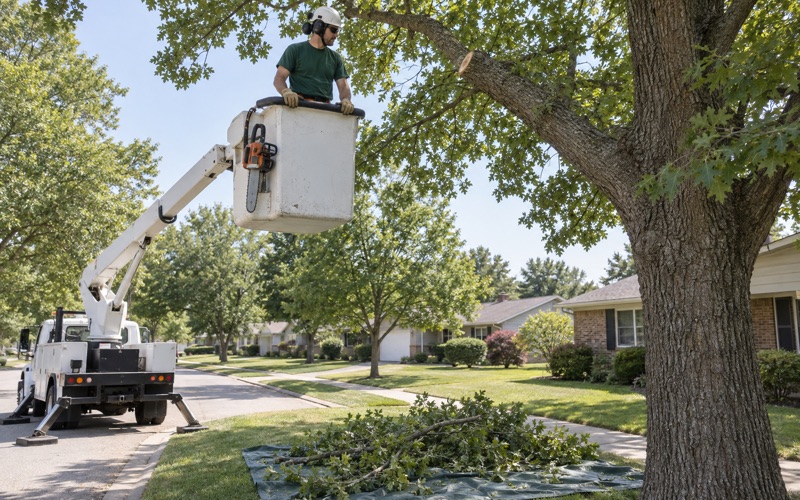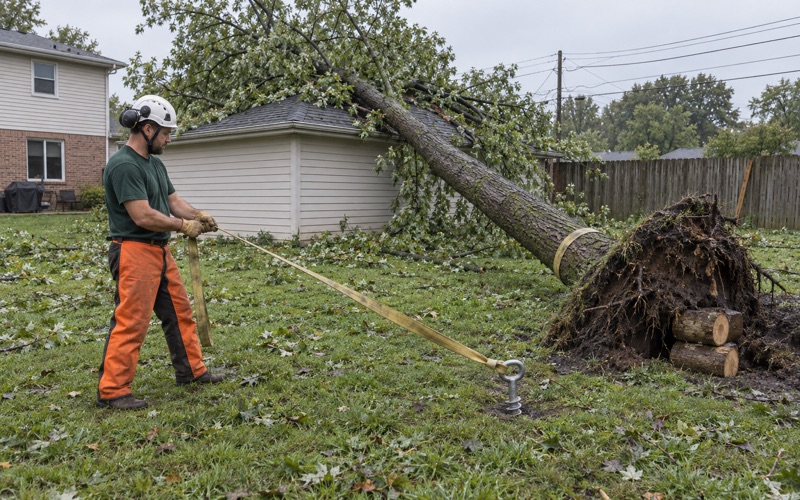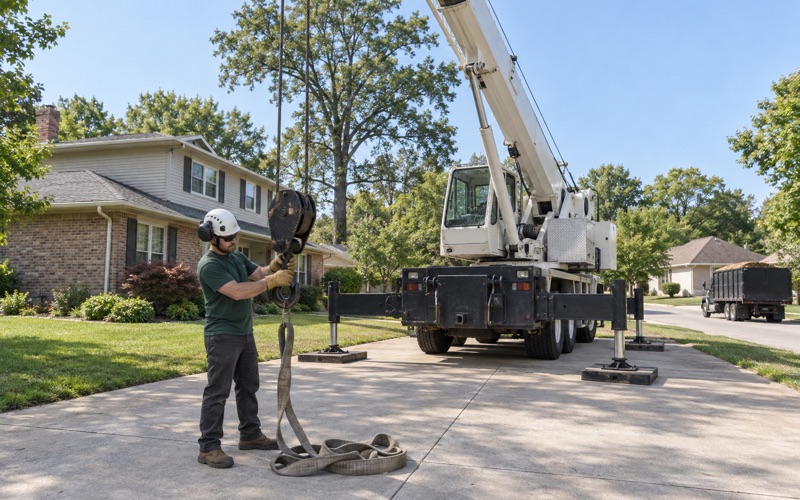
Blue Springs Tree Removal handles tree removal in Lexington, Missouri, and we have been taking trees down across the Kansas City metro for more than twenty years. Lexington sits far enough east of our home ground that the rules change, and we have learned which ones actually bind here. Every job starts with a free on-site assessment and a written condition report, not a figure scribbled on the back of a card.
What that report tells you is the condition of the tree, what we propose to do with it, and where the wood and the brush are going before a saw comes out of the truck. The price we quote is the price in writing, and proof of insurance reaches you before a crew sets foot on the property. If a tree can be held with cabling and bracing or brought back with structural pruning, we will price that instead and say why.
Most of what follows is Lexington specific: the city ordinance that covers vegetation, the diameter limit at the yard-waste gate, and which utility answers when a limb is in a line. It is the sort of detail a homeowner cannot easily find in one place, so we have put it in one place.
The vegetation chapter that is mostly reserved
Lexington is the rare city in this part of Missouri with a municipal code chapter titled Vegetation, and opening it is an anticlimax in the best possible way. Chapter 26, Article I, is a single operative section: Section 26-1, Hedges Adjacent to Public Ways to be Trimmed. Sections 26-2 through 26-12 are all marked reserved, which is a drafter’s way of holding open numbers nobody has filled.
What that means for a homeowner is the answer everybody wants and few contractors will commit to: there is no tree-removal permit for a finished private lot in Lexington. There is no heritage or landmark tree designation, no street-tree regime, and no published clearance height over a sidewalk or a street. We think that answer is worth stating plainly, because it will still be the answer when you look the chapter up yourself and see the word Vegetation at the top of it.
What the city does regulate
The provisions that do carry weight are the ordinary ones: hedges along public ways have to be kept trimmed, and weeds and accumulated debris are enforceable nuisances. Building and Codes Enforcement is the department that answers on those, and a pile of limbs left at a curb for a month is the kind of thing that draws a letter. That is one reason our debris leaves with us rather than sitting out front waiting on a hauler.
Historic districts, and the question we will not answer for you
Lexington also has a Historical Preservation Commission that describes itself as a regulatory board and publishes a fillable Certificate of Appropriateness. Whether that certificate reaches trees, landscaping or any other site feature is not something we could establish from the published material, and we will not tell you it does or that it does not. If your property sits inside one of the older districts, call City Hall at 660-259-4633 before work is scheduled and get the answer from the people who issue it.
Looking for tree-removal closer to Harrisonville? See Tree-Removal Services in Harrisonville.
The four-inch limb at the yard-waste dumpster
The City of Lexington Street Department runs a yard-waste dumpster, and it publishes the only diameter cap we have found anywhere in Lafayette County: tree limbs must be less than four inches in diameter. Leaves have to be placed in paper bags. The bulky-trash drop-off is separate, and the permit for it has to be bought at City Hall first, not paid for at the gate.
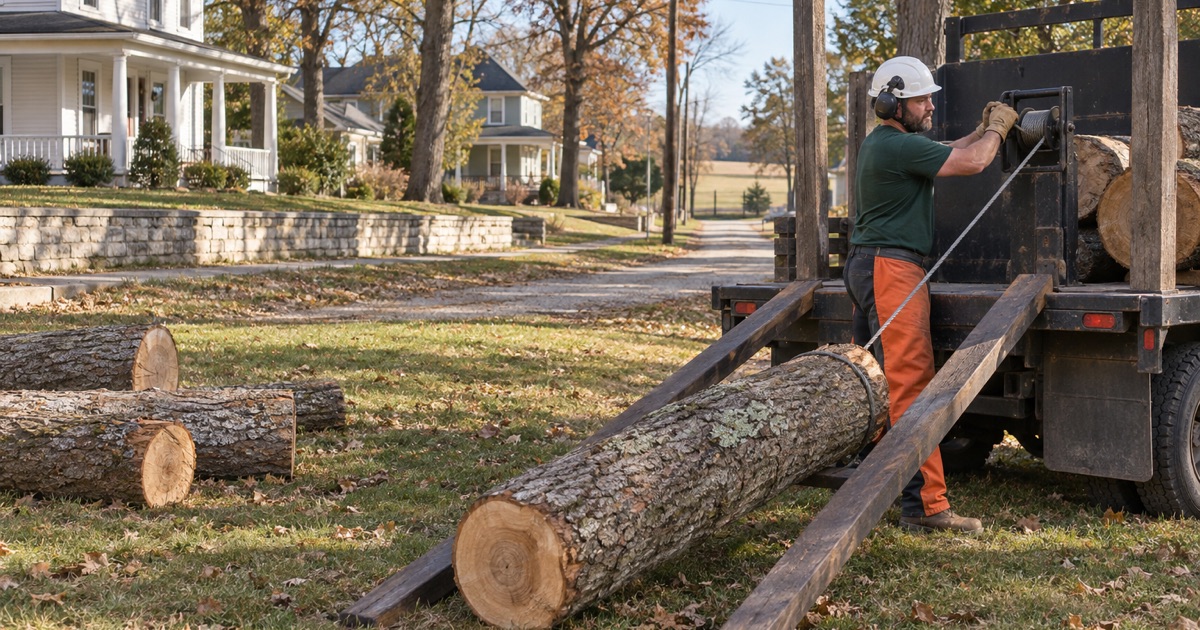
Read that four-inch line against an actual removal and it splits the job in two. The brush qualifies; the trunk sections do not, and neither do the larger scaffold limbs off a mature oak. A homeowner who plans to handle disposal by making trips to the dumpster usually discovers this halfway through the pile, which is why we tell you where the wood is going before we start.
Where the volume actually goes
Lafayette County operates no brush gate of its own at any price. The county recycling operation in Higginsville takes electronics, motor and metal breakage and cardboard, and its own material lists carry no brush, yard waste, limbs or logs. Under RSMo 260.250 yard waste cannot go into a Missouri solid waste disposal area at all, which is why every outlet within reach of this town is a composter rather than a landfill.
Burning is not the shortcut it looks like
Missouri regulates open burning statewide at 10 CSR 10-6.045, which defines vegetative waste to include tree trunks, limbs, trimmings and yard waste, and prohibits burning construction or demolition waste other than untreated wood. Commercial land clearing burns inside city limits, or within 200 yards of an occupied structure, have to meet a set of conditions that includes burning only between sunrise and sunset, a 200 yard setback from the nearest structure, supervision at all times, and notice to the local fire control authority beforehand. On a town lot in Lexington that setback simply cannot be met; on acreage outside the city limits it can. We did not find the city’s own general burning ordinance, so if burning is your plan, call the Lexington Fire Department and let them set the terms.
Which utility answers, and where the statute reaches
Electric service in Lexington comes from Evergy Missouri West, an investor-owned utility. The city does not own an electric system: its published departments are administration, building and codes enforcement, economic development, emergency management, fire, parks and recreation, police, street, wastewater and water, and the bill it sends covers water, sewer and trash. We mention this because the belief that Lexington runs its own power company circulates widely and traces to a different Lexington in another state entirely.
The distinction is not trivia, because Missouri’s tree statute is written around a definition. RSMo 537.340 gives a property owner treble damages against anyone who cuts down, injures or carries away a tree grown for use, shade or ornament, without proving negligence or intent, and the same statute carves out electric suppliers with their own notice and remedy provisions. Its definition of an electric supplier covers chapter 394 rural cooperatives, cooperative-plan corporations and chapter 91 municipally owned systems, and an investor-owned electrical corporation matches none of those limbs.
So inside the city limits those supplier-specific rights are not the lever a homeowner has. What does apply is the Missouri Public Service Commission’s vegetation management rule at 20 CSR 4240-23.030, which requires the utility to file an annual report, so the trim cycle, the miles scheduled and the clearance guideline are public record you can read before you argue about a trim. Outside the city limits the answer flips, and that is worth a paragraph of its own.
Out on the unincorporated ground
Unincorporated Lafayette County is served by West Central Electric Cooperative, headquartered in Higginsville with a branch at Oak Grove, running more than 15,000 meters across some 2,600 miles of line. Its published right-of-way goal is to eliminate all trees and brush within 15 feet of either side of its power lines by spraying, trimming and removal, which is a wider corridor than most people picture. A cooperative does fall inside the statutory definition, so a landowner out there holds rights that a homeowner in town does not, and the cooperative can be reached at 816-565-4942.
Who to call first
For a downed conductor or a broken pole inside the city, the electric utility’s outage line comes before City Hall, because the city cannot de-energize a system it does not operate. For a burning tree, the fire department. For a limb across a public street or a question about the yard-waste dumpster, the Street Department at 660-232-3827. Before any stump grinding anywhere, Missouri One Call at 1-800-344-7483, which is the 811 utility locate that keeps a grinder wheel out of a gas service.
An older river town, and what it means on the ground
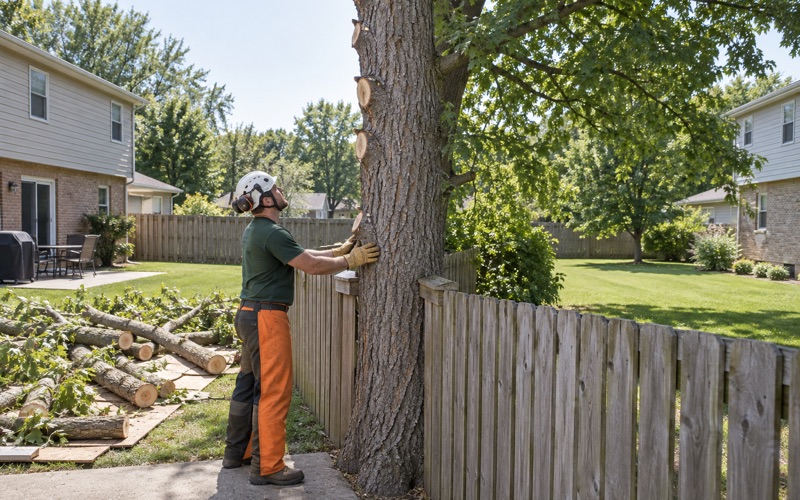
Lexington’s housing stock is genuinely old by metro standards: 46.60 percent of it was built before 1960 and 81.03 percent before 1980, with a quarter of the total dating from the 1950s alone. A mature canopy is the real thing here, not a marketing phrase, and so is everything that follows from decades of unmanaged growth: co-dominant stems with included bark, split leaders, heartwood decay behind an old topping cut. Tree risk assessment on a lot like that is mostly reading what past decisions did to the structure.
What age does not tell you here is access. The pattern is roughly 413 housing units per square mile with 79.50 percent of them single-unit detached, which is low-density detached ground rather than the alley-and-fence layout an antebellum date usually suggests. We still check the plat rather than assume, and on most of these properties the constraint sits in the back yard and the drop zone instead of at the curb.
Some of that history is still standing in plain sight: the Battle of Lexington State Historic Site on Delaware Street preserves the Anderson House that served as a hospital during the fighting in September 1861. Trees on and around grounds like that are not our call to make, but they set the expectation homeowners bring to their own lots, which is that a big old tree is worth trying to keep. Where cabling and bracing or a crown reduction will buy a sound tree another decade, that is what we price.
Gates, grinders and what fits
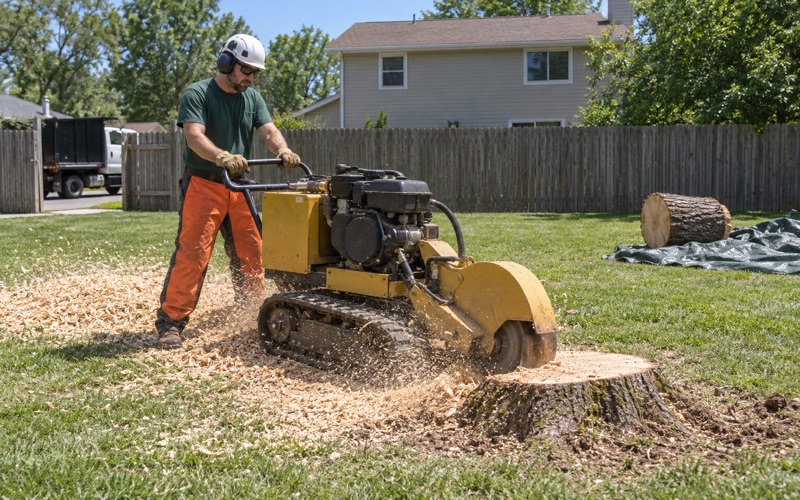
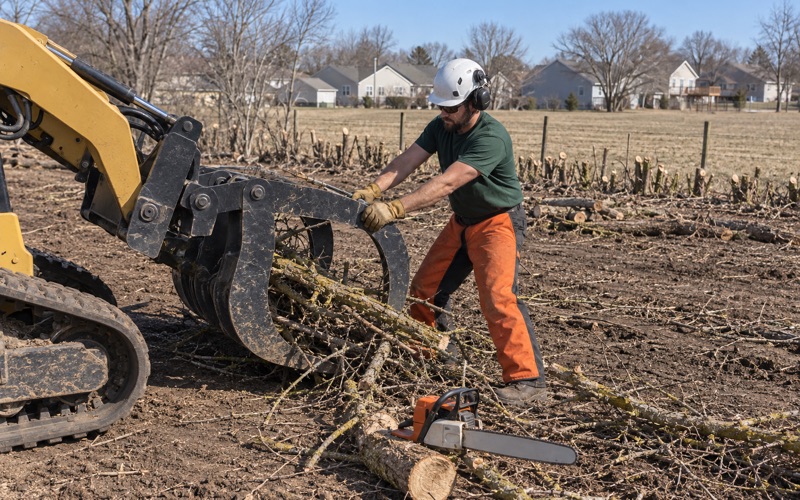
The binding constraint on this work is machine width and brush handling rather than horsepower. Compact grinders and tracked lifts are built to gates in the 25 to 35 inch class, while a chipper runs seven to eight feet wide and around ten thousand pounds and never goes through a gate at all. Width and below-grade cut depth are not coupled, either: some 35 inch machines cut 25 inches below grade and a dual-wheel option can take the same machine deeper, so we quote the machine as it will actually be configured for your lot.
Bluffs, shale and the depth nobody should promise
Most of the mapped soils in this part of Lafayette County are deep relative to what a stump grinder is rated to cut, so the machine’s own stop binds before the ground does. The exception is the Snead series, moderately deep soils formed in residuum from calcareous clayey gray shales, with depth to a paralithic contact of 20 to 40 inches, whose shallow end sits under a 25 inch cut. Snead is extensive across northern and western Missouri and bluffs and dissected valley sides are exactly where shale comes near the surface, so on a bluff-side lot we look before we commit to a below-grade depth rather than promising one over the phone.
- 20+ Years in the KC Metro
- Free On-Site Assessment
- Written Price, Insured Crews