Blue Springs Tree Removal has been taking down trees in Liberty for more than twenty years, and tree removal in Liberty is really two jobs sharing one street grid. Roughly 823 homes here were built before 1940, while more than half the city went up between 1980 and 2009, and those two populations of trees fail in different ways and need different equipment. We quote both from the same free on-site visit, and the number you are given is the number that goes in writing.
What you get from that visit is a written condition assessment rather than a figure on the back of a card: species, diameter at breast height, the defects we can see from the ground and from the climb, and what we expect the tree to do next. If a stem can be held with cabling and bracing or corrected with a crown reduction, we say so and price that work instead of a removal. We do not top trees, and if someone else offers to, we will explain what topping actually does to a maple.
Proof of insurance reaches you before a crew reaches the property, and we tell you where the wood, the chips and the grindings are going before the saw comes out of the truck. That last part carries more weight in Liberty than most homeowners expect, because the city’s own brush gate turns away the kind of truck that would haul it. When a tree is on a roof, a car or a service line, we respond the same day.
Two tree markets, one street grid
Liberty holds 12,085 housing units across 29.665 square miles of land, which works out to 407 housing units per square mile. That is a low figure for a suburb of this size, and it is the number that most changes how we price work here. Density usually decides whether equipment can reach a tree at all, and Liberty simply has less of it than its age profile would suggest.
The blocks around the historic square
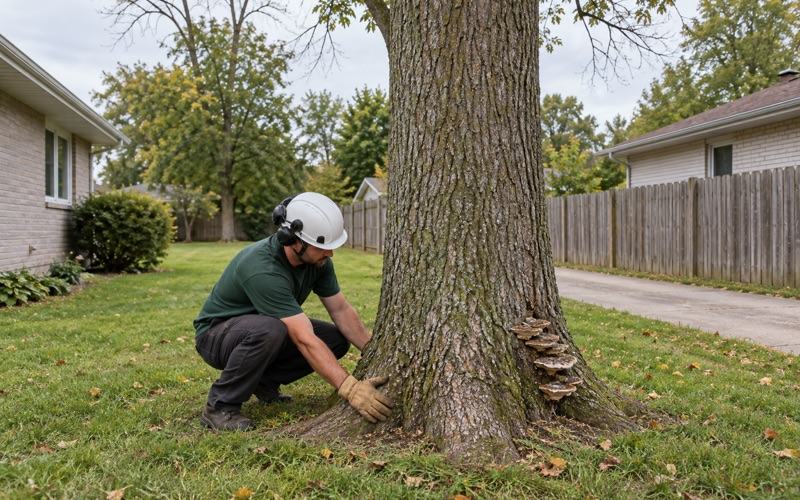
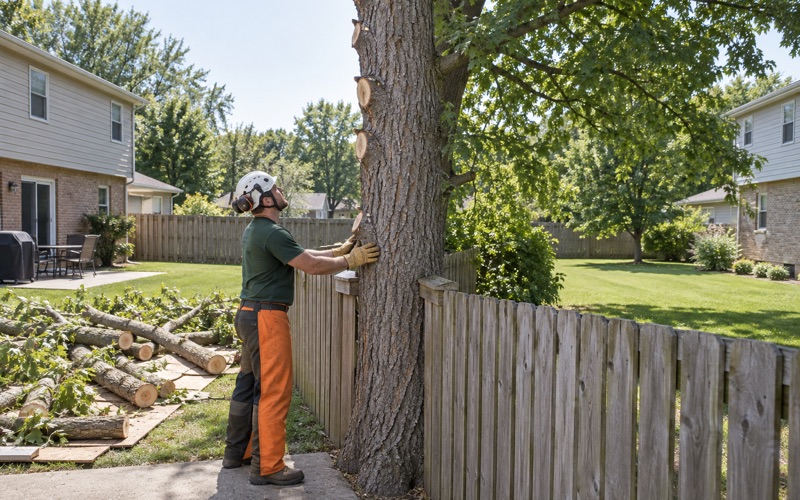
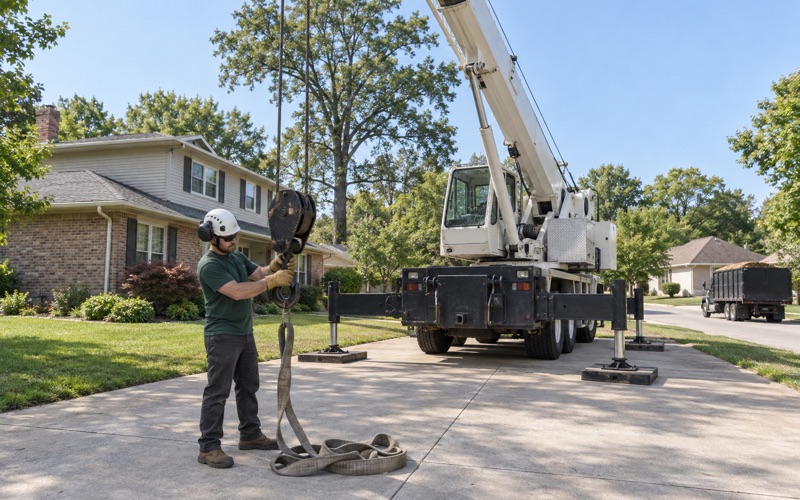
The 823 units that predate 1940 sit mostly in the older grid around a commercial square that still works as a downtown, with a Historic Downtown Liberty Commercial Community Improvement District of its own. Trees on those blocks are old enough to carry heartwood decay, conks at the root flare, and co-dominant stems with included bark that opened up decades ago. We plan removals there around the root plate and the drop zone rather than around the gate, and on the tightest of them a crane-assisted removal costs less than a full day of rigged pieces lowered over a porch roof.
The 1980s and 1990s subdivision belt
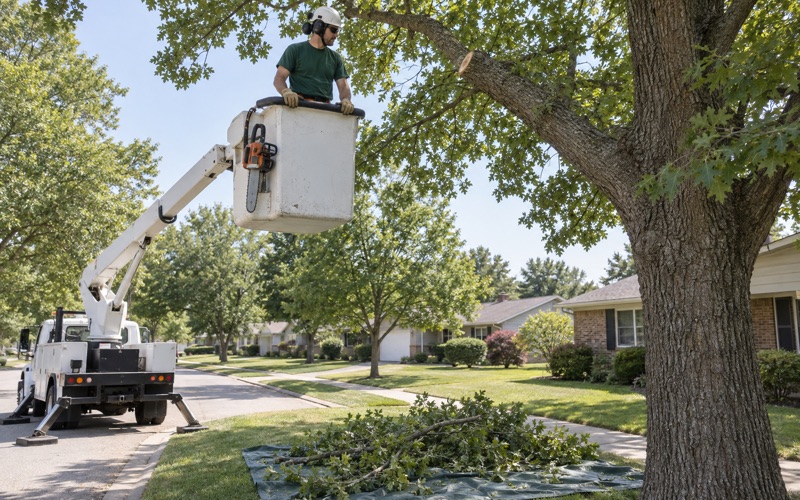
The other spine is newer and much larger: 51.58 percent of the housing stock was built between 1980 and 2009, with the busiest single decade running from 1990 through 1999. Those trees are now thirty to forty-five years old, which is old enough to fail and young enough that the failure is structural rather than rotten. A split leader on a forty-year-old maple that was never pruned for structure is the most common call we take on that side of town, and it is often a crown reduction and a cable rather than a removal.
With 72.43 percent of the stock detached single-family and 72.98 percent owner-occupied, nearly every quote we write in Liberty goes to the person who will live with the result. We write the assessment for that reader rather than for a file.
Looking for tree-removal closer to North Kansas City? See Tree-Removal in North Kansas City.
Why old stock here does not mean a tight gate
In most cities the age of a neighborhood predicts the access problem, because old lots are narrow and the gate is the binding constraint. Liberty decouples the two. At 407 units per square mile the lots are generally wide enough to walk equipment to the back, and what sets the price instead is the drop zone and the carry distance out to the truck.
Carry distance, not gate width
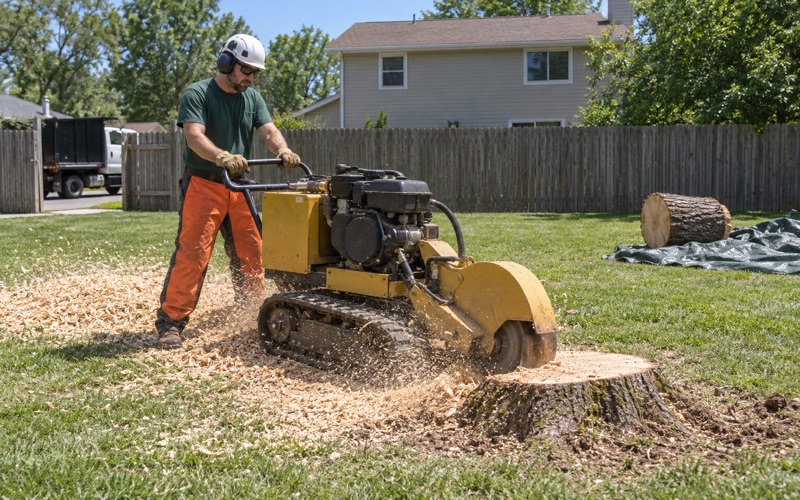
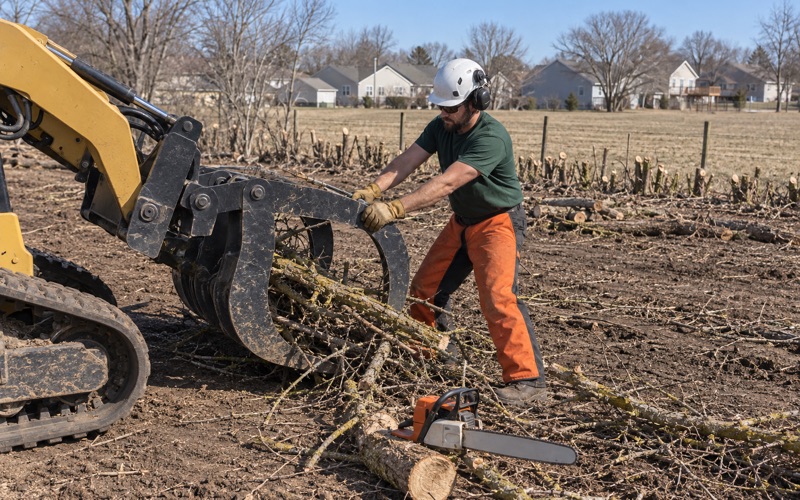
A compact stump grinder is built for a gate in the 25 to 35 inch class and a tracked lift will pass a doorway, so the machine that actually stays out front is the chipper. A Bandit Intimidator 19XPC is 7 feet 9 inches wide and weighs around 10,500 pounds, and it never goes through a gate anywhere. Everything cut in the back yard is carried or dragged to it, and that distance is what we are measuring while we walk the property with you.
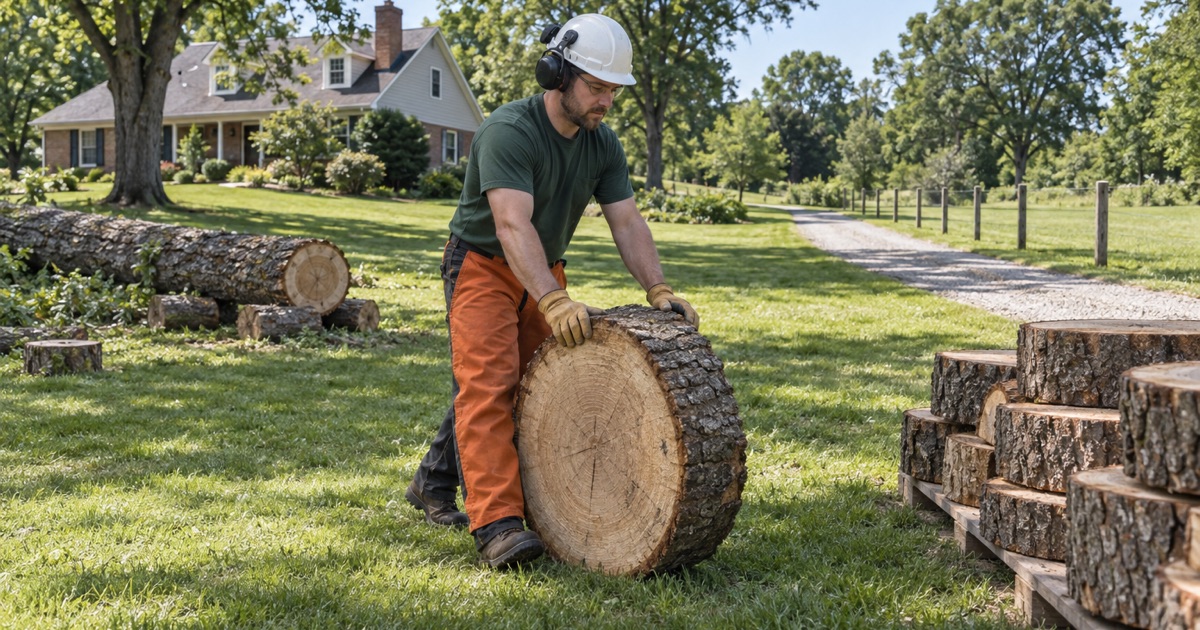
It is also why the firewood credit on a Liberty estimate moves with the carry rather than with the species. Rounds worth keeping at forty feet from the truck are worth nothing at two hundred, and we put that on the written price as a line item instead of deciding it on the day.
Manufactured-home lanes and service drops
Liberty counts 498 mobile homes, about 4.1 percent of its stock, and that segment is a distinct access problem almost nobody writes for. Interior lanes are narrow, setbacks are tight, and the service drop running from the pole to the meter often crosses exactly the airspace a limb needs. We take those removals down in small pieces on a bull rope and a Port-a-Wrap friction device sized to a working load limit we can state, rather than dropping anything into a lane.
The city’s own tree list, and who approves a removal
Liberty has been a Tree City since April 8, 2005, and its Tree Board publishes a citizens’ guide to street trees that we read before quoting a replacement. It is more specific than most cities bother to be, and it settles most arguments before they start.
Eight oaks, and where they can go
The recommended list for species maturing over thirty feet carries red maple, Freeman maple, sugar maple and eight oaks — northern red, scarlet, black, Shumard, swamp white, shingle, willow and sawtooth — along with hackberry, sugarberry, linden, ginkgo and honeylocust. Under wires the list switches to small growing species such as redbud, flowering dogwood, downy serviceberry and flowering crabapple. Nine entries are refused from the right-of-way outright for weak wood, disease, messy droppings or sight-line problems, and evergreens are refused as an entire category in a single word.
Placement is specified as tightly as species: a tree maturing over thirty feet belongs at least thirty feet from overhead utilities, and no tree goes within ten feet of a driveway, a fire hydrant, or a gas valve, water valve or cable box. Along arterial and collector streets nothing is planted within 140 feet of the corner, and along residential collectors and local streets within thirty feet. Anything not on either list routes through a call to the Parks and Open Space Manager at 816.439.4384 rather than through a variance.
What this ground actually grows
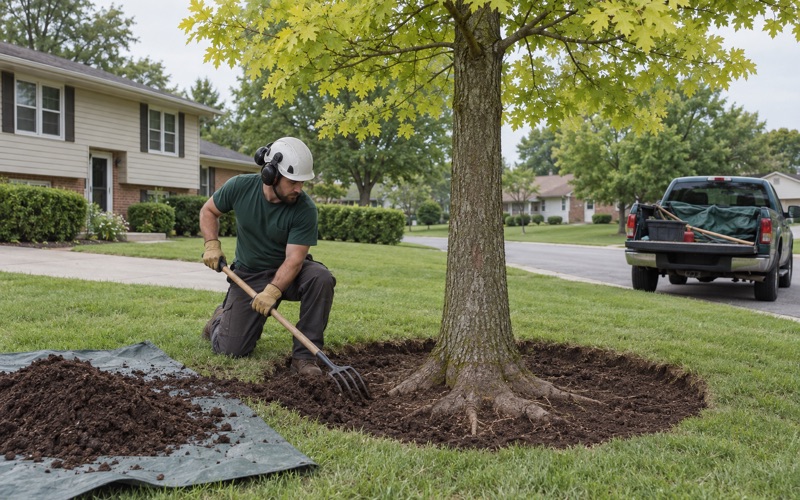
Liberty sits in EPA Level IV ecoregion 47f, the Rolling Loess Prairies, glaciated ground whose native woodland is bur oak over prairie rather than the mixed hardwood of the unglaciated country south and east of it. That is worth saying because of one promise we will not make: bur oak is not known for fall color, and the Missouri Department of Conservation assigns it none. The oaks that do turn are the ones already on the city’s list — northern red goes russet to bright red, white oak to a deep claret — so if autumn color is part of why you are replanting, the species choice is doing all of that work.
The approval that actually applies
We found no permit for removing a tree on a finished private lot in Liberty. What binds is Chapter 30, the Unified Development Ordinance, and Section 30-95(6)(f) in particular: approval for the removal of a street tree due to disease, deterioration or other natural causes has to be granted by the city before the tree comes down. That covers the tree between the curb and the sidewalk, not the one in your back yard, and it is the sentence most homeowners here have never read.
On the development side, each existing tree eight inches or more in diameter measured four and a half feet above grade that is removed has to be replaced with two large growing trees, with an explicit exemption where the tree is unhealthy or sits where it could cause a safety hazard. We flag which rule your job falls under in the written assessment, because the two answers are not close.
Evergy, the service drop and the call order
Electric service in Liberty is Evergy, named on the city’s own new-resident page, and the order of who to call is worth knowing before a storm makes it urgent. A downed conductor or a limb resting on an energized line goes to Evergy and to nobody else, a tree blocking a public street goes to the city, and the service drop between the pole and your meter is the homeowner’s own responsibility. Evergy holds ten feet of clearance on conductors energized at 600 to 50,000 volts and needs signed owner permission before it removes anything more than four inches in diameter, so its crews and ours are not interchangeable.
We call an 811 utility locate before a grinder turns in Liberty, every time. The city’s own placement rule contemplates gas valves, water valves and cable boxes sitting within ten feet of a street tree, which tells you exactly what can be under the strip you are asking us to grind.
Stumps, brush and where the debris goes
Loess, not rock
The uplands here are deep loess, and the soil series described for this landscape — Sharpsburg, Grundy and Knox — all publish a rock fragment content of zero. For stump work that is genuinely unusual: there is no wear factor on the tooth wheel, and what limits below-grade cut depth is the machine’s own rated stop rather than anything buried. A grinder rated for 12 to 25 inches below grade reaches that stop long before the ground argues, which is why we state the machine class and its rated cut instead of promising a depth sight-unseen.
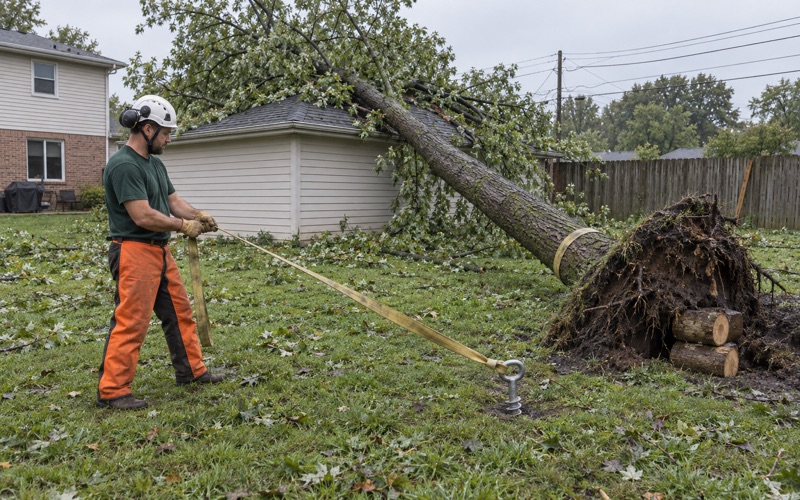
What replaces rock in this soil is movement. Sharpsburg and Grundy are fine-textured smectitic clays that shrink and crack through a dry August and heave back afterwards, and that shows up in root-plate behavior on a leaning stem far more than it shows up in the grinding.
The gate that refuses our truck
Liberty runs a tree limb disposal yard on new 210 Highway, roughly one-half mile east of Highway 291, open the last few days of April and October and often after a major storm. Its published rule is a vehicle-class refusal rather than a materials one: only tree limbs, no other yard waste, and no commercial vehicles allowed on the site, with residents showing a driver’s license or a city water bill at the gate. A homeowner’s pickup gets in and a chip truck does not, whoever the tree belonged to.
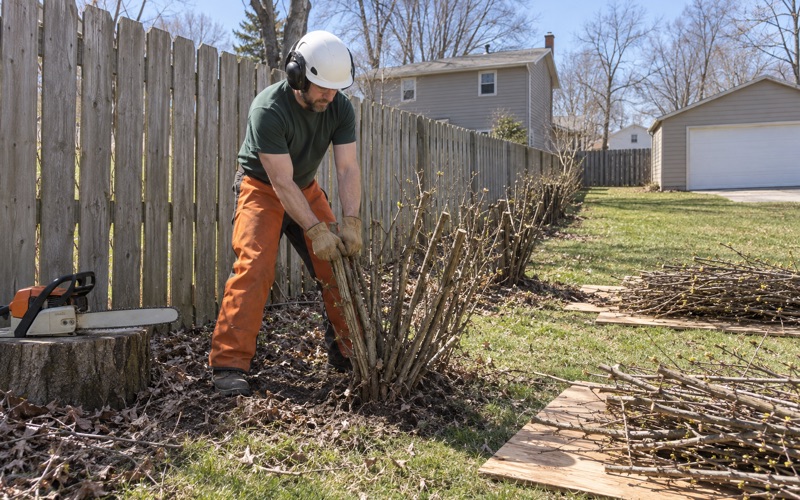
Curbside yard waste is a subscription through Republic Services — a 95-gallon cart from April through December, then brown paper bags only between December 15 and March 15, with bulky wood bundled in four-foot lengths under 40 pounds. None of that absorbs a removal, and a pile left at your curb is a pile the city is entitled to refuse. Our debris leaves with us on the same trip, and you know before the first cut whether the wood is going to a composter, onto a firewood pile or through the chipper.
Every regional outlet in this market prices brush by the cubic yard, by vehicle size and by origin, and not one publishes a per-ton yard-waste rate. A ground stump has effectively no commercial outlet here at any published price, which is precisely why grinding rather than pulling is the economical answer on a Liberty stump.
- 20+ Years in the KC Metro
- Free On-Site Assessment
- Written Price, Insured Crews