Blue Springs Tree Removal has been handling tree removal in Merriam for more than twenty years, working both sides of the state line out of the same shop. Kansas jobs are not Missouri jobs with a different ZIP code, and the paperwork proves it. What a homeowner owes, who signs off on a curb-strip tree, and where the wood is allowed to sit all change here.
Most cities in this metro write their tree rules as a list of things you may not do. Merriam wrote its as a thing you must do, and that single inversion reorders the whole conversation about a dead oak in a back yard. There is no application to file and no waiting period to plan around.
So the estimate we hand you starts with the code that actually governs your address, then the condition of the tree, then a written number you can hold us to. Everything below is what we tell Merriam homeowners before a saw leaves the truck.
Merriam asks you to remove the tree, not for permission to remove it
Article VII of Chapter 47 of the Merriam Code of Ordinances runs eight sections, and not one of them creates a removal application, a fee schedule or a review step. What it creates instead is a responsibility. Section 47-248, adopted in February 1997, reads that property owners and occupants of private property shall be responsible for the removal and proper disposal of dead trees and tree limbs.
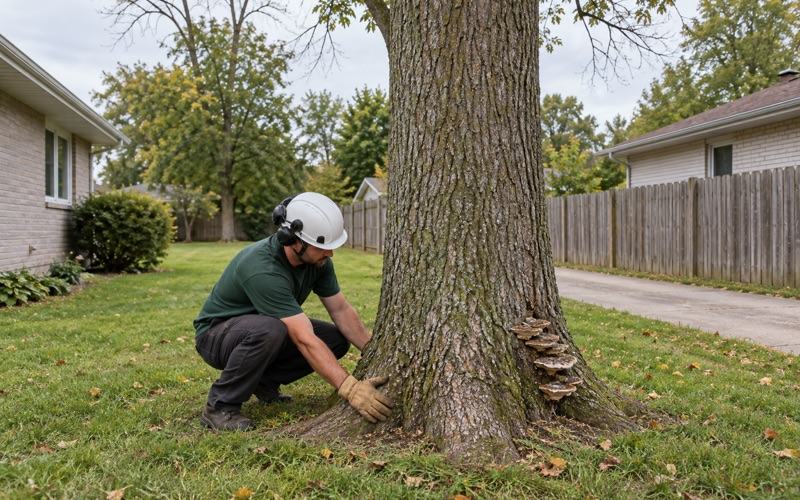
The city says the same thing in plain language on its own codes page: property owners are responsible for tree maintenance on their private property and trees located in the adjacent right of way areas, and dead trees or fallen limbs must be removed from the property. Tree work is not among the activities Merriam lists as needing a building permit. So the question a Merriam homeowner is really asking is not whether they are allowed to take the tree down, but whether they are already late.
The curb-strip tree is yours to work
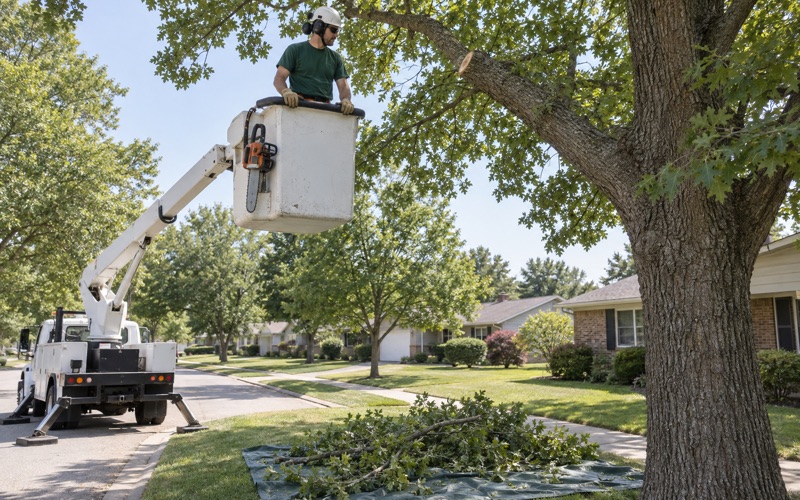
Section 47-223 lets an owner whose property abuts a city right of way, easement, alley or park prune, spray, plant or remove trees in the abutting portion not used for public travel. Written approval from public works and parks and recreation is required only to deviate from the standard, not to do the work. That is worth knowing before you pay anyone to chase an approval that Merriam does not ask for.
The reverse case has teeth. When the city itself proposes to take a right of way tree, Section 47-246 requires at least thirty days of written notice by certified mail or personal delivery, naming the property, the tree, the reason and the relocation options, with a right to a hearing before city council. The abutting owner ordinarily carries the cost, payable within thirty days, and an unpaid amount becomes a lien. Vegetation interfering with a utility is the utility’s to handle at no cost to the city or the owner.
Looking for tree-removal closer to Richmond? See Tree-Removal in Richmond.
The firewood proviso, and what the wood haul is worth
The same section that puts the duty on you also protects one thing explicitly. Section 47-248 adds that nothing in it prohibits the storage of firewood in compliance with the code, then sends tree limbs and other yard waste to the solid waste chapter for disposal. That proviso is written into Merriam’s own ordinance rather than inherited from anywhere else, so we confirm the storage rule for whichever address we are quoting instead of assuming this one travels.
Keeping the rounds matters because the wood haul is a priced line, not a courtesy. On one job three independent bids came in at $12,400, $7,500 and $4,700, and all three priced the wood haul at $3,000. What drives that number is carry distance rather than species value, so a trunk twenty feet from a driveway and the same trunk behind a house are two different prices. We tell you which way that credit runs on your job before the saw comes out of the truck.
Where the brush and the wood actually go
Merriam’s spring tree limb pickup is written with a minimum rather than a maximum: any tree limb or brush larger than a pencil will be collected. Weekly yard waste under the city’s contracted hauler runs to ten bags, bundles or rigid containers, with two amnesty weeks and up to three bulk items a month, and large item pickup falls in the third full weeks of April and October. City collection starts through GFL Environmental on November 1, 2026 at $22.87 a month for 2027, and the charge appears on the property tax bill rather than as a separate invoice.
Behind the curb there is nowhere close to put a log. Johnson County runs no public yard waste gate, so removal wood from this side crosses the state line to Missouri Organic Recycling in Kansas City, Missouri, at $10.00 a cubic yard for brush and $7.00 for lawn debris. That yard takes logs up to 40 inches in diameter if they are under five feet long and refuses stumps with dirt still on them, which is why our grindings and our stumps are handled differently from our wood.
One case cuts against the firewood proviso, and we say so out loud. K-State’s pine wilt guidance tells a homeowner to cut an infected pine to the ground with no stump left, to chip or burn the wood immediately, and not to save it for firewood, with removal done by May 1 and better by April 1. Merriam’s code permits the storage and the disease guidance asks you not to store it, and neither document resolves the other. On a pine we handle the wood as the pathology asks and tell you why the usual credit does not apply.
A 1960s and 1970s city, and what that puts in the drop zone
Merriam holds 5,537 housing units on 4.317 square miles, which works out to 1,283 units per square mile, and 59.62 percent of them are one unit detached against 40.07 percent attached or multifamily. The addressable yard count is narrower still: 2,933 owner occupied single family detached homes, with owner occupancy at 60.74 percent overall. Only 24.92 percent of the stock predates 1960 while 68.58 percent predates 1980, and the two heaviest cohorts are the 1960s at 24.90 percent and the 1970s at 18.75 percent.
That mix puts two different jobs on the same route. On the older half we are taking down trees planted with the first houses, often over a roof line and often needing rigging rather than a felling cut. On the newer half, where 27.76 percent of the stock went up between 1980 and 2009, we are doing first cycle removals of trees that came with the subdivision and have reached the age their weaknesses show.
The Johnson County Extension Master Gardeners brochure for metropolitan Kansas City is blunt about which of those trees they are. It refuses Silver Maple, Pin Oak, Green Ash, Box Elder, Bradford Pear, Siberian Elm and Willow among others, warns that many fast growing varieties are brittle with narrow crotch angles that can lead to severe breakage during storms, and says plainly not to plant the Bradford cultivar because severe splitting occurs on 10 to 15 year old trees. Those pears are decades past that window here, and the co-dominant stems with included bark that split them are the same defect we assess on every job.
What limits the work is the chipper, not the saw
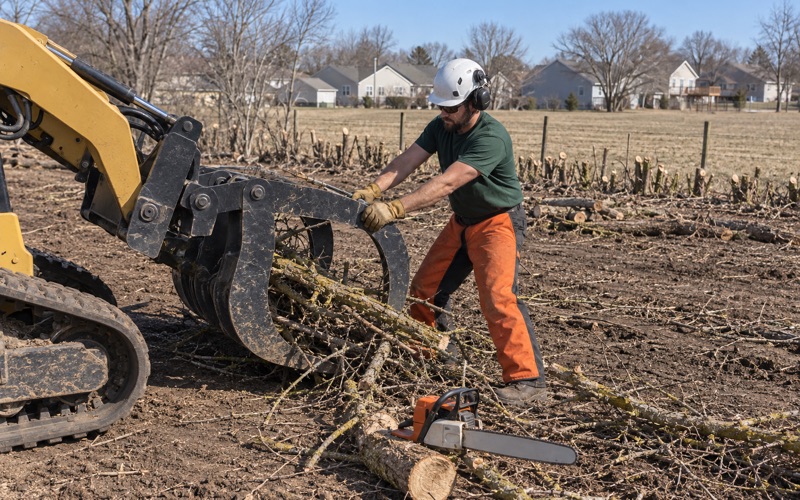
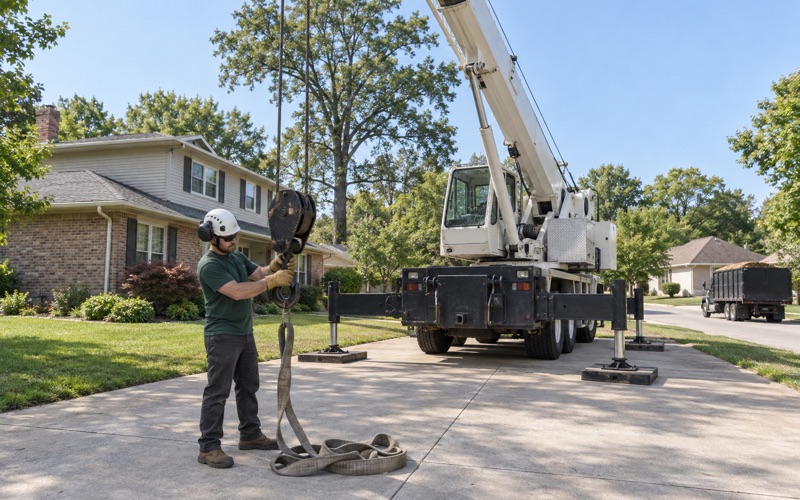
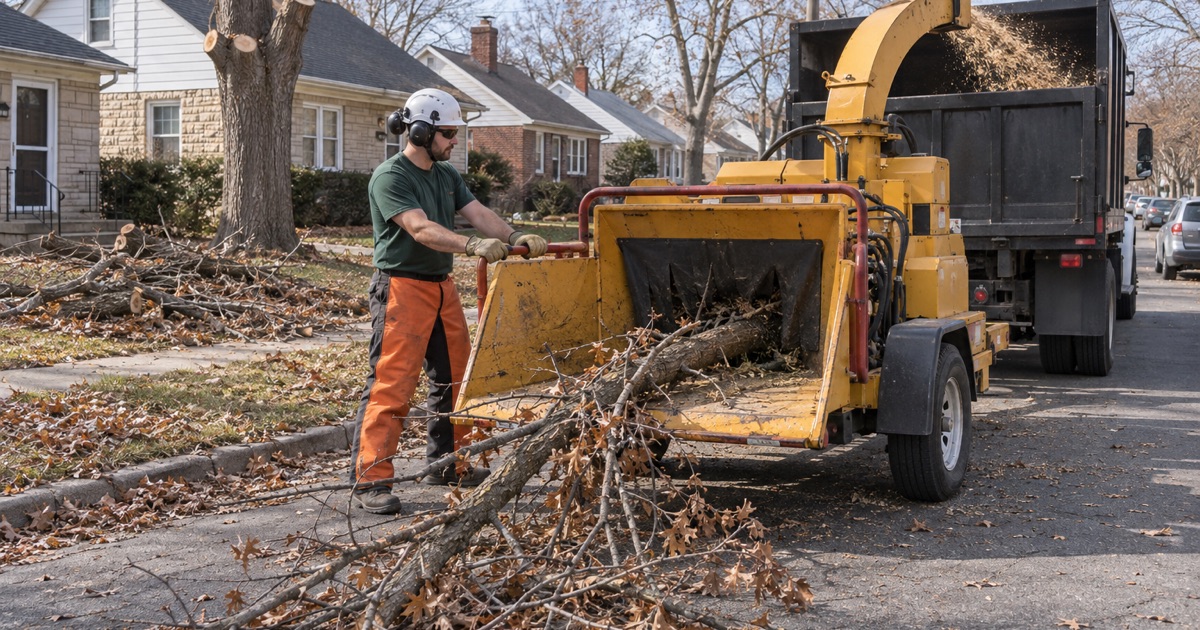
A compact stump grinder fits through a 35 inch gate and a pedestrian gate machine through 25 inches, but a full size chipper is nearly eight feet wide and weighs more than five tons, so it never leaves the driveway. Back yard pricing is therefore a brush handling and carry distance question before it is a cutting question. Along the Turkey Creek valley and next to Antioch Park the approach is often narrower than the yard suggests, and we walk it before we quote it.
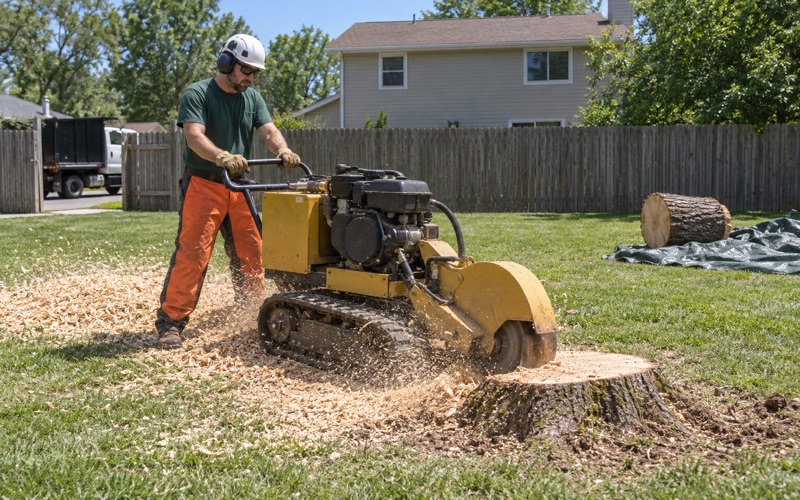
Below grade there is a second unknown. The Johnson County soil survey puts several mapped series within a foot or two of rock, with Vinland at 10 to 20 inches to a paralithic contact and Sogn at 4 to 20 inches to lithic bedrock, while others carry no bedrock restriction at all. A stump grinder tooth wheel cuts roughly 12 to 25 inches below grade depending on machine class, so on the shallow series the rock stops the wheel before the machine’s own limit does. Which series sits under your parcel is not something anyone should promise before seeing it.
Lines, storms and the tree on the property line
Evergy Kansas Metro serves this side and answers to the Kansas Corporation Commission, which adopts the National Electrical Safety Code by reference and publishes no vegetation management plan, so the trim cycle here is not a public document. Evergy treats the service drop from the pole to your meter as the customer’s responsibility, evaluates requests by inspection, clears all limbs within ten feet of energized conductors on an assist, and leaves the debris at the worksite. Section 47-246 sends utility interfering vegetation to the utility at no cost to the city or the owner, which is why the line gets cleared and the mess is still standing in the yard when we arrive.
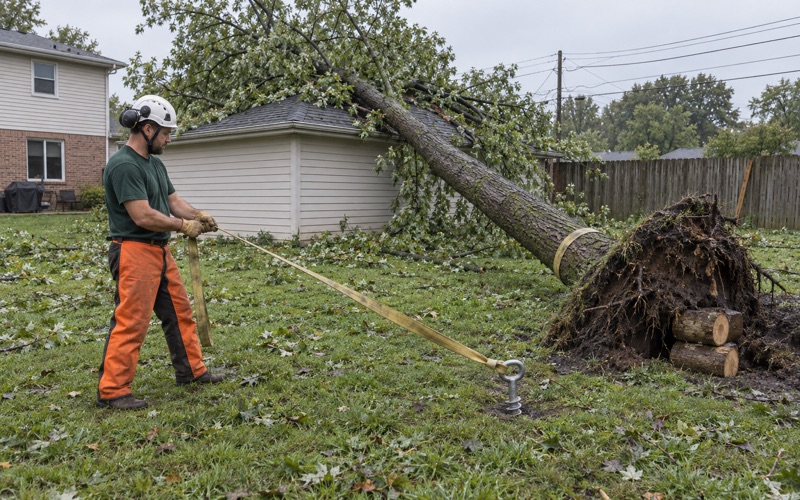
Nobody works a tree in contact with a primary conductor, and nobody works one during the storm that brought it down. ANSI Z133 forbids work near energized conductors in thunderstorms, high winds, snow and ice, and the ten foot standoff at 600 to 50,000 volts is not negotiable. The National Weather Service office that forecasts for this area logged an 89 mph wind storm across the metro on July 14, 2023 that left roughly 200,000 customers without power and about 60,000 still out the next day, and that is the kind of morning when the fastest available crew is the wrong crew.
The neighbor’s tree, on this side of the line
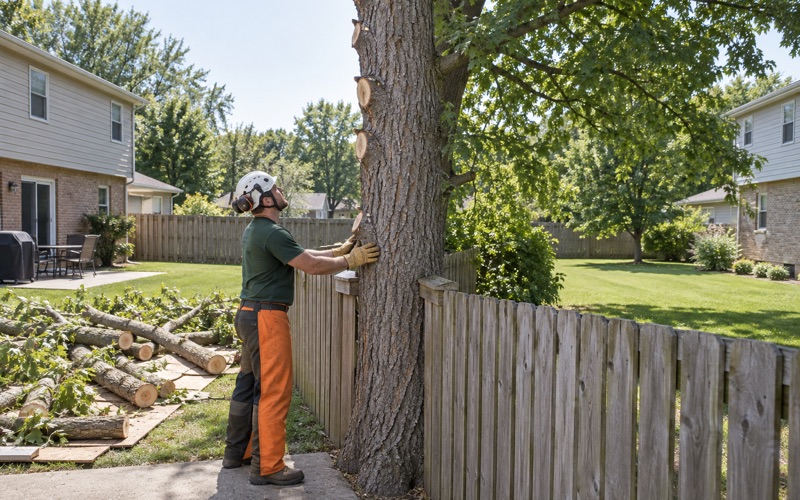
Kansas answers the overhanging branch as a nuisance question rather than a property one. A 1985 Kansas Court of Appeals decision held that branches doing substantial harm or creating imminent danger make the tree a nuisance the neighbor can compel the owner to abate, and in that case the court ordered the tree taken out at the base. Short of that, self help stops at the property line, with no right to enter and no easement earned in the airspace over time. That answer changes if you cross into Missouri, which is the single most common thing we correct on a first phone call.
Every Merriam estimate we write comes with a condition assessment in writing, proof of insurance sent to you before a crew arrives, and a plan for where the wood, the brush and the grindings are going. We do not top trees, and if cabling or a reduction saves the tree we price that instead of a removal. Call 811 before anything is ground, and call us for the free on site look; the number you are quoted is the number in writing.
- 20+ Years in the KC Metro
- Free On-Site Assessment
- Written Price, Insured Crews