Blue Springs Tree Removal handles tree removal in Mission with more than twenty years of work behind us on both sides of State Line Road. What changes about a Mission job is not the saw work but the line the city drew in late 2024 around trees near a property boundary. Most of the trees people call us about here stand within a few feet of a fence, and that is precisely the tree Mission wrote a rule for.
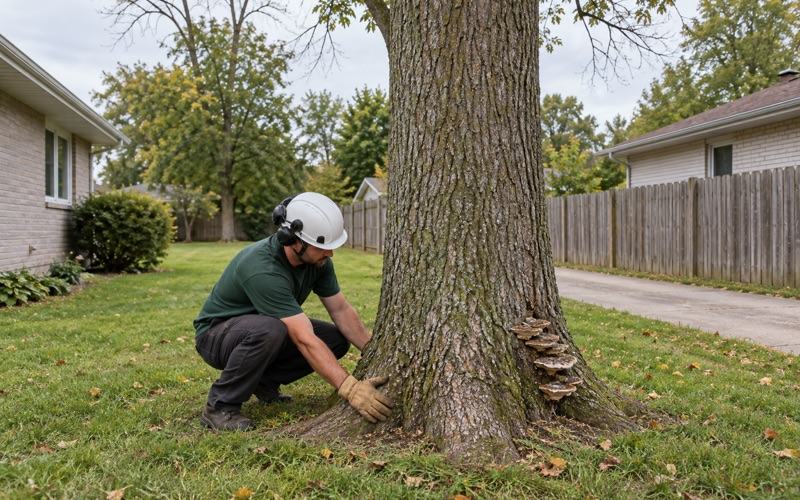
We come out, look at the tree, and put a written condition assessment and a fixed price in your hands before anything is cut. That quote says where the wood and the brush are going, because in Mission the disposal question has a legal edge to it. Proof of insurance reaches you before a crew sets foot on the property.
If the tree can be held with cabling or corrective pruning instead, we will price that and say so. We do not top trees, and we will explain why when someone offers to.
What Mission’s 2024 tree ordinance actually reaches
On November 20, 2024 the City Council adopted Ordinance 1617, which deleted Chapter 240 of the municipal code in full and replaced it with a new chapter on trees and shrubs. A companion ordinance rewrote the nuisance definition in Chapter 220 the same night. Both matter to a removal, but they work in opposite directions, and confusing them is how a homeowner ends up worrying about the wrong thing.
The tree protection machinery in Article IV opens with a construction condition. Section 240.460(A) applies its procedures prior to demolition or construction for a new commercial project or significant changes, and Section 240.460(B)(1) requires a tree protection and removal plan before a permit issues for a new commercial or significant residential project. On a finished, occupied lot with no project underway, that machinery never starts.
The five categories of protected tree
Where a project does trigger Article IV, Section 240.460(C) sorts protected trees by size and location. Every tree of any size in the public right-of-way is protected, as is any tree over 4 inches DBH within 20 feet of the front lot line, any tree over 6 inches DBH within 10 feet of a non-street property line, any tree over 8 inches DBH outside the buildable area set by the setbacks, and any tree over 12 inches DBH inside it.
DBH is diameter at breast height, measured at four and one-half feet above the ground, and it is the number that decides which rung a tree lands on. Mitigation is priced per caliper inch and rises with the tier, from a 1 for 1 replacement under 4 inches to full replacement of every inch at the top, with fees in lieu running $100.00 to $400.00 per inch. Replacement trees have to be at least 2.5 inches caliper and drawn from the species list the Parks, Recreation and Tree Commission keeps.
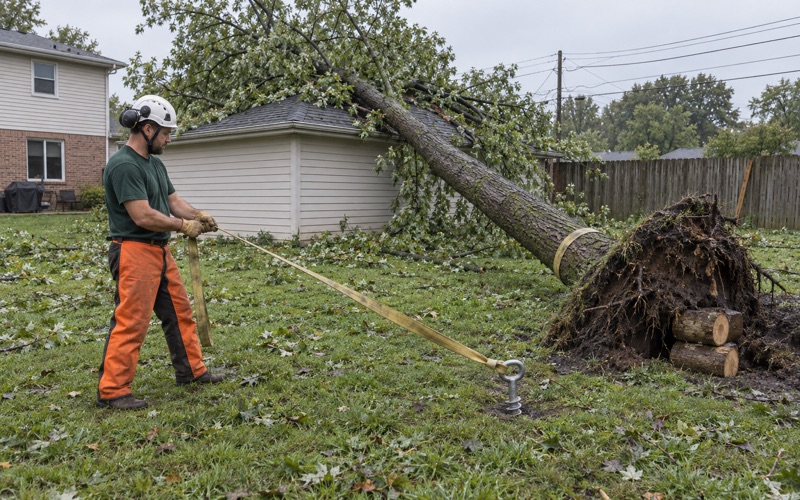
The ordinance also writes in its own storm answer: mitigation may be waived or reduced for trees destroyed by an act of God, trees that die in ordinary conditions, or trees that reached the end of their useful life through no act of the owner. That clause is worth knowing before a windstorm sends anyone into a panic about replacement costs.
Looking for tree-removal closer to Gladstone? See Tree-Removal Services in Gladstone.
The tree on the line, and who can do what to it
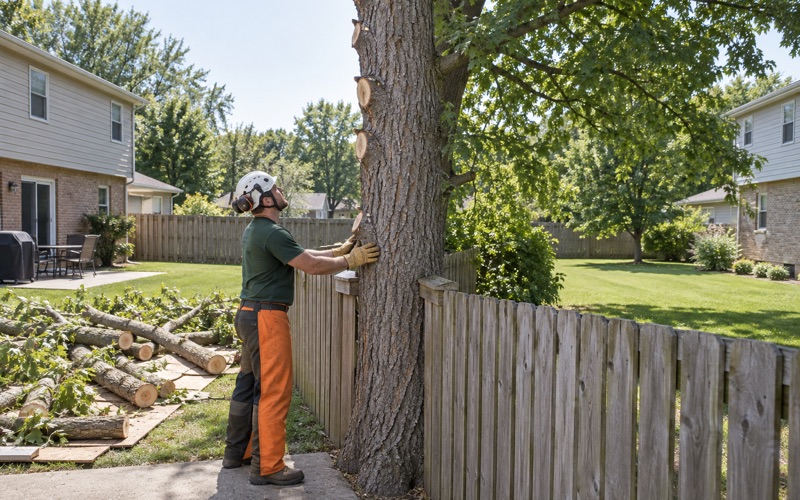
Item three of that ladder is the one worth stopping on. A ten-foot band runs along every side and rear property line, and inside it any tree over 6 inches DBH is protected. That is the exact tree two households argue about, and Mission put it in the code.
Kansas and the overhanging branch
Kansas follows what lawyers call the Hawaii rule. Branches doing substantial harm or creating imminent danger make a tree a nuisance the neighbor can compel the owner to abate, a rule the Kansas Court of Appeals set out in Pierce v. Casady, 711 P.2d 766 (1985).
In practice that means a homeowner may cut back to the property line and no further, and cannot step across to do it. It also means a tree left to decline over a fence line is a liability that grows, not a stalemate. We measure DBH, write down what we see, and give both households a document they can act on.
What that changes about a quote
Before we price a boundary removal we work out whose tree it is, whether a project is in play, and whether the trunk sits inside that ten-foot band. On a finished lot with no construction, none of it stops the work; on a lot heading into a build, the same tree carries mitigation and belongs in the plan before the permit stage. Our written assessment says which case you are in, in plain language, so nobody discovers it later.
Who actually signs off on a tree here
Mission is not a city of owner-occupied houses with big yards, and pretending otherwise gets a quote wrong. About 53.88 percent of the housing units are attached or multifamily, 44.91 percent are owner-occupied, and the entire city holds only 2,159 owner-occupied single-family detached houses. The person deciding about a tree here is very often a landlord, a property manager or a board member rather than the person living under it.
That changes the conversation from one tree to a portfolio. An owner with buildings at four addresses is exposed at four addresses at once, on a schedule rather than an emergency, and usually wants the condition of everything on the ground before choosing what comes down this year. We are set up to walk a whole property list, price it line by line, and stage the work across a season.
Two housing stocks, two access problems
The building stock splits in two. The peak decade was the 1950s at 27.73 percent of units, and 36.24 percent of everything here predates 1960, which is the detached half with mature trees planted close to the house. The 1980s and after brought the multifamily half, at 31.14 percent built between 1980 and 2009, and those sites come with parking, fences and narrow service gaps instead of open yards.
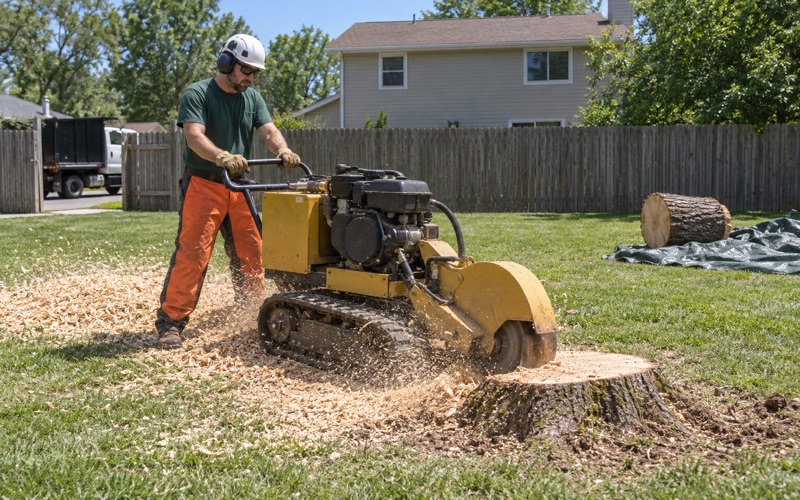
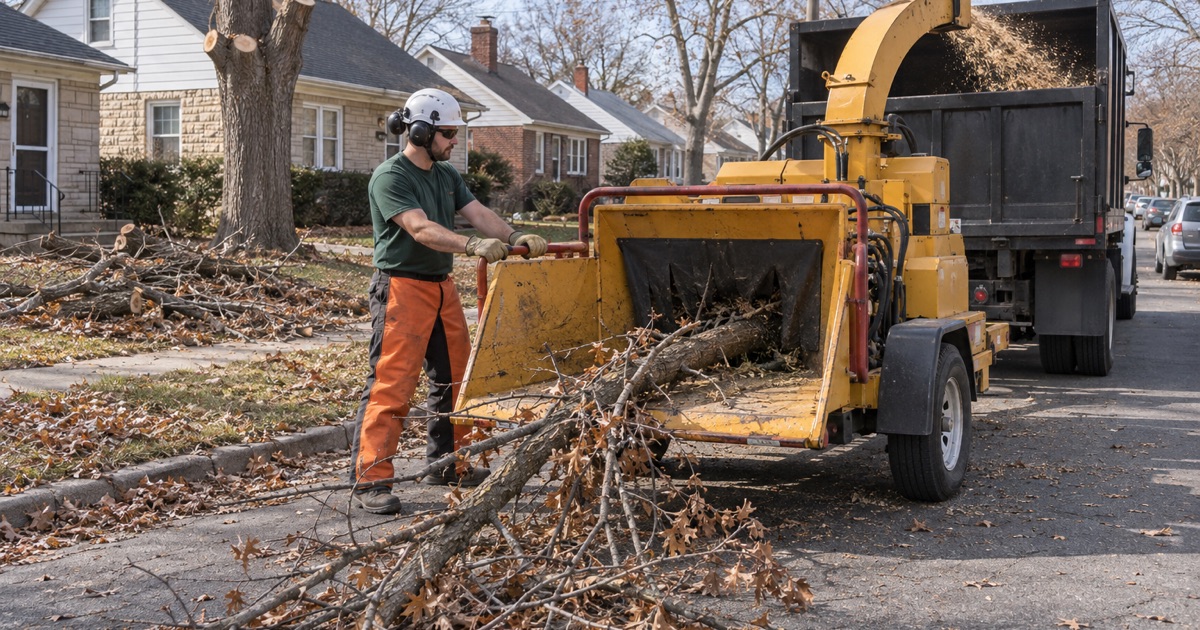
At roughly 2,140 housing units per square mile, access is the physical spine of the job on many of these lots. The chipper is usually the binding constraint rather than the grinder: a compact stump grinder can get through a 35-inch gate and a pedestrian-gate machine through 25 inches, while a full-size chipper is nearly eight feet wide and weighs several tons. Carry distance is the other number, since every foot between the drop zone and the truck is paid labor, and it is why the wood haul shows up as its own line on our quote rather than as a favor.
What stands on every parcel, and where the wood goes
The nuisance chapter is the standing obligation, and it does not wait for a project. Subsection (A)(6) of Section 220.010 makes an unlawful nuisance of all dead trees, dead shrubs, diseased trees or diseased shrubs on any property, whether vacant or occupied. A dead tree in Mission is a code question the day it dies, whether or not anyone has complained.
Enforcement runs through Article III of the tree chapter. It takes a written statement from a competent City, State or Federal authority resting on a laboratory test or other supporting evidence, after which the Code Enforcement Officer issues notice giving not less than ten days to treat or remove. If the work is not done the City can do it and assess the cost, which the City Clerk certifies to the County Clerk to be extended on the county tax roll against the parcel, with a ten-day written appeal to the Governing Body available.
The species Mission will not let you grow
Section 240.250 does something unusual: it names ten groups of trees that may not be planted or grown inside the city limits. The list covers most elms, tree of heaven, boxelder and silver maple, the entire ash genus, Bradford pear, Austrian and Scotch pine, silver and Lombardy poplar, cottonless cottonwood, European white birch and willows. The operative words are or grown rather than merely planted, which puts an existing silver maple, ash, Bradford pear or Austrian pine on a list the code says may not be grown here.
That list tracks the Johnson County Extension master gardeners’ guidance for metropolitan Kansas City almost line for line, which refuses silver maple for weak wood, green ash for emerald ash borer, and Austrian and Scotch pine for disease, and says plainly not to plant the Bradford cultivar because severe splitting occurs on 10 to 15 year old trees. Penalties under the tree chapter run to a fine of not more than $1,000 or six months in jail, with each day a violation continues counting as a separate offense.
Brush, wood and the two-inch curb rule
Subsection (A)(1) of the same nuisance section makes tree limbs and wood left deposited on any lot, vacant or occupied, an unlawful nuisance too, so a pile cannot simply stay behind. The city’s published yard-waste rules are strict about what the curb will take: limbs less than 2 inches in diameter, bundles tied with string or twine no more than four feet long and 18 inches across, nothing over 40 pounds, a ten bag or bundle limit, and no plastic bags. Other city communications have circulated looser figures than the published page, and we work to the page.
A removal produces wood no curbside program in this county was built for. Johnson County operates no public yard-waste gate and its landfill caps landscape waste at 3 inches in diameter, so removal wood crosses back into Missouri to Missouri Organic Recycling in Kansas City, which takes brush by the cubic yard and logs up to 40 inches in diameter under five feet long. That is why our quote names the destination before the saw comes out of the truck, and why nothing is stacked at your curb for the hauler to refuse.
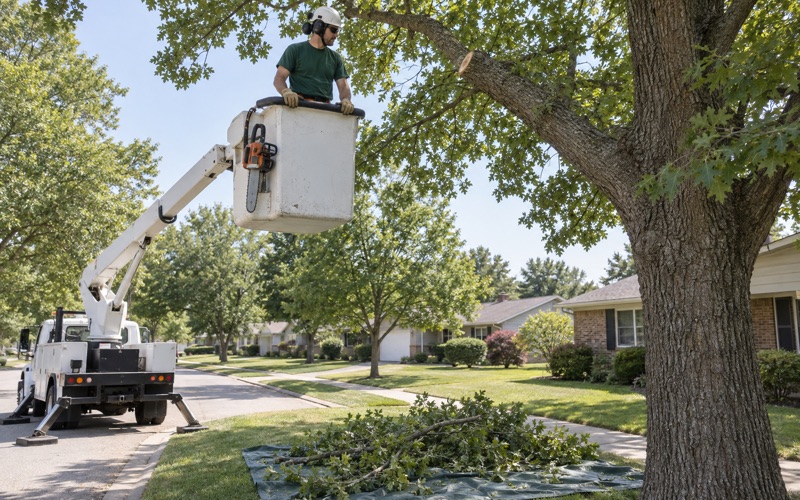
One more seam belongs in the quote. Section 240.270 puts care, trimming and removal inside a utility easement on the property owner, lets the operator trim or remove without notice and without liability for the loss, and makes debris left behind after that work the owner’s to clear. Evergy Kansas Metro publishes the same practice from its side, removing limbs within ten feet of energized conductors and leaving any debris at the worksite, and it treats the service drop from pole to meter as the customer’s. We clean up after that kind of visit, and we do not go near an energized primary line, which is the utility’s call and nobody else’s.
- 20+ Years in the KC Metro
- Free On-Site Assessment
- Written Price, Insured Crews