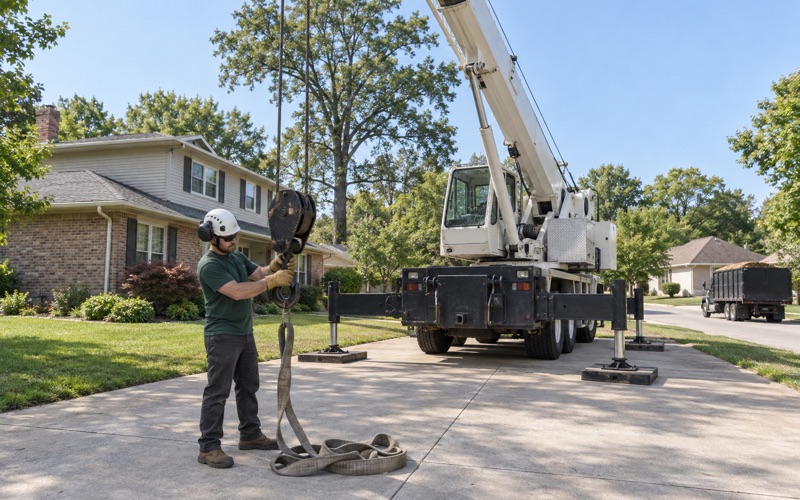
Blue Springs Tree Removal has more than twenty years behind it, and tree removal in North Kansas City is the job we quote most carefully in the whole metro, because this city requires a permit before almost any tree comes down. Not just on a development site. A three-inch trunk in a fenced back yard is inside the ordinance, and so is the crew that cuts it.
That changes what a quote from us has to include. Before we price a removal here we establish which permit path the job sits on, who is going to sign the application, and what the city will want to see about the tree’s condition. It is paperwork that happens before the truck is loaded, not a form someone fills in afterward.
We work Missouri and Kansas, so we are used to the answer changing when you cross a line on a map. This city is the sharpest version of that anywhere we work, and getting it wrong is not a warning letter—the ordinance calls an unpermitted removal a public nuisance and names the person who did the cutting.
The permit that covers a back-yard tree, not just a job site
The city council passed Ordinance No. 8446, Bill No. 6647, on February 23, 2010, adding Chapter 15.60, Vegetation, to the city code. Article I of that chapter is cited in its own text as the City Tree Preservation and Tree Abuse Ordinance, and it is short, plainly written and much broader than people expect.
Section 15.60.020 sets the reach in one line: the article applies to all real property located within the city limits, except as provided in the article itself. There is no acreage trigger and no exemption for a single-family lot. Section 15.60.030-B then states that a person shall not cause, suffer, permit or allow the removal of any tree without first obtaining a permit from the city.
What counts as a tree at three inches
The definition does the work. Chapter 15.60 defines a tree as a woody perennial with a DBH of no less than three inches that normally grows to at least ten feet overall in Northwest Missouri, and diameter at breast height is measured four and one-half feet above natural grade. On a multi-trunk tree the code sums the individual trunk diameters, so a clump of volunteer stems clears the threshold long before anyone would call it a shade tree.
Removal is defined just as widely: to cut down, dig up, destroy, effectively destroy, or the unlicensed relocation of any tree. Effectively destroy reaches acts that put a tree into unnatural decline within a year of the act, including root damage from heavy machinery, excessive trimming, a grade change over the root system, or a trunk wound of fifty percent or more of the circumference. That is why we do not top trees here or anywhere else, and why we will say so plainly when someone else offers to.
The fee, and when a survey is not required
The permit is not the expensive part. The published fee table charges $20.00 where the cost of work is up to and including $5,000, and $40.00 from $5,001 and up; the filing fee is non-refundable and cannot be applied to another application. A certified tree survey sits on the document list, but the code carves out the ordinary job: in no case is a survey required when five or fewer trees are removed from the property within any twelve-month period.
Section 15.60.035-B closes the gap that catches most homeowners: any land activity that does not require a site plan or a building permit still has to obtain a tree removal permit. Removing a dying silver maple involves no building permit at all, which is exactly why people assume there is nothing to file. Applying also carries a consent term, since the application is treated as the owner’s consent for the city to inspect the property.
Looking for tree-removal closer to Fairway? See Tree-Removal Services in Fairway.
The hazard exception is only good if you documented it first
Section 15.60.040 lists the exceptions to the permit, and number four is the one that matters on a dead or leaning tree. It exempts removal of any tree that is diseased, injured or in danger of falling, to the extent that its continued existence threatens the health or safety of contiguous persons or property—provided that the owner can document that the condition existed prior to the removal of the tree.
Read the proviso rather than the exception. The tree is exempt only if the owner can prove afterward what it looked like beforehand, and once it is on the ground and through the chipper the only evidence that will ever exist is what somebody recorded first. A hazard nobody photographed is, from the city’s side of the counter, indistinguishable from a healthy tree somebody wanted gone.
What we record before the saw comes out
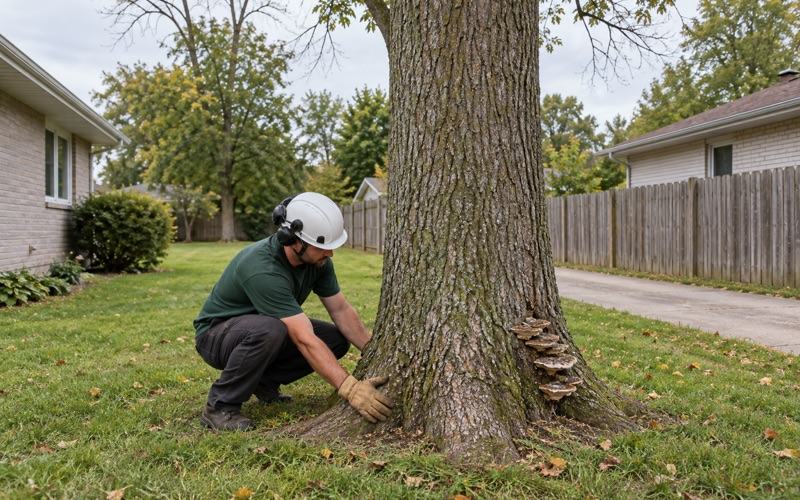
This is why every job here starts with a written condition assessment rather than a number scribbled on a card. We photograph the tree from several angles including the root flare and the failure point, note conks, heartwood decay, included bark at a co-dominant union, epicormic sprouts or a lifting root plate, and date the whole record. A tree risk assessment written down before the work is what turns an exempt removal into a defensible one.
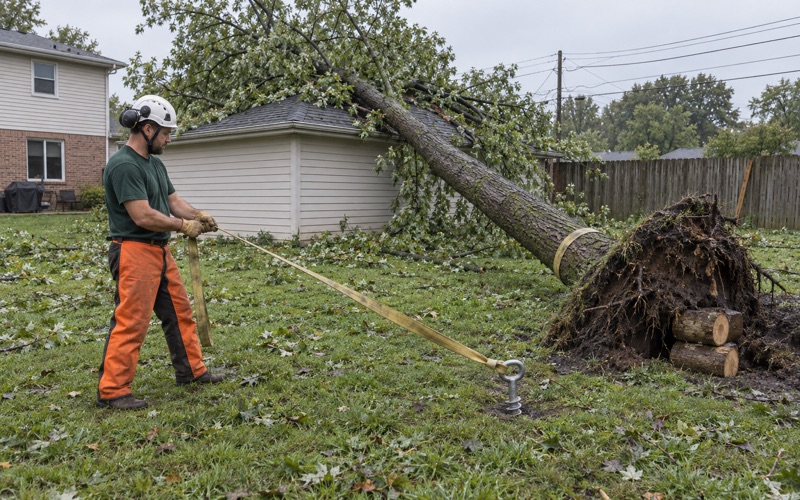
The other exceptions are narrower than they sound. They cover city-owned property, state highway department property and right-of-way, a public utility working inside its own easement or right-of-way, and a suspension of the whole article by direction of the mayor during emergency conditions caused by a tornado or other disaster. Note the shape of that last one: after a bad storm the article can be suspended, but only the mayor can suspend it, so no crew should assume it has happened.
When a tree is already on a roof, a car or a line, the order changes. A conductor on the ground or a limb bridging conductors is a 911 call and then the Evergy outage line, because the city does not operate the electric system and cannot de-energize it; a fire or a burn permit goes to North Kansas City Fire Prevention at (816) 274-6025, not to a department across the river. We respond the same day on that kind of call, and the documentation the ordinance wants still gets made on the way in.
The cutter is liable too, which changes who you should hire
Most municipal tree rules put the whole exposure on the property owner. This one does not: 15.60.030-B makes the property owner, the owner of an easement and the person removing a tree without a permit each responsible for the violation, and calls the removal itself a public nuisance. A contractor who cuts first and asks later is not exposing only the customer.
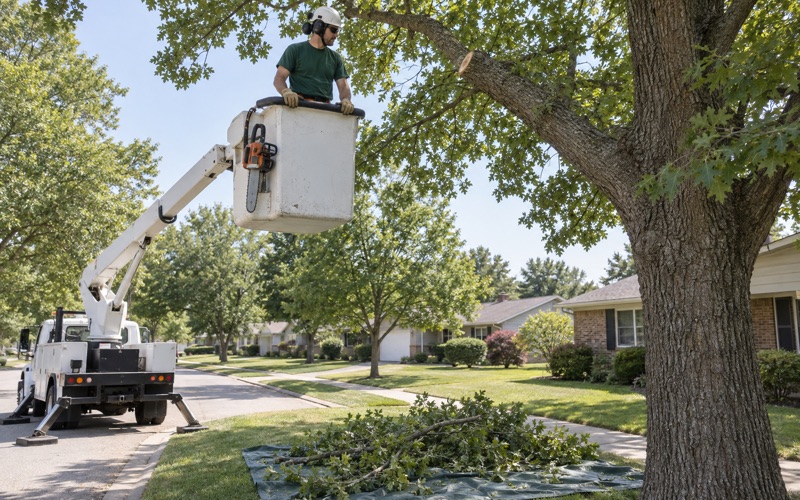
It also shapes the trimming conversation. Because the code’s own definition of removal includes effectively destroying a tree, a hard cut back on a neighbor’s overhanging limbs can be an unpermitted removal here even though state law lets an owner cut to the property line at their own cost. We prune to the ANSI A300 standard and work to ANSI Z133 on the safety side, which keeps a boundary job inside natural target pruning instead of the kind of cut the ordinance describes.
Who signs the application in a city of renters
The housing here is not what a tree service usually assumes. Census estimates for the city put 74.06 percent of occupied units in the hands of renters, with only 633 owner-occupied detached houses in the whole city, so the person calling us is often a property manager or an owner’s agent rather than the owner. The code anticipates that: an application may come from the fee simple owner, the owner’s agent, a lessee, an optionee, a contract purchaser or the holder of an easement.
That matters after the removal as well. Trees taken down and not relocated have to be replaced so there is no loss of total caliper inches, performance bonds may be required, and the permittee stays responsible for the health of each replacement for a year, with a condition determination submitted to the city at the end of it. We tell you that obligation exists while we are quoting, because it belongs in the budget rather than in a letter twelve months later.
Levees, the Corps, and what happens to the wood
Section 15.60.050-A raises the bar near water. On any property adjacent to a levee, drainage ditch, stream, creek or tributary, a tree may be removed only when the applicant has demonstrated to the city that the proposed development cannot be located on the site without removing it and that there is no practical way to avoid the removal. That is a proximity test, not a zoning one, and it applies to lots that look ordinary from the street.
Clearing a lot outright is a separate permit under Article II of the same chapter, and it is a different order of project. The application has to include a letter from the North Kansas City Levee District stating that no levee is affected, or a Levee District permit where one is, and for any clearing greater than one-half acre affecting a levee it also has to show permit approvals from the Army Corps of Engineers. The clearing permit itself costs $500.00 per acre or fraction thereof, on top of a tree preservation plan, a hazard evaluation of the trees that stay, erosion control and a runoff analysis.
River-bottom ground and the stump
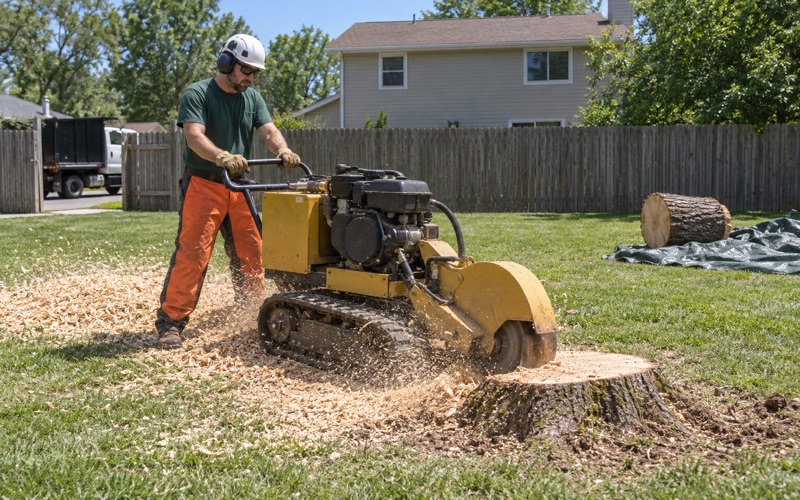
The levee clause is in the tree code because this is river-bottom ground; the mapped ecoregion under the city is the Missouri Alluvial Plain. For stump work that usually means the grinder’s own geometry is the limit rather than rock, since a wheel rated somewhere between twelve and twenty-five inches below grade is nowhere near the depth of the alluvium under it. We still do not promise a below-grade cut depth on a lot we have not seen, because the alluvium was never confirmed uniform across the city and a floodplain water table is a real variable on its own.
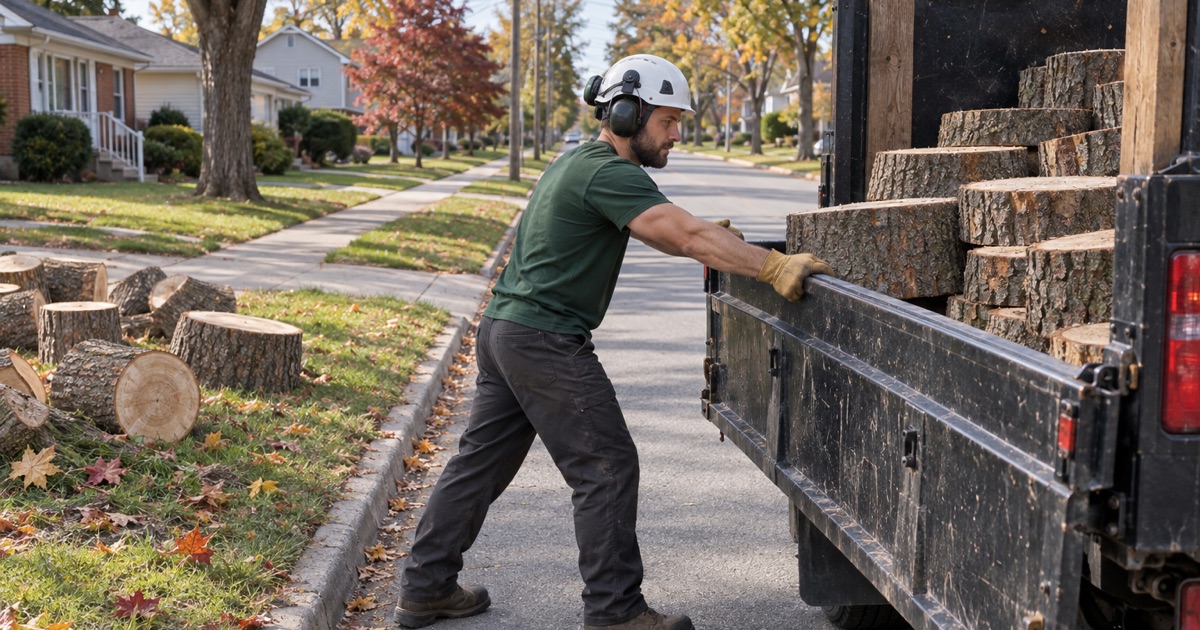
Debris is settled before the truck loads, not after. The wood and the brush leave with us and go to a commercial composting gate, because Missouri law bars yard waste from a solid waste disposal area and a compost yard is the only outlet in reach; the nearest one takes logs up to forty inches in diameter if they are under five feet long, and refuses stumps carrying dirt and rock. Nothing is stacked at your curb for the weekly Tuesday collection to refuse, and we call in an 811 utility locate through Missouri One Call before any stump grinding or root excavation.
- 20+ Years in the KC Metro
- Free On-Site Assessment
- Written Price, Insured Crews