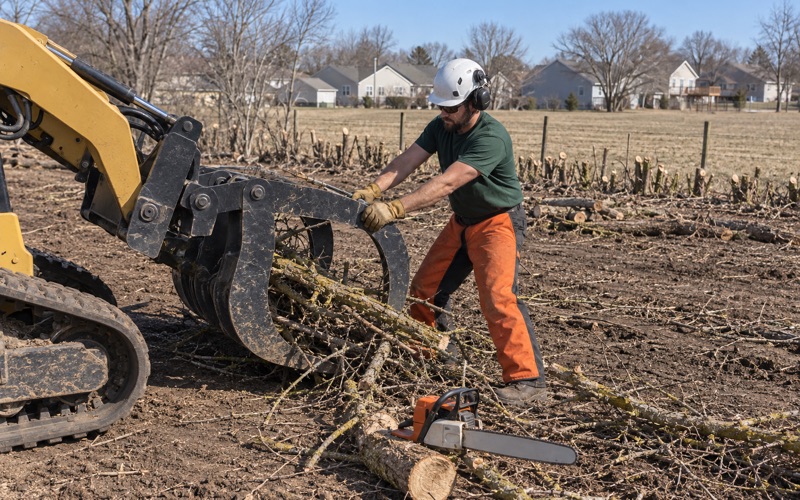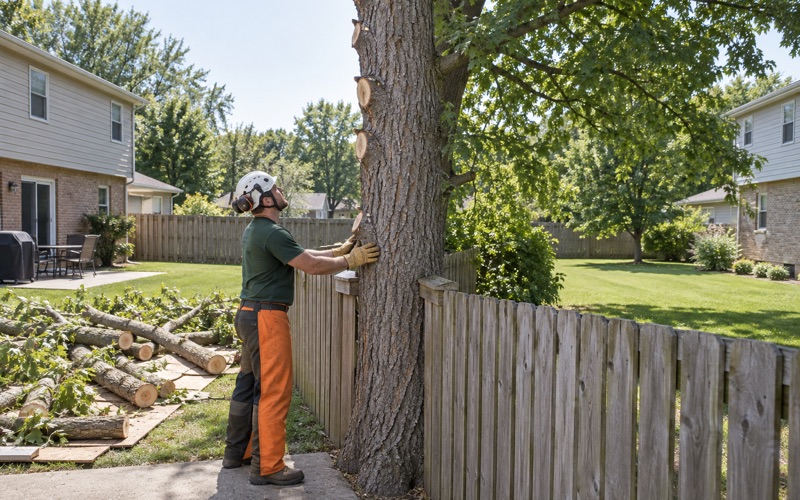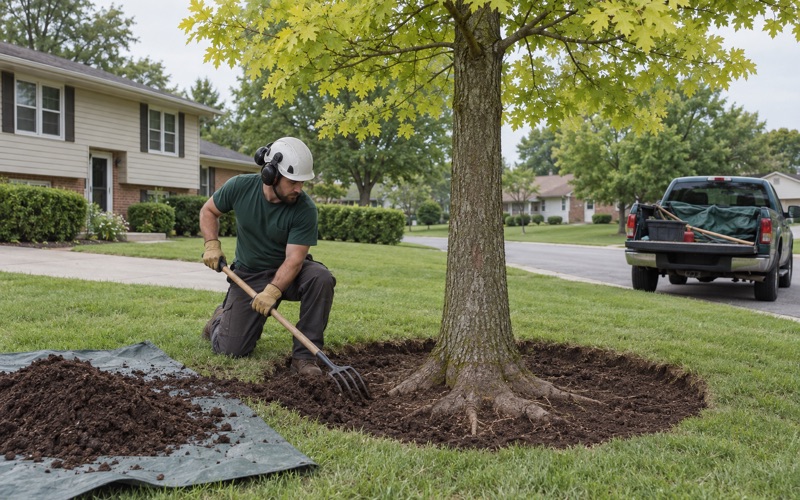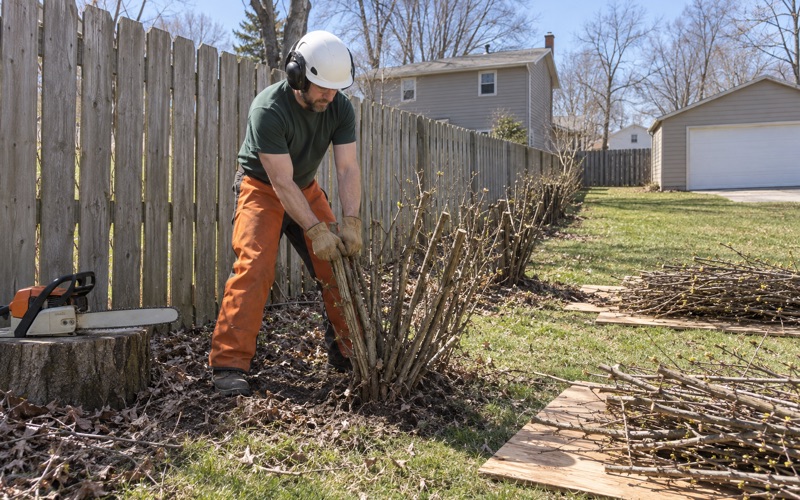
Blue Springs Tree Removal handles tree removal in Oak Grove with more than twenty years of taking trees down across the Kansas City metro behind it, on both sides of the state line. That range matters more than it sounds like it should: the answer to a leaning silver maple over a shared fence is not the same in Missouri as it is a few miles west in Kansas, and we deal with both answers every week.
Every job here starts with a free on-site assessment and ends with a written condition assessment rather than a number scribbled on the back of a card. You get the scope, the sequence and the price in writing, and the price you were quoted is the price you pay.
We also tell you where the wood and the brush are going before the saw comes out of the truck, which turns out to be a real question in this city and not a courtesy line. And if a tree can be kept standing with cabling or a season of proper pruning, we will say so and price that work instead.
The soil series of this whole area is type-located at the north edge of town
The USDA Natural Resources Conservation Service writes an Official Series Description for every named soil, and each one is anchored to a single sampled profile somewhere on the map. For the Sibley series, that profile sits in Jackson County, Missouri, at the north edge of Oak Grove, sixty feet west and 330 feet north of the southeast corner of section 29, T. 49 N., R. 29 W. The ground that gave this soil its published description is here.
Sibley is a deep, well drained, moderately permeable soil formed in thick loess on convex ridgetops and side slopes, of large extent through west-central Missouri along the Missouri River. Its solum is typically 50 to 60 inches thick and ranges from 46 to more than 65 inches; the mollic epipedon runs 24 to 36 inches; slopes are commonly 2 to 9 percent and range to 14. That is a lot of soil before anything firm shows up.
Clay is what loads a grinder here
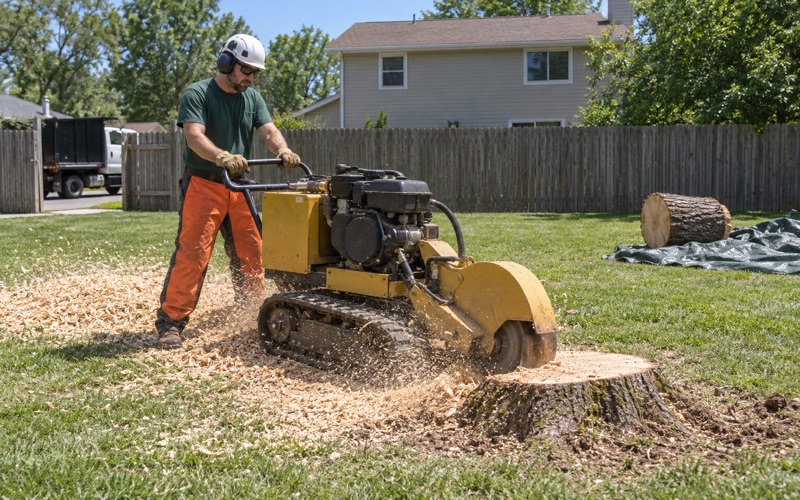
The upper twenty inches of the argillic horizon averages 30 to 35 percent clay, with individual horizons measured between 28 and 38. A stump grinder carries a rated below-grade cut depth, usually somewhere in the range of twelve to twenty-five inches, so on a profile like this one the machine reaches its own stop first, by a factor of roughly two to five, and never gets near anything harder than dirt.
What you feel instead is clay. It loads a tooth wheel, it packs into the grindings, and it turns a wet excavation around a root plate into shovel work. A stump that took forty minutes in a dry August can take considerably longer in a saturated March, and we would rather explain that in advance than discover it with a customer watching.
We do not quote a finished depth for a stump we have not stood over. The machine’s rating and the mapped soil for your particular lot are two different numbers, and only one of them is printed on a sales sheet.
Snead is the one shallow exception in this association
Deep loess is not the whole picture, particularly toward the eastern side of the city where the county line runs. The Snead series reaches a paralithic contact at 20 to 40 inches over gray shale, and it is the single profile in this association shallow enough to sit inside a grinder’s rated cut. Greenton sits on clayey shales at more than 40 inches and Higginsville carries bedrock at more than 60, both still well past where the wheel stops.
So the shallow question in this city is a Snead question, answered by looking up the mapped series for the address rather than by generalizing about the town. Before the wheel turns on any stump we file a locate request with Missouri 811, which RSMo Chapter 319 requires at least three but not more than ten working days ahead of excavation; the old number, 1-800-DIG-RITE, still reaches it.
Looking for tree-trimming closer to Lee’s Summit? See Tree-Trimming in Lee’s Summit.
Who has a say over a tree here, and where the wood goes
A city that maintains its own tree apparatus
The municipal code carries Chapter 240, Tree Planting, Maintenance and Preservation Program, at Sections 240.010 through 240.060, and Chapter 145 establishes a Tree Board of five members who are citizens and residents of the city, four of them appointed by the Mayor. The board’s published duties are to study, investigate, advise, report and recommend to the Board of Aldermen on the care, preservation and planting of trees on public property, and to help secure the cooperation of residents in a coordinated program of tree protection and planting.
Read as written, those duties are advisory and aimed at public trees rather than at a permit window for a finished private lot. We still check the printed chapter against your address before quoting, because a town carrying six sections of tree code is not a town to make assumptions about. On the development side, Article VI of the general development standards notes that the city has identified specific trees recommended for use in developments, and Article X is the subdivision regulations.
The county’s public yard-waste gate is inside the city limits
The Eastern Jackson County Yard Waste Collection Center sits at 37910 E Pink Hill Road, 816-847-7050, within these city limits. It prices by volume and vehicle rather than by weight, in two tiers: bags at one dollar for residents and two for non-residential, pick-up trucks and small trailers at fifteen and twenty-five dollars, large trucks and large trailers at ten dollars per cubic yard for residents and fifteen for non-residential. It takes cut-up logs, limbs and leaves, and refuses sod, trash, metal, glass, plastic bottles, tires and hazardous waste.
The calendar is the catch. The gate opens Saturdays only, April through November 21, from 8 a.m. to 4 p.m., which means a crew working a Tuesday, or working anywhere between December and March, has no public Jackson County outlet at all. Payment is listed as cash only on the county’s own page while a local write-up says card only, and the two simply disagree.
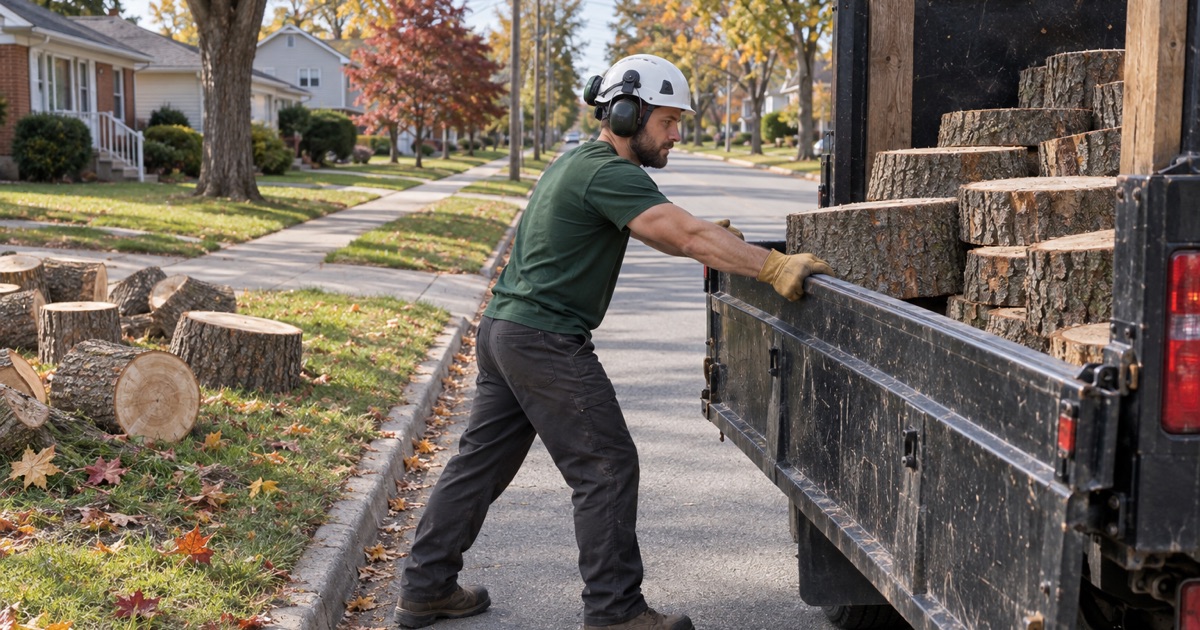
None of that lands on you. Our debris leaves with our trucks, and nothing gets stacked at your curb hoping a hauler takes it. The city’s own clean-up event is a free service for Oak Grove residents who show proof of residency, which makes it a homeowner benefit rather than a contractor’s disposal route. It is worth knowing, too, that this is a two-county city, 93.99 percent of its land area in Jackson County and 6.01 percent in Lafayette, so the disposal answer for a job can depend on which side of that line your lot sits on.
Two spines of canopy on one street grid
Across roughly 3,202 housing units, 42.63 percent predate 1980 while 45.57 percent were built between 1980 and 2009, and 738 of them went up in the 1970s alone. Nearly 71 percent are one-unit detached houses. Two entirely different tree problems live inside those numbers, and a crew that only knows one of them will misprice the other.
The half with fifty years on it
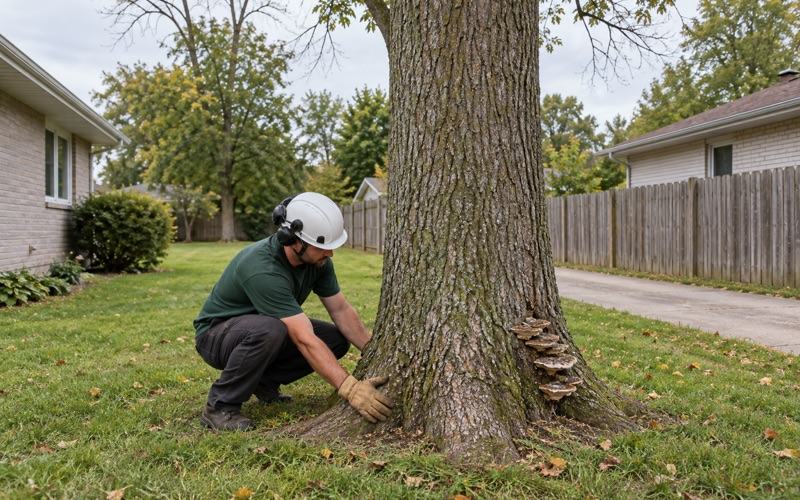
A point query inside the city returns EPA Level IV ecoregion 40c, Wooded Osage Plains, inside Level III 40 Central Irregular Plains, and the potential natural vegetation for 40c includes oak woodlands alongside the prairie types. On the older lots that half of the sentence is still legible on the ground, in trees with real diameter at breast height and real defects: heartwood decay, conks at the root flare, co-dominant stems with included bark that were never corrected forty years ago.
University of Missouri Extension publication G6867 gives the thresholds that actually have a Missouri owner, and those are the ones in our written assessments. One threshold is whether at least 50 percent of the crown is still intact; past that, a tree has lost its survival edge. A 2- to 3-inch wound on a 12-inch diameter limb will seal over. Bent trees and branches larger than 6 inches in diameter belong to someone with more experience.
The fifteen-degree lean and the forty-mile-per-hour failure number that circulate in this trade have no such source, so we do not quote them at you.
The half planted with the subdivisions
Kansas State Research and Extension’s list of recommended landscape trees for metropolitan Kansas City is blunt about the cohort that went in with newer streets: do not plant the Bradford cultivar, because severe splitting occurs on trees ten to fifteen years old. Silver maple, pin oak, green ash, Austrian pine, Scotch pine, box elder, Lombardy poplar, Siberian elm and willow all sit on its not-recommended list for this area, and a good share of them are standing in yards here right now.
Pine wilt is the one removal that carries a deadline. K-State records that Scots pine plantings in eastern Kansas have been devastated, with Austrian pines affected in recent years; symptoms surface from August into December, and an infected tree should come down as soon as possible and by May 1 at the latest, with April 1 the better target. Cut to the ground with no stump left, chip or burn the wood immediately, and do not save any of it for firewood. A dying windbreak pine on a lot of that vintage is a job with a date attached, not a job for next spring.
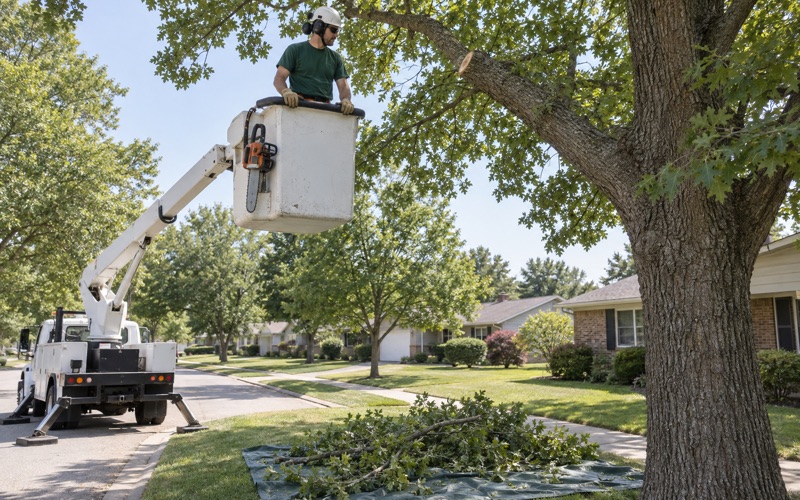
Where a tree is worth keeping, we price the work that keeps it: crown cleaning, a measured crown reduction to the ANSI A300 pruning standard, or cabling and bracing on a split leader that still has good wood around it. We do not top trees, and when somebody else offers to, we will explain exactly what it costs you three years later.
Storm work, lines, and the calls in the right order
The National Weather Service office at Pleasant Hill names this city in its own event record: March 6, 2017, numerous tornadoes near Kansas City, including an EF-3 at Oak Grove. That same office reports more than 300 tornadoes since 1950 across the 44-county area it warns for, which is a warning-area figure rather than a count for this city or this metro.
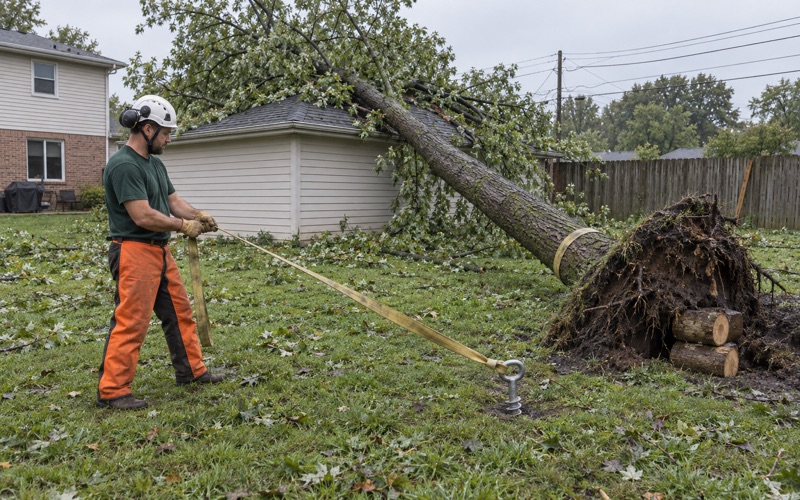
When a tree lands on a line, the order of the calls matters more than the speed of them. Stay at least thirty feet back from a downed conductor and touch nothing in contact with it, including fences, vehicles, ladders and the ground itself. Call 911 first, then Evergy at 888-544-4852. Do not pull a limb off a power line yourself, because electricity travels through objects and does it best when they are wet.
The line running from the pole to your meter, the service drop, is the customer’s responsibility rather than the utility’s, and that is where most of our calls originate. On its own conductors, Evergy’s assist work normally clears overhanging branches and limbs within ten feet of energized lines carrying 600 to 50,000 volts, and leaves the debris at the worksite when it goes. A tree across a city street is City Hall at 816-690-3773 during business hours; a tree across Interstate 70 is MoDOT right-of-way, reported at 1-888-ASK-MoDOT.
When a tree is on a roof, a car or a line, we respond the same day. Missouri issues no license or certification for tree work at all, and the credentials in this trade, ISA certification among them, are voluntary industry ones, so the checks that actually protect you are proof of insurance and a written scope you can hold someone to. Both arrive before we start.
- 20+ Years in the KC Metro
- Free On-Site Assessment
- Written Price, Insured Crews