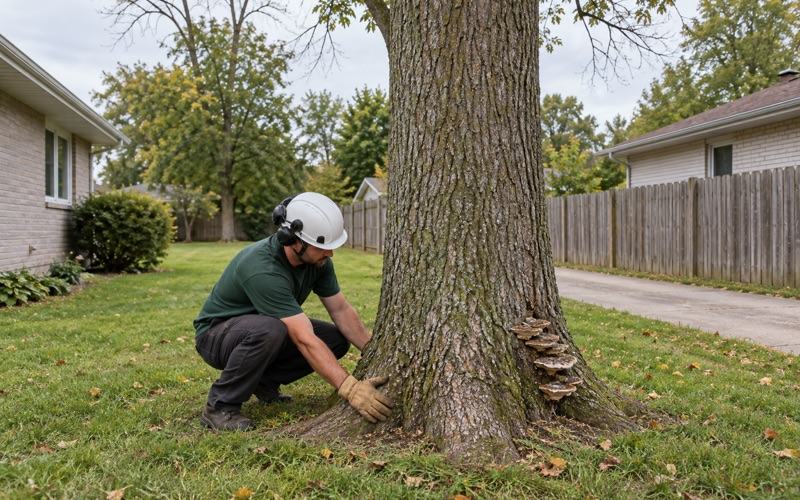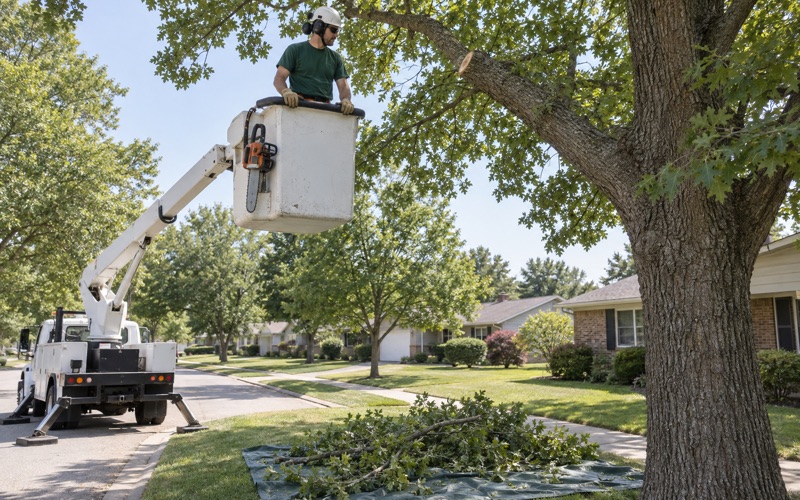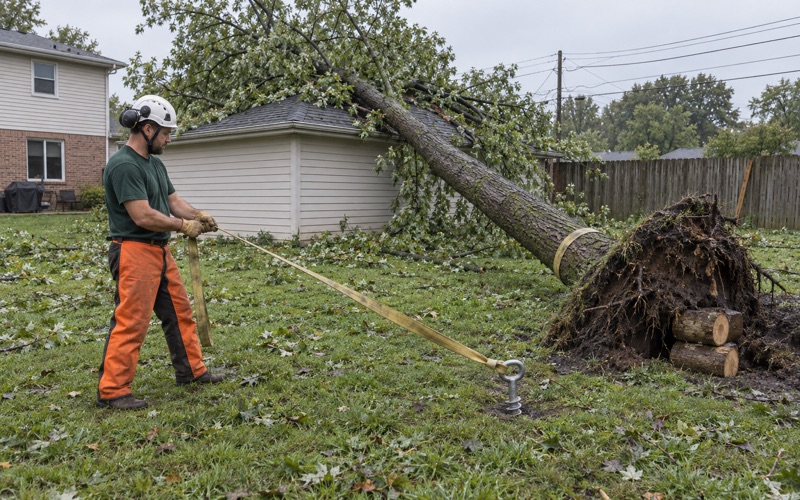
Blue Springs Tree Removal has handled tree removal in Odessa for more than twenty years, working both sides of the state line out of the Kansas City metro. A takedown here is priced the same way we price every job: an on-site assessment at no charge, a written condition assessment of the tree rather than a number scribbled on a card, and a quote that stays the quote in writing.
What changes from one Odessa address to the next is who owns the wire overhead and which set of rules the property sits under. The city runs its own electric department, and the open-burning math flips the moment you cross the city limit, so the same removal is a different job on a town lot than on the acreage a mile out. We work out which one you have before the saw comes off the truck.
You also get proof of insurance before a crew sets foot on the property, and a plain answer about where the wood and the brush are going. Nothing gets stacked at your curb for somebody else to refuse. When a tree is on a roof, a car or a line, we respond the same day.
A City-Owned Electric Department, and Who Trims the Lines
Odessa is one of the few cities in this part of Missouri that owns its power system outright. The City of Odessa Electric Department is a municipal utility, and outages or a downed pole go to the city at 816-633-5521 rather than to an investor-owned call center. That ownership is not trivia for a tree job, because Missouri’s trimming statute defines an electric supplier to cover municipally owned electric systems under chapter 91 and rural cooperatives under chapter 394.
Two rights come with that definition and they are worth knowing before anyone climbs. Under RSMo 537.340.2(6) the supplier owes the owner or occupier fourteen days’ notice before removing a tree, unless removal is immediately necessary. Under 537.340.2(7), where a tree the supplier partially trimmed dies within three months as a result, the owner may ask in writing to have it removed at the supplier’s expense.
What the City Crews Actually Cut
The statute’s own clearance changes at the city limit: inside a city it is ten feet plus half the length of any attached cross arm from the centerline for lines at or below 34.5 kV, and outside it the figure jumps to thirty feet for the same voltage. Odessa works past that in-town minimum. The city has put contractor crews on a 20-foot clearance and describes its own effort as mainly trimming the primary lines out along the roads, which in practice leaves the service drop running from the pole to your house sitting with the property owner.
Past the city limit the wire belongs to West Central Electric Cooperative, which runs more than 15,000 meters over 2,600 miles of line out of Higginsville with a branch at Oak Grove. Its published right-of-way goal is to eliminate every tree and brush within 15 feet of either side of the line, by spraying, trimming or removal. A cooperative is an electric supplier under the same statute, so the notice and the dead-tree remedy follow you onto the acreage; only the clearance number and the phone number change, and theirs is 816-565-4942.
Looking for tree-removal closer to Grandview? See Grandview Tree-Removal.
The Burn Rule That Flips at the City Limit
Odessa allows outdoor burning, which is not true of every city in this metro. The city’s own rules are narrow: private property only, never a street, alley, other thoroughfare or public place; daylight hours only, nothing between sunset and sunrise; and only organic material that has not been chemically treated. Permission for a controlled burn comes from the Odessa Fire Department at 816-633-7182.
Sitting on top of that is the state rule, 10 CSR 10-6.045, which governs all open burning throughout Missouri. It treats tree trunks, limbs, trimmings, vegetation and yard waste as vegetative waste, and it prohibits burning trade waste and construction or demolition waste apart from untreated wood. So the pile has to be clean before anything is lit.
Why a Land-Clearing Burn Works on Acreage and Not in Town
The clause that decides a commercial job is 10 CSR 10-6.045(3)(B)1. It puts a commercial land clearing operation under the conditions at subsection (3)(E) whenever the burning sits inside the city limits or less than 200 yards from the nearest occupied structure. Those conditions are burning only between sunrise and sunset, a setback of at least 200 yards from the nearest structure, supervision at all times, and notification of the local fire control authority before the burn is started.
Work that through on a town lot and the setback cannot be met, because 200 yards of clear ground does not exist between houses inside Odessa. On acreage past the limit it usually can, and the fire department call before we light is not a formality we skip. Burning is a real option on the farm ground here and effectively not one in town, which is why we quote hauling for in-town work and ask about burning only where the parcel supports it.
Where the Brush Goes Instead
Hauling out of Odessa is its own piece of the price. Lafayette County has no yard-waste or brush gate at all: the county’s recycling operation takes electronics, metal breakage and cardboard, and lists no brush, limbs or logs. The city provides a yard-waste dumpster at 400 N 1st Street for residential yard waste, which is sized for a homeowner’s trimmings and not for a removal. Missouri bars yard waste from a solid waste disposal area under RSMo 260.250, so every outlet within reach is a composter rather than a landfill.
The nearest gate that takes volume is the composting center at Oak Grove, open Saturdays only from April through November 21, priced by the vehicle rather than by weight and cash only. A Saturday-only, seven-month gate is a scheduling fact on a Thursday job rather than a footnote. Missouri Organic Recycling, farther west, takes brush by the cubic yard and logs up to 40 inches across and under five feet long, and refuses stumps with dirt on them, all of which we work out before we quote rather than after.
Owner Duties Under Odessa’s Property Maintenance Code
Odessa adopted the 2012 International Property Maintenance Code in August 2017, and its Codes Enforcement office runs a tree maintenance program built around what an owner owes rather than around an application window. The duties are stated plainly: keep clearances over streets and walkways, eliminate dead, dying or diseased limbs, and remove dead or diseased trees. The city frames the whole thing as moving property maintenance from a reactive emergency to a proactive strategy.
In practice that means a dead tree over a sidewalk is your obligation before it is anyone else’s, and a neighbor can raise it with the Codes Enforcement Officer at 816-633-7575 through the city’s online permitting portal. A written condition assessment is worth having on file for exactly that conversation, which is why we hand one over on every estimate. It records what is dead, what is dying, and what only looks bad.
Zoning, Sign-Offs and What We Check First
Odessa’s zoning ordinance is Chapter 50 of the municipal code, and it runs seven articles covering general provisions, district regulations, off-street parking and loading, nonconforming uses, manufactured homes, signs, and administration and enforcement. It carries no tree preservation, landscaping or land-clearing requirement anywhere in it; its one sentence about vegetation encourages landscape features around ground-mounted signs. We still confirm the current requirements with Codes Enforcement before a removal rather than assuming what applies, and we do the same on the neighbor question.
Missouri follows the Massachusetts Rule on a neighbor’s tree, which gives no cause of action for damage from a healthy tree next door and leaves self-help up to the property line at the complaining owner’s own cost. Crossing the state line changes that answer, and we work both sides of it often enough to know which one you are standing on. A dead or failing tree is a different analysis, and that is the one Codes Enforcement acts on.
Town Lots and Surrounding Acreage: Two Different Job Lists
Do not read Odessa’s plat as tight alley access. The city holds 2,370 housing units across 4.099 square miles, about 578 to the square mile, and three quarters of them are single-unit detached, which is a spread-out pattern rather than a fenced-in one. Its peak building decade was 2000 through 2009 at 25.23 percent of the stock, so a good share of the trees we take down here were planted with the house and are only now reaching the size that makes them a problem.
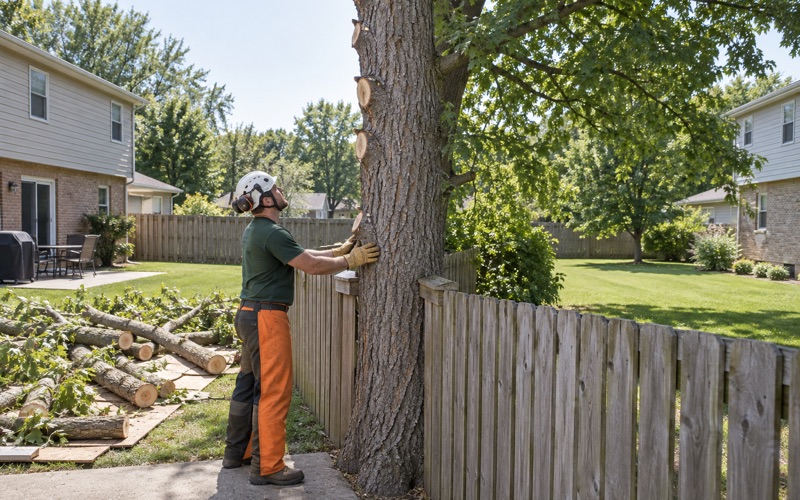
What binds a back-yard job in town is machine width and brush handling, not horsepower. Compact grinders and tracked lifts are built for gates in the 25 to 35 inch class, while the chipper is a nine to ten thousand pound machine seven to eight feet wide that never goes through a gate at all. So the drop zone and the brush route decide the approach before tree size does, and we walk both before quoting.
Stumps, Grindings and the 811 Call
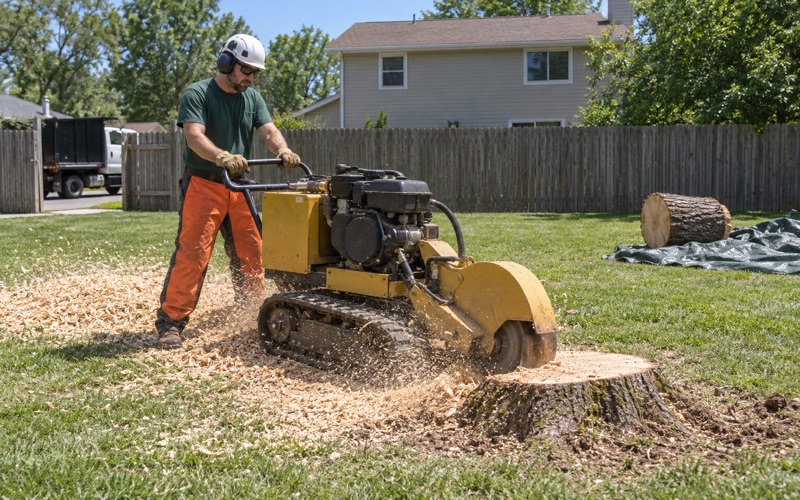
Cut width and cut depth are not coupled on a stump grinder: some 35 inch machines take 25 inches below grade, and a dual-wheel option can put the same machine at 56 inches. We quote the machine as it will arrive configured rather than by class. What we will not do is promise a below-grade depth on a lot we have not seen, because the shale-derived Snead soils that run through northern and western Missouri hit a paralithic contact somewhere between 20 and 40 inches, and the shallow end of that sits under a 25 inch cut.
Before any grinding we call Missouri One Call at 1-800-344-7483, which notifies the City of Odessa so electric, water and sewer get marked. The city asks for 48 hours’ notice except in an emergency, the locates are free, and the marks are good for ten days. That timeline is part of why a stump appointment is not always the same visit as the takedown.
Out on the Acreage
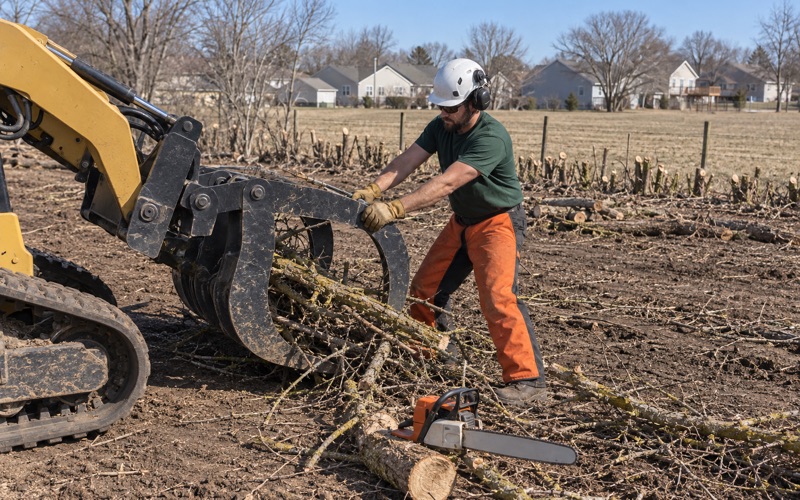
Past the city limit the constraint inverts. The drop zone is free and haul distance becomes the cost, which is where a firewood credit gets decided and where burning is back on the table. The work itself changes too: Osage orange fencerows that no longer serve a farming operation, and eastern redcedar taking over unmanaged pasture, are a forestry mulching and lot-clearing job rather than a takedown.
Odessa sits in the Wooded Osage Plains, an oak woodland edge of the Central Irregular Plains, and the oaks here are the ones that color in fall rather than the bur oak of the prairie ground north and west. That matters less for the saw than for the decision: a red or white oak worth keeping gets priced as crown cleaning or cabling and bracing, not as a removal. We do not top trees, and if someone has offered to, we will tell you what it does to the tree.
- 20+ Years in the KC Metro
- Free On-Site Assessment
- Written Price, Insured Crews