Blue Springs Tree Removal has worked as an arborist in Overland Park for more than twenty years, and the first thing we tell a homeowner here is that the tree at your curb and the tree in your back yard are governed by two opposite rules. One of them is yours to decide. The other one belongs to the City Forester, and the code says you do not even have to be told.
That split is the practical center of our work on this side of State Line Road. We take down trees, grind stumps and haul the wood on residential lots across Overland Park, and on every estimate we sort the trees into the ones you control and the ones the city controls before we price anything. Getting that order wrong is how a removal turns into an enforcement problem.
Every visit starts the same way: a free on-site assessment, a written condition report on each tree rather than a number on the back of a card, and proof of insurance in your hands before a crew arrives. If a tree can be kept with cabling or a round of pruning, we will price that instead and say why.
The City Forester decides the curb tree, and no notice is owed
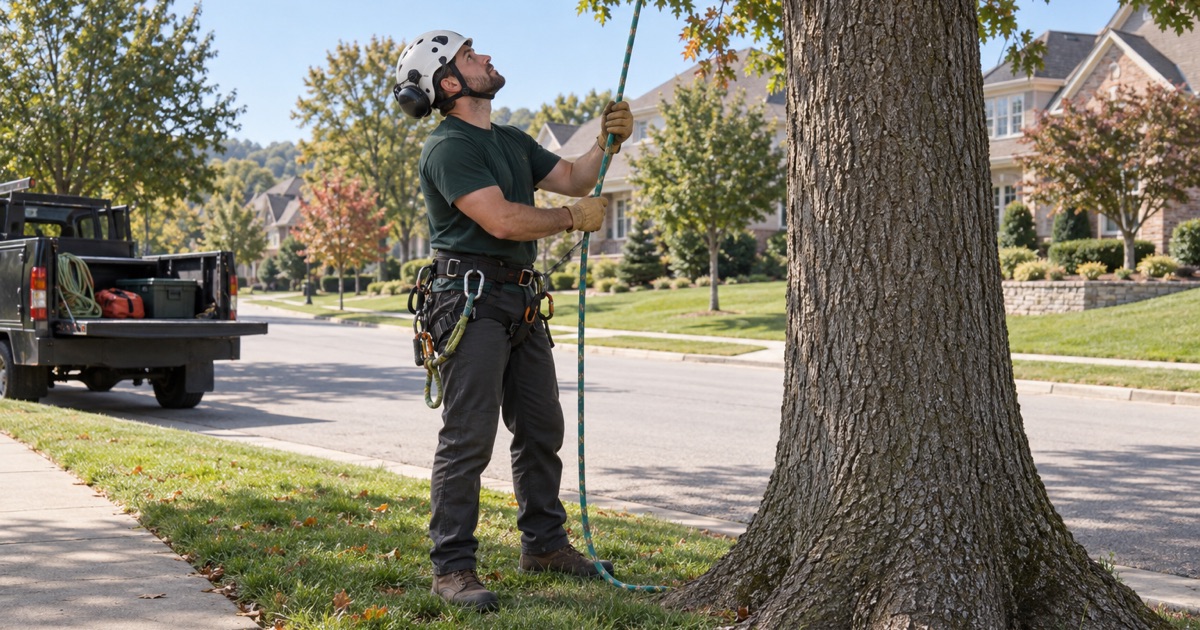
Overland Park Municipal Code 7.16.195 hands the City Forester authority to regulate and enforce every regulation concerning the planting, maintenance and removal of trees and shrubs on public property. The city says it plainly on its own street trees page: removing a tree from the right-of-way is prohibited unless authorized by the city forester. That is not a permit you apply for and receive; it is authorization the Forestry Division may or may not give.
The same section goes further than most homeowners expect. Where the City Forester determines that removal of a right-of-way tree is necessary, the code directs city staff or the city’s contractor to perform the removal, and notice to any abutting owner is not required. You can lose the tree in front of your house without a letter, a door hanger or a phone call, and the crew that does it will not be ours.
What happens if a right-of-way tree comes out anyway
Enforcement sits in 7.16.210, and it is worth reading before anyone puts a saw into a curb tree on their own initiative. A person in violation is required to provide a replacement tree or shrub of a species and caliper approved by the City Forester, subject to a discretionary waiver. The violation is also a public offense punishable under OPMC 1.12.010, and the city may pursue an injunction or a civil penalty on top of that.
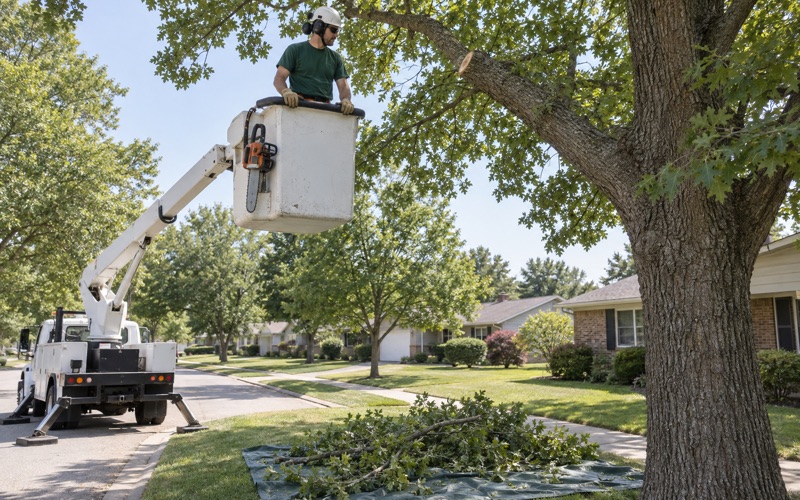
So when a customer asks us to take the tree between the sidewalk and the street, our answer is the same every time. We will assess it, tell you what we see and put it in writing, but the authorization has to come from the City Forester, and in practice the city’s own forces or its contractor do that work.
Looking for tree-removal closer to Lexington? See Tree-Removal in Lexington.
Your own lot is unregulated, and the species rules stop at the lot line
Cross the property line and the picture inverts. Taking down a tree that stands wholly on private residential property in Overland Park takes no permit, and nothing in the tree chapter tells you what you may plant in your own yard once the house is finished. For the 45,322 owner-occupied one-unit-detached houses in the city, that means the decision on a back yard tree is genuinely the owner’s.
The right-of-way is the opposite again. OPMC 7.16.180 sets up the city’s list of street tree species allowed to be planted and grown within the right-of-way, and states that planting any species not on that list is prohibited unless prior written authorization of the City Forester is obtained. We do not tell customers which species sit on it, because reading it is the Forestry Division’s call and guessing wrong is what buys you a replacement tree.
Nobody licenses tree work in Kansas
Overland Park issues no contractor license of its own; its permits page says the city requires contractors to hold an active Johnson County contractor’s license to receive a building permit for work inside the city limits. Johnson County Contractor Licensing runs eleven classes covering construction, alteration, repair or demolition of structures, from general and building down to roofing, plumbing and swimming pools. Not one of them covers tree work, arboriculture or landscaping, and a removal needs no building permit, so it triggers no county license at all.
That absence is why we hand you proof of insurance before the crew shows up rather than waving a license number at you. What exists in Kansas is certification rather than licensure, and the Kansas Forest Service points homeowners to the International Society of Arboriculture and to the Kansas Arborists Association. The standards that actually govern the cuts, ANSI A300 for pruning and ANSI Z133 for safety, are industry standards rather than state law.
What a consulting arborist is actually for in Overland Park
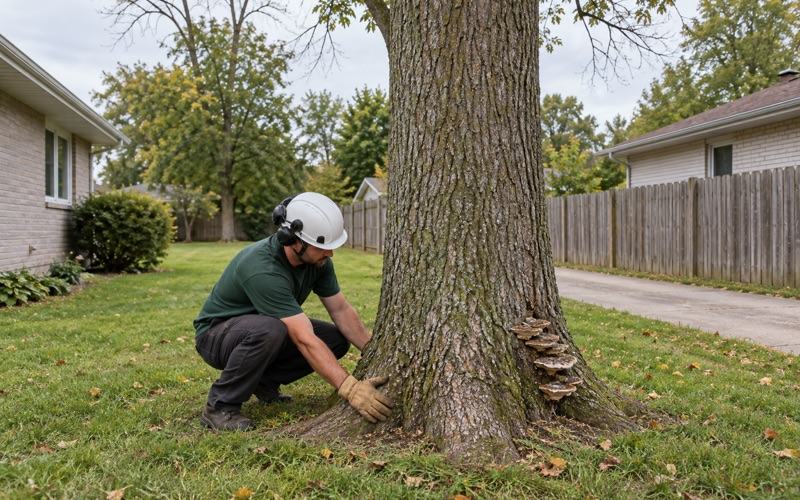
Because so little is regulated on private ground here, the useful document is not a permit. It is a tree risk assessment: a written record of what the tree is, what is wrong with it and how likely the failure is, taken at diameter at breast height with the root flare, the union and the crown all inspected rather than eyeballed from the driveway. Conks, heartwood decay, included bark at a co-dominant union and a lifting root plate are the findings that change a price, and they are the findings that change an argument.
That last part matters more in Kansas than it does at our home end of the metro. Kansas follows the nuisance rule on a neighbor’s tree: you may cut what overhangs your side, you may not step onto their land to do it, and where a tree does substantial harm or presents an imminent danger the neighbor can be compelled to abate it. Twenty minutes east across the state line the answer flips, and the same report that gives you leverage here would only document a cut you pay for yourself.
Storm calls, service drops and the order things happen in
The regional record here is convective wind rather than anything exotic. The weather service office at Kansas City and Pleasant Hill titled the 14 July 2023 event a wind storm through Kansas City with widespread power outages, logged an 89 mph gust in the county and roughly 200,000 customers out, and recorded a squall line across Johnson County on 19 May 2024 that produced four brief tornadoes. An ice storm in February 2019 put an eighth to a quarter inch of accretion across all of eastern Kansas.
When a limb is on a line, the order is not negotiable. Evergy’s own instruction is to call 911 first and then Evergy, and never to try to rescue someone who has contacted a downed line; nothing starts on site until the utility has cleared it. The span running from the pole to your meter is the customer’s responsibility under Evergy’s published rule, and since no line drop service is offered here we plan that work around an energized conductor at ANSI Z133 clearances. Before any stump grinding or root excavation we call Kansas 811.
One city, two canopies, and two different removals
Only 10.59 percent of Overland Park’s 89,079 housing units predate 1960 and only a third predate 1980, which reads as a young suburb until you look at where the old stock sits. 11,105 units from the 1960s and 6,813 from the 1950s are concentrated in the northern third of the city, on narrower plats under 60 to 70 year old canopy. Another 16.02 percent of the city was built in 2010 or later, out on the southern edge.
North of I-435: rigging between close houses
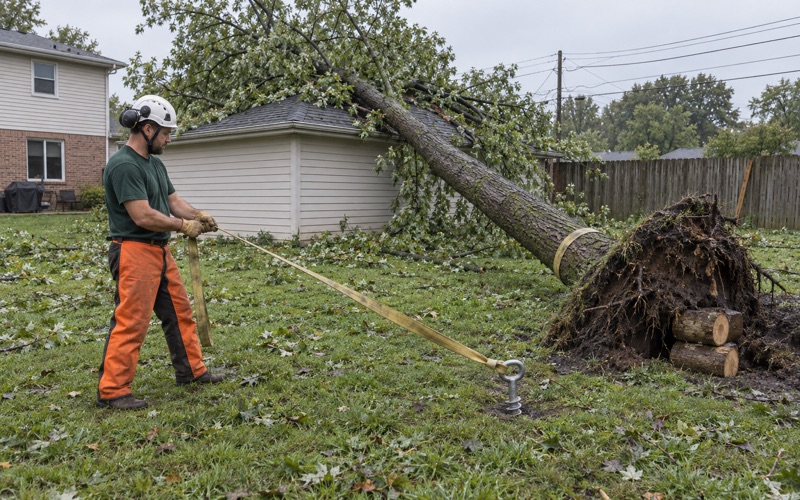
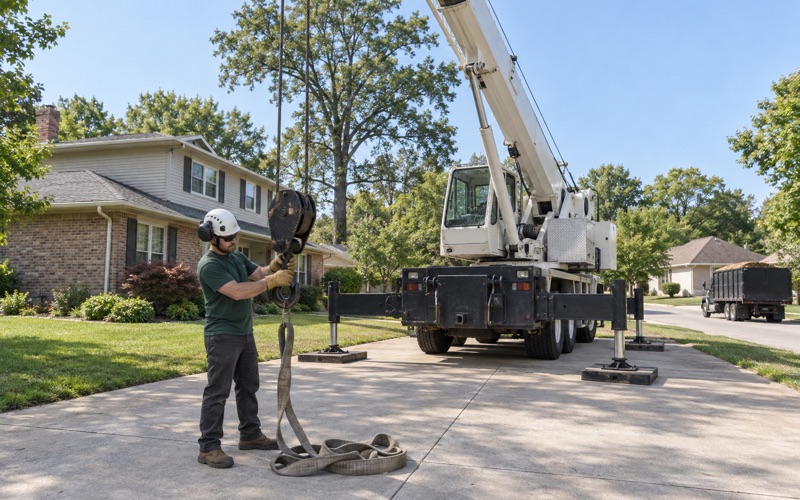
On the north end the job is usually a large mature tree with no drop zone worth the name. That is crane-assisted removal or a rigging plan built around a bull rope, a Port-a-Wrap friction device and a working load limit we can actually justify, with the three-cut method on anything that has to be taken in pieces over a roof. We do not top trees to make them easier, and when someone else offers to, we will explain what topping does to the wood you are left with.
South of it: the first removal cycle
South of I-435 the calls are mostly first-cycle failures of trees planted with the house 20 to 45 years ago, plus lot clearing at the growth edge. The Johnson County Master Gardeners brochure on recommended landscape trees for the metro is candid about which of those were mistakes: silver maple for weak wood, pin oak for soil issues, green ash for emerald ash borer, along with Bradford pear, box elder, Siberian elm, Lombardy poplar, willow and cottonless cottonwood, with red maple and white ash to be planted with caution. Its own line on the Bradford cultivar is not to plant it, because severe splitting occurs on 10 to 15 year old trees, and its general warning is that many fast growing varieties are brittle with narrow crotch angles that can lead to severe breakage during storms.
The one removal on this ground with a date attached is pine wilt. K-State Research and Extension says Scots pine plantings in eastern Kansas have been devastated and that Austrian pines have been affected in recent years, that an affected tree should be cut down as soon as possible or by 1 May at the latest with 1 April a better deadline, cut to the ground with no stump left, and the wood chipped or burned immediately rather than saved for firewood. That last instruction is why we tell you where the wood is going before the saw comes out of the truck.
Where the debris actually goes
Overland Park runs no city trash or yard waste collection and operates no city gate. It permits haulers instead, under a hauler permit and a separate hauler vehicle permit required by municipal code 7.36.110, and its only published yard waste requirement is that yard waste be bundled in lawn bags, that plastic bags will not be picked up, and that haulers collect yard waste at least 40 weeks a year. Read literally that leaves up to twelve weeks with no collection at all, and the diameter cap on what your hauler will take is in your own contract rather than in any public rule.
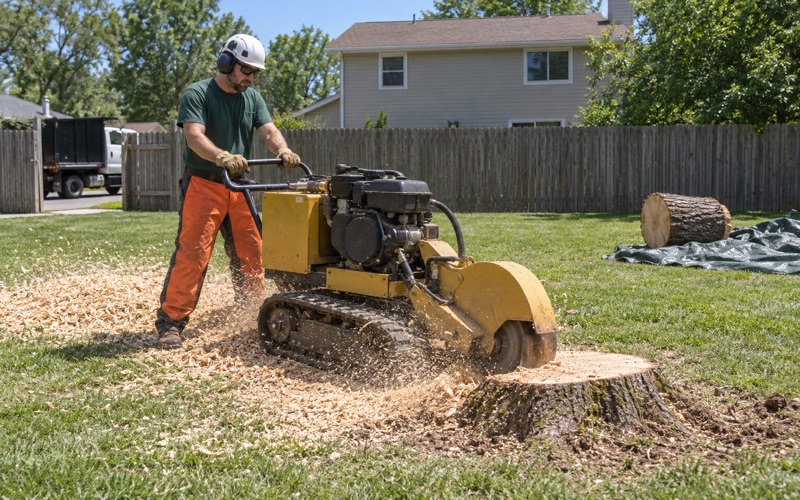
So the debris from a removal here leaves the property with us, on our trucks, to a private outlet we name on the estimate. Missouri Organic Recycling takes brush at $10.00 per cubic yard and lawn debris at $7.00 per cubic yard and accepts logs up to 40 inches in diameter if they are under 5 feet long, but it refuses stumps with dirt, which is the practical reason grinding beats pulling on almost every job we quote. Nothing is stacked at your curb for a hauler to refuse.
- 20+ Years in the KC Metro
- Free On-Site Assessment
- Written Price, Insured Crews