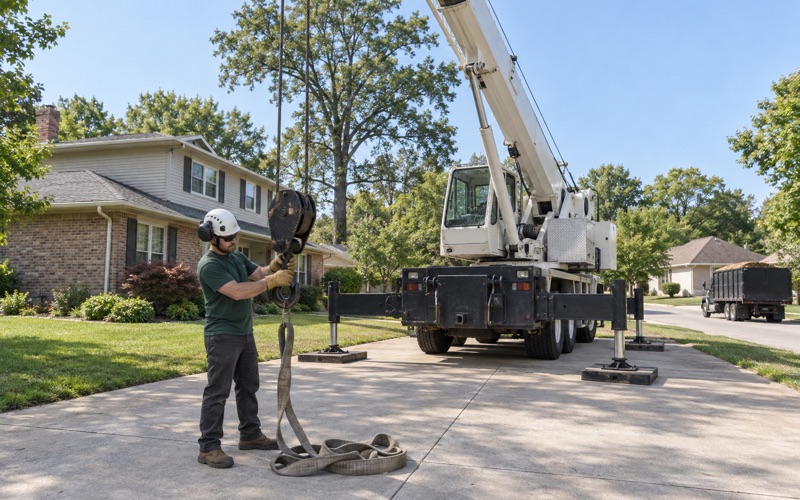
Blue Springs Tree Removal has handled tree removal in Parkville for more than twenty years, working both sides of the state line across the Kansas City metro. Every job here starts the same way, with a free on-site look, a written condition assessment rather than a number scribbled on a card, and a price that stays the price once it is in writing.
What changes here is the ground itself. A crew can spend the morning on a subdivision lot above the river and the afternoon on a wooded bluff face inside the same city limit, and those are two different removals with two different rigging plans. We tell you which one you have, and where the wood and the brush are going, before the saw comes out of the truck.
Proof of insurance reaches you before a crew sets foot on the property, and the debris leaves with us rather than sitting at your curb waiting to be refused. If the tree can be held with cabling and bracing or brought back with sound pruning, we price that instead and say why.
Two working environments inside one city limit
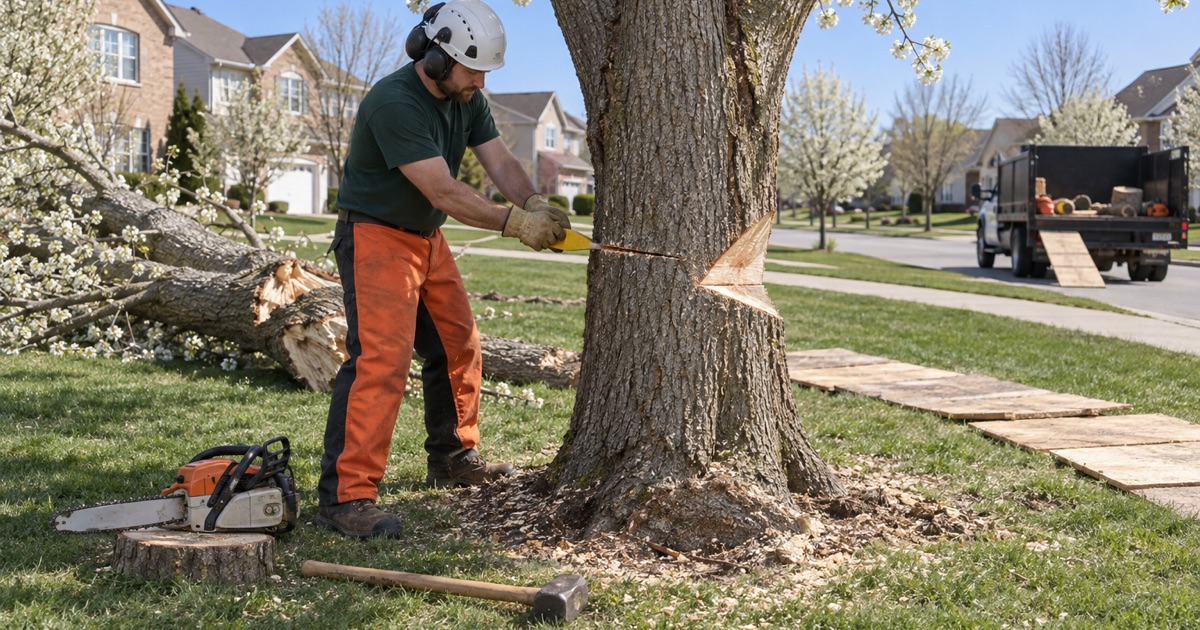
Parkville maps to EPA Level IV ecoregion 47f, the Rolling Loess Prairies, and that classification does more work than it looks like it should. Prairie-derived country was never closed forest, so most of the mature canopy standing over a subdivision lot here was planted rather than inherited. The species mix on a given lot reflects what a nursery sold and what a developer specified, not what covered this ground before the town existed.
That has a practical consequence on the estimate. A planted canopy tends toward even-aged rows of the same few species, so what takes one tree out on a street usually threatens its neighbors on the same schedule. We say so when we see it, rather than coming back three times in five years for the same reason.
The river edge is a different forest
The exception runs along the Missouri River. The bottoms and the wooded bluff faces above them carry genuine bottomland and slope woodland, where stems established themselves and crowns grew into each other rather than into a planting plan. A removal on that ground is a forestry problem wearing a residential address, and pricing it like a yard tree is how a crew gets hurt.
Large lots move the constraint to the back yard
Across 14.948 square miles the city carries roughly 214 housing units per square mile, and better than three quarters of the stock is single-unit detached. That is large-lot ground rather than alley-and-fence ground, so the tight spot on a Parkville job is rarely the curb. It is the back yard, the drop zone, and whatever the slope is doing behind the house, which is why we walk the plat and the ground instead of guessing access from the street.
Looking for tree-removal closer to Lenexa? See Tree-Removal Services in Lenexa.
A 2000s canopy reaching its first removal cycle
More than half of the housing in this city was built this century. Some 54.25 percent of the stock dates to 2000 or later and 29.16 percent to 2010 or later, against 19.69 percent built before 1980. The trees now failing in those subdivisions went into the ground with the houses, which makes most of this work first-cycle removal rather than veteran takedown.
What twenty-year-old failure looks like
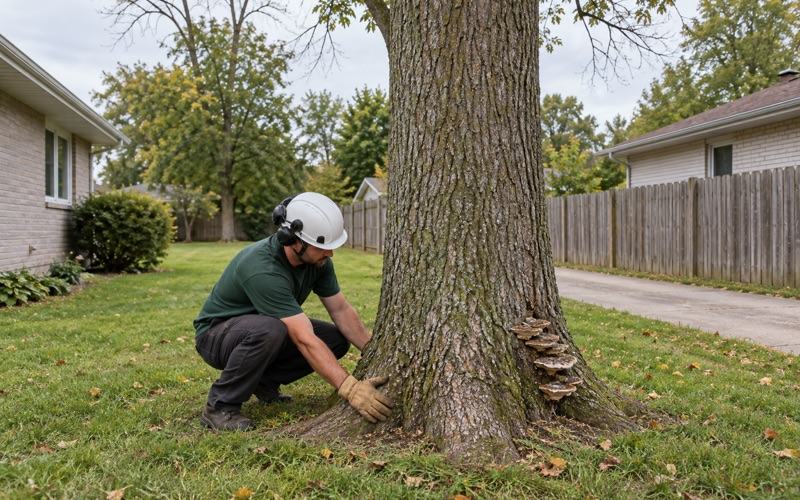
Callery pear cultivars split at the co-dominant stems and included bark they were bred to grow, usually under the first ice load heavy enough to weight one side. Screen conifers set on centers far tighter than their mature spread leave a row of one-sided crowns and dead interiors, and no amount of pruning gives that back. Neither failure is a decay failure, so a conk at the root collar is not what we expect to find on a lot built in 2004.
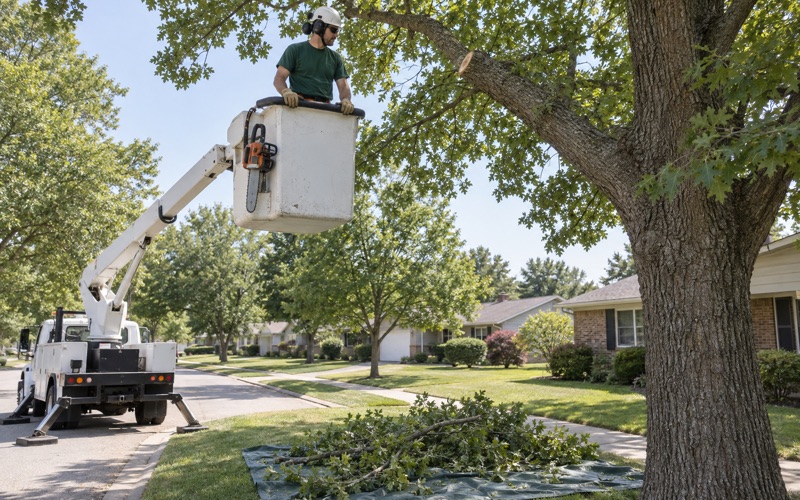
We do not top trees, and on a young split leader we will explain why rather than just refusing. Topping trades one hazard for a flush of epicormic sprouts attached to nothing but the outer wood, and in ten years you are paying to take down a heavier tree with worse attachments. Crown reduction and crown cleaning to the ANSI A300 pruning standard do the same job without buying that problem.
The old trees in this city are somewhere else
The other population is genuinely old and sits where the town started: the historic downtown platted in 1844, the university grounds established in 1875 on the bluff above it, and the parks down on the river bottoms. A stem that has stood for a century is a decay and root-plate question rather than a structural-defect question, and it gets a different inspection. Either way we measure diameter at breast height, read the root flare, and hand you the tree risk assessment in writing.
Rigging a bluff face is not a yard job
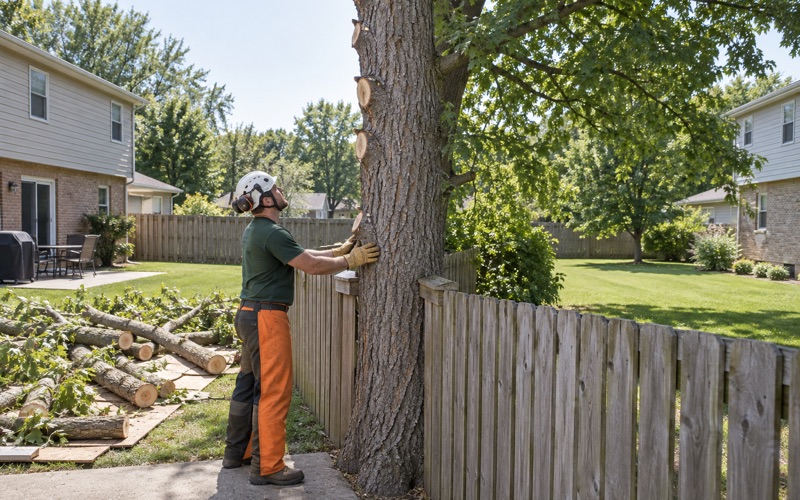
On a level lot the rigging question is where the wood lands. On a bluff face it is what the climber and the load are anchored to, because there is no flat ground under the drop zone and gravity is already doing half of the work we are trying to control. The river corridor adds its own exposure as well, since a bluff edge and an open bottom take a wind fetch that a sheltered upland subdivision never sees, and the failures follow that.
Anchors, friction and a load that never free-falls
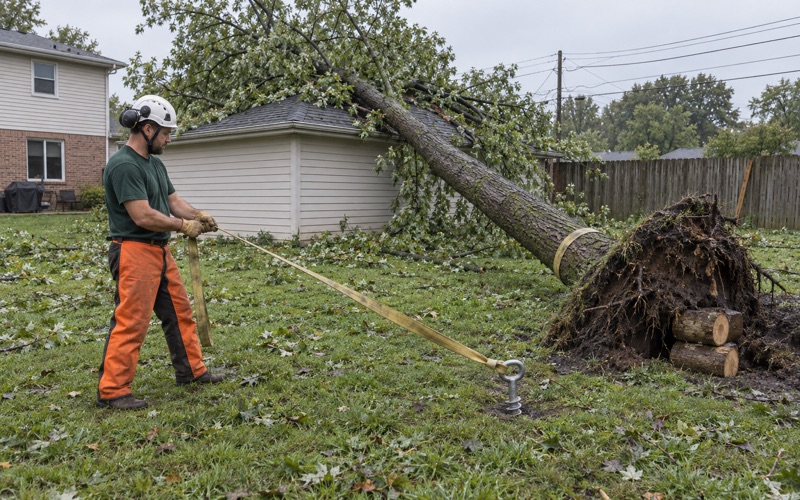
Slope removals come down in pieces on a bull rope through a Port-a-Wrap friction device, sized against a working load limit we can state rather than estimate, and cut to the ANSI Z133 safety standard. Nothing free-falls on a face where a rolling log has a hundred feet of runout below it. Down on the bottoms the problem inverts, because saturated ground and a shallow water table mean the root plate lifts before the stem breaks, and the truck that would normally park under the tree cannot be there at all.
What fits through the gate, and what never will
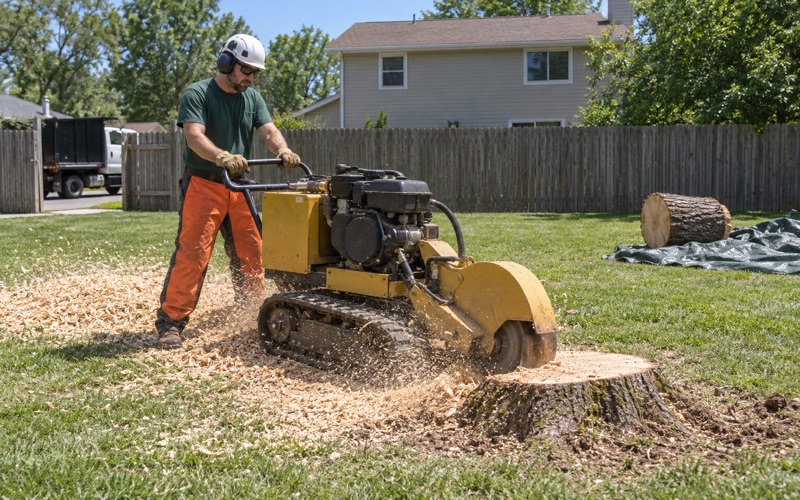
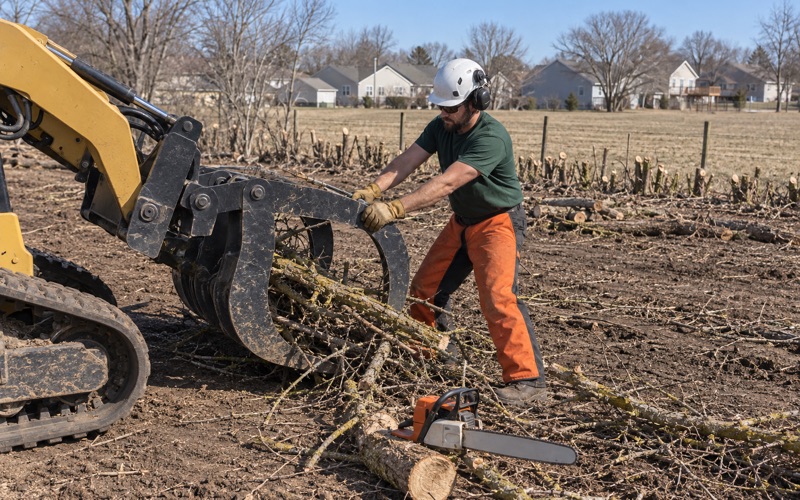
The binding constraint in this trade is machine width and brush handling rather than horsepower. Compact grinders and tracked lifts are built to gates in the 25-to-35-inch class, while the chipper runs seven to eight feet wide at about ten thousand pounds and never goes through a gate at all. Width and cut depth are not coupled either, since some 35-inch machines still cut 25 inches below grade and a dual-wheel option takes the same machine out to 56 inches, so we quote the grinder as it will actually be configured on your lot.
Below-grade depth is seldom the limit on upland ground here. The deep loess that gives this ecoregion its name runs several times deeper than any stump grinder’s rated cut, so the machine’s own stop binds long before anything harder does. An 811 utility locate goes in before the wheel turns, every time, without being asked.
Where the brush goes, and who to call
Disposal is the leg most quotes here leave vague, and in this city it is unusually specific. Residents can drop yard waste at no charge at Rockridge Quarry, 6305 Northwest River Park Drive, on weekdays outside holidays from half past seven in the morning until half past three in the afternoon. The catch is the calendar, because that gate is open only during the extended windows that follow the spring cleanup in April and the fall cleanup in October, roughly four to six weeks each.
Residents only, and no businesses at any price
The eligibility rule is documentary and strict. Proof of residency is a City of Parkville sewer utility bill or a Platte County property tax bill, a driver’s license is expressly not accepted, and the city states plainly that businesses are not taken. Yard waste only, no bagging required, and the published fall 2026 window runs Monday, October 12 through Friday, December 4.
Two things follow from that, and both belong in a quote rather than a surprise. No contractor working here can use that gate at any price, so our disposal leg is priced into the job and hauled elsewhere, and we name the destination before the crew arrives. Even a homeowner cutting their own limbs has no free local outlet for most of the year, curbside pickup caps limbs at four feet, and Missouri law keeps yard waste out of solid waste disposal areas altogether, which is why every outlet within reach is a composter.
Who signs, and who answers the phone
This is an owner-occupied market almost without exception. Some 82.32 percent of occupied units are owner-occupied, only 522 in the entire city are rented, and 2,330 of them are owner-occupied single-family detached homes. The person signing the estimate is nearly always the person living under the tree, which is why we walk the job with you instead of mailing a number.
Neighbor questions come up on these lots more than people expect, and the answer changes with the state line. Missouri follows the rule that there is no cause of action for damage from a healthy tree next door, and that self-help stops at the property line at the complaining owner’s own cost. We have worked both sides of that line for two decades and will tell you which one you are standing on before anyone starts cutting.
When a tree is on a roof, a car or a line, we respond the same day, and the call order matters. A downed conductor or a leaning pole goes to Evergy, whose number the city publishes on its own utility contacts page, because City Hall does not run the electric system and cannot de-energize a line. A burning tree or a burn notification goes to the Southern Platte Fire Protection District, a tree on public park ground belongs to the Director of Parks and Recreation, and code questions route through the city’s Communications Director.
If your ground sits outside the city limit on unincorporated Platte County acreage, both the work and the paperwork change shape. Out there the job is often Osage orange fencerows and eastern redcedar taking over unmanaged pasture, which is forestry mulching and lot clearing rather than a takedown. The county’s own zoning regulations govern that ground and include a height section tied to the county airport, which is a county instrument for unincorporated land rather than a rule reaching a homeowner inside the city, so Platte County Planning and Zoning is the office to ask.
- 20+ Years in the KC Metro
- Free On-Site Assessment
- Written Price, Insured Crews