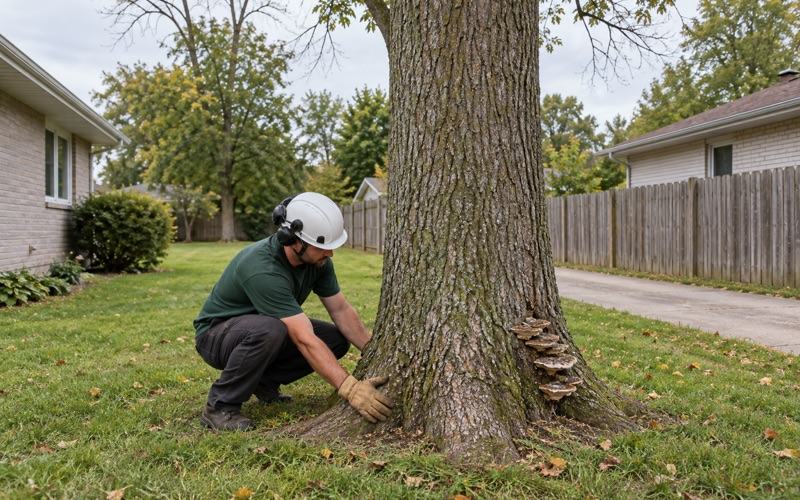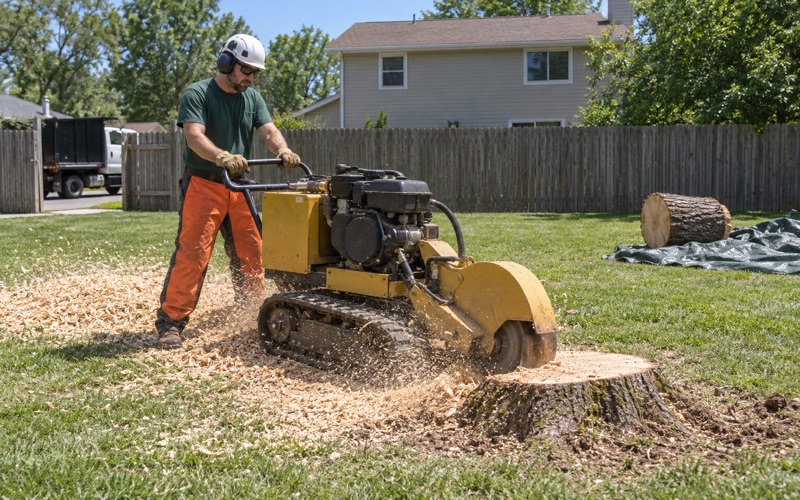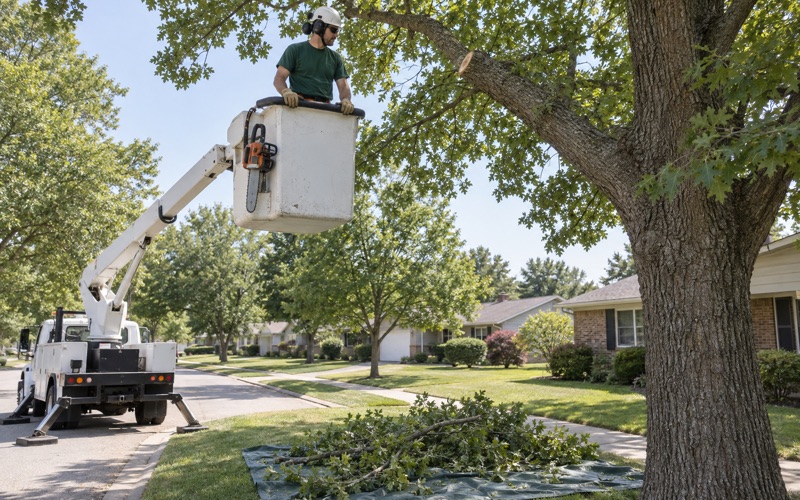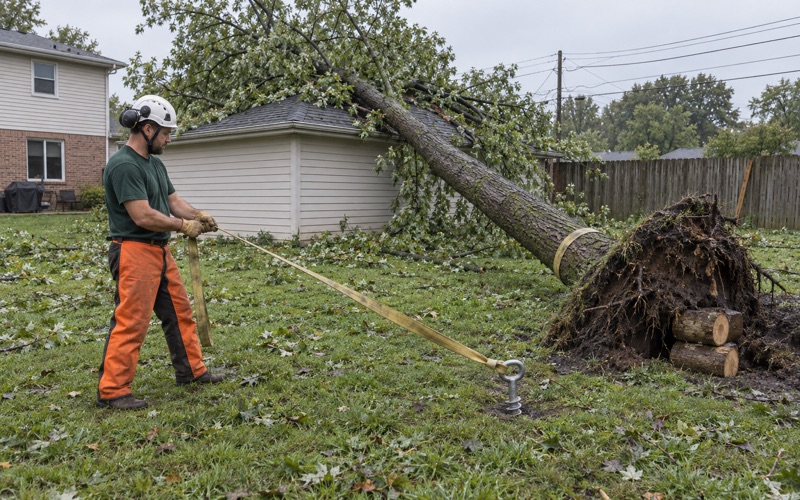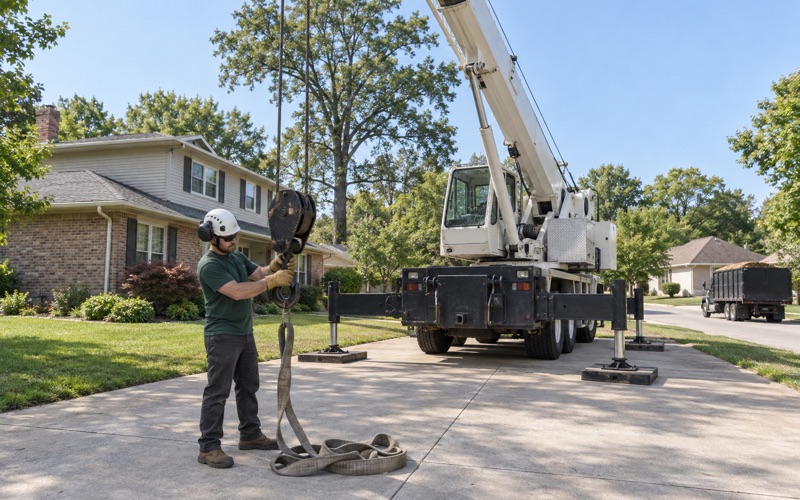
Blue Springs Tree Removal has handled tree removal in Peculiar for more than twenty years, working both sides of the state line out of the Kansas City metro. Peculiar is not a dense suburb, and that single fact changes almost everything about how a takedown gets planned, priced and hauled out of here. Large lots move the burn rules, the utility question and the disposal answer somewhere different than most homeowners expect.
What we bring to that is a written condition assessment rather than a figure scrawled on the back of a card, proof of insurance in your hands before a crew steps onto the property, and a plain answer about where the wood and the brush are going before the saw comes off the truck. The assessment is free and the quoted price is the price in writing. If the tree can be held with cabling or corrective pruning instead, we will price that and say so.
We also do not top trees, and we are happy to explain why when a competitor offers to. Everything below is what we have learned about doing this work inside this particular city limit.
The 200-yard setback that is genuinely achievable here
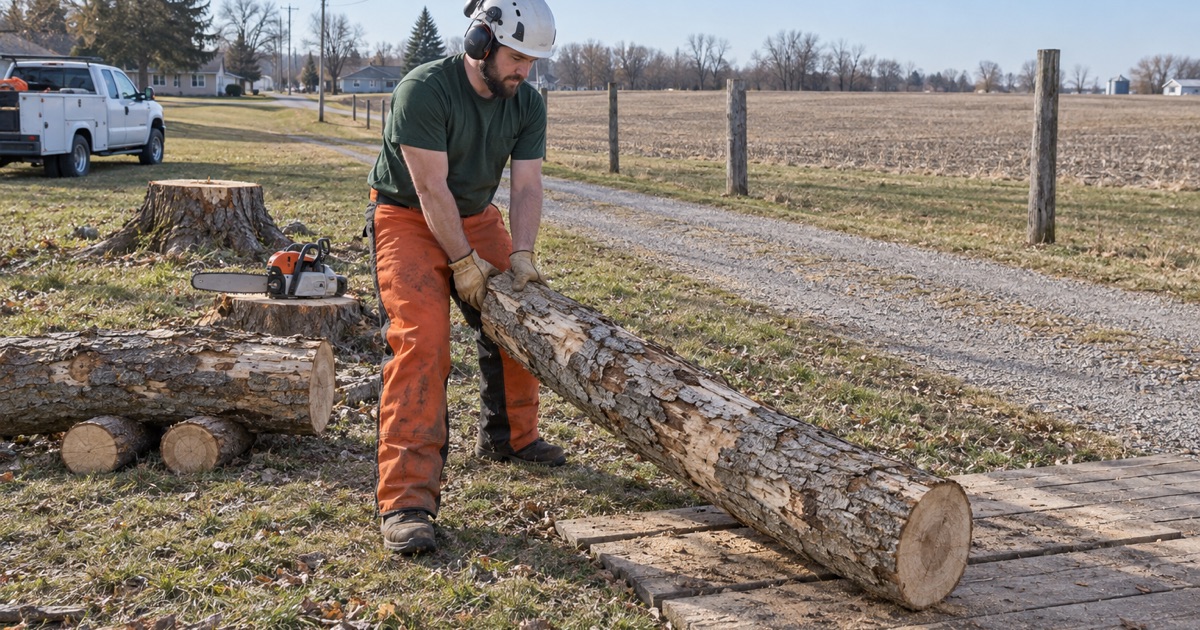
Missouri regulates open burning statewide under 10 CSR 10-6.045, and the rule counts tree trunks, tree limbs, tree trimmings, vegetation and yard waste as vegetative waste. The clause that governs a tree crew is subsection (3)(B)1, which puts commercial land clearing operations under the conditions in (3)(E) whenever the burn sits inside a city limit or less than two hundred yards from the nearest occupied structure. Those conditions are four: burning only between sunrise and sunset, a position at least 200 yards from the nearest structure, supervision at all times, and notification of the local fire control authority before the burn is started.
In most of the cities we work, that structure setback is where the conversation ends, because no residential lot in a subdivision can put a fire two hundred yards from a neighbor’s house. Peculiar is built differently. The city covers 9.065 square miles and carries 2,060 housing units, which works out to 227 units per square mile, and 200 yards is a little over a tenth of a mile. On some parcels here the nearest occupied structure genuinely is that far off.
Notifying the fire control authority is the real condition
Because the distance can be met on the right parcel, the condition that actually governs a land clearing burn here is the one everybody treats as paperwork: the local fire control authority serving the address has to be notified before anything is lit. We treat that as a phone call made in advance, not a form filed afterward, and we make it part of the plan when a burn is on the table. Supervision at all times means a person stays with the fire from ignition to the end, and sunrise to sunset means the burn is out before dark rather than smoldering overnight.
What the state rule leaves alone in Cass County
Two of the rule’s conditions attach only in ozone areas, and Cass County appears nowhere in the federal listing of Missouri ozone counties under any standard, so those two do not reach this address. What does still reach it is everything else in (3)(E), and the state rule is not a substitute for whatever the fire authority tells you when you call. We did not locate a municipal open burning ordinance for Peculiar, so we do not describe one; the office that serves your address is the office that answers that question.
Looking for tree-removal closer to Riverside? See Tree-Removal in Riverside.
Two electric providers, and why your bill decides your rights
The city’s own utility pages list two electric providers inside the city limits: Osage Valley Electric Cooperative and Evergy, Inc., each with its own phone number. That is not a formatting slip on a web page. It is how this city is shaped, and the same pages note that there are three different water providers within the city limits and invite residents to call the Utility Department at 816-779-2222 if they are not sure which one is theirs.
For most trades that is trivia. For ours it decides what rights a homeowner has when a utility crew trims or removes a tree. RSMo 537.340.3 defines an electric supplier to include a rural electric cooperative subject to chapter 394, along with certain municipal systems, and it does not reach an investor-owned electrical corporation. Osage Valley is a chapter 394 cooperative; Evergy is not.
So the statute’s fourteen-day notice before a utility removal, and the written right to demand that a partially trimmed tree which dies within three months be taken out at the supplier’s expense, read differently at one address than at the next one down the road. Which company feeds your meter is the deciding fact, and it is not something we can tell you from the curb. Pull the bill before you assume either answer applies to you.
When a limb is on the line
The same question is step one of an emergency. A conductor down, arcing, or a tree in contact with an energized line is a call to your own electric provider, and the city does not operate the electric system and cannot de-energize it for you. No private crew works near energized conductors, and the ANSI Z133 safety standard bars work near them during thunderstorms, high winds, snow or ice. We respond the same day when a tree is on a roof, a car or a line, and the first thing we ask is whose wire it is.
It matters again after a wind storm. Long spans of rural distribution line get restored after the dense circuits do, so an outage on acreage often runs longer than one in town under the very same warning. We plan storm work around that rather than around the forecast.
Two inches, four feet, once a month: where the debris actually goes
GFL Environmental holds the city’s curbside contract, and the yard waste terms are the operative fact of any removal in this city. Yard waste is collected on the second Friday of every month, not weekly, and the accepted materials are grass clippings, leaves, plants, small shrubs, and small limbs and branches. Every limb and branch has to be individually less than two inches in diameter and four feet in length. Bundles are tied with string or rope, no wire, no more than 24 inches across, and the limit is 25 bags or bundles.
Read the cap and the calendar together and the consequence is sharp. A tree taken down on the thirteenth waits nearly four weeks for a route that will not accept anything thicker than a broom handle, and yard waste has to be in proper biodegradable bags, never plastic, never mixed with trash, never in a drum or a trash container. Nothing a takedown produces qualifies. That is why the debris leaves with us instead of sitting at your curb waiting to be refused.
No gate here, and none in the county
There is no yard waste drop-off in Peculiar and no public one operated by Cass County. The regional recycling directory routes residents here to Kansas City Composting on East 171st Street in Belton, a private facility in another city, whose published Missouri terms take brush and logs under 10 feet in length and logs up to 40 inches in diameter if they are under 5 feet long. What that yard refuses is the interesting part: stumps with dirt on them, tangled debris, brush over 10 feet, landscape timbers, building materials, plastic bags, trash, dirt or rock, and railroad ties.
A pulled stump carries dirt by definition, so it has no outlet within reach, and that is the practical reason we grind in place rather than excavate. Missouri law separately bars yard waste from a solid waste disposal area, which is why every destination in this direction is a composter and not a landfill.
What the work looks like on a Peculiar parcel
Roughly 81.60 percent of the housing here is one-unit detached and 73.83 percent of occupied units are owner occupied, so almost every job is a homeowner’s own decision on their own ground. Nearly half the stock, 45.34 percent, went up in 2000 or later, which means a great many of the yard trees were planted at the same time and are now hitting the age where a species choice starts to show.
Two jobs on one property
On the built acre the species list is the suburban one the extension services warn about. Johnson County K-State Extension’s list of recommended landscape trees for metropolitan Kansas City puts silver maple, pin oak, green ash, Austrian pine, Scotch pine, box elder, Bradford pear, Lombardy poplar, Siberian elm and willow in the not-recommended column, and instructs outright that the Bradford cultivar not be planted because severe splitting occurs on ten to fifteen year old trees. Those are the trees we get called to after a wind event, usually at a co-dominant stem with included bark.
One removal here is genuinely deadline-driven. K-State’s L722 records that Scots pine plantings in eastern Kansas have been devastated by pine wilt, which shows itself between August and December; the guidance is to take the tree down as soon as possible and by May 1 at the latest, with April 1 better, cut to the ground with no stump left, and chip or burn the wood immediately rather than saving it for firewood. If you have a browning pine on the place in October, that is the one job that will not wait for spring.
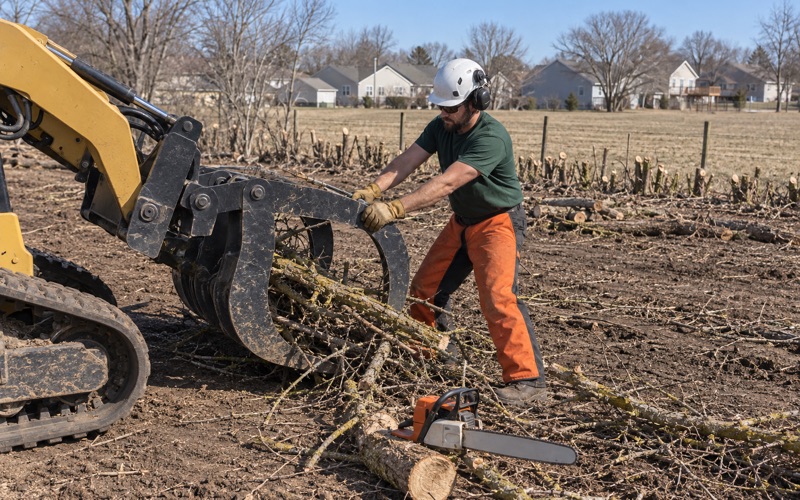
Past the mown ground the work stops being a takedown at all. This is Wooded Osage Plains country, a prairie matrix with oak woodland rather than an unbroken forest, and what grows back on unmanaged acreage is Osage orange fencerow, called hedge locally and no longer needed for farming, along with eastern redcedar pushing into old pasture. That is forestry mulching and lot clearing, priced by the acre and by access, and it is a different machine and a different day than a removal in a front yard.
Stumps, permits and what nobody signs off on
We found no trees or vegetation chapter and no tree removal permit anywhere in this city’s published code, and the Codes Enforcement Division’s own list of what it handles names weeds or tall grass, lack of property maintenance, unlicensed or inoperable vehicles, trash or debris in a yard, and other situations, with no tree or dead-limb duty on it. Take that as it reads rather than as a promise: none was found on the city’s own pages. The practical effect is that a dead tree on private ground here is a risk assessment you make yourself, not a letter that arrives and forces the decision.
On the stumps themselves, the shallow-rock story that shortens grinding elsewhere does not hold on this ground. The deep loess soils in this part of the county run well past 60 inches to bedrock, so a grinder rated at roughly 12 to 25 inches below grade hits its own stop before it hits rock, with the shallower shale-over-clay soils as the named exception. We will not promise you a below-grade depth sight unseen, and before any grinding starts we place the Missouri One Call locate, which is not optional on parcels where private water lines, septic laterals and service runs cross ground nobody has a plat for.
None of this is complicated once somebody lays it out, but nobody in this trade lays it out. If you want a written assessment of what is standing on your property and a straight answer about where it goes, the visit is free and the quote is the number you will pay.
- 20+ Years in the KC Metro
- Free On-Site Assessment
- Written Price, Insured Crews