Blue Springs Tree Removal has been doing tree removal in Pleasant Hill for more than twenty years, on both sides of the state line and in every jurisdiction between them. Pleasant Hill is one of the few cities on our map where the paperwork question has two entirely different answers depending on where the tree is standing. Get that distinction wrong and you either wait on an approval you never needed, or cut a tree the city holds authority over.
The short version: nothing is required of you to take down a tree on your own finished lot here, while a contractor pruning or removing a street or park tree for hire has to hold a Pleasant Hill occupational license first. That is not a permit in the ordinary sense, and the ordinance says so in its own odd way. We work the distinction out on the first visit, before you have paid anyone anything.
Every removal we quote starts with a free on-site assessment and a written condition report, not a figure on the back of a card. If the tree can be held with cabling or a sensible reduction instead, we price that and say why.
What Pleasant Hill regulates, and what it leaves alone
Ordinance 1782 and the sections that carry it
Pleasant Hill’s tree rules arrived as Ordinance 1782, carried as Bill 17-11-A and read and approved on December 11, 2017. It amended Chapter 50, the Vegetation Code, adding a Tree Maintenance and Care article that runs from Section 50-68 through Section 50-83. One quirk if you go looking for it: the ordinance’s header, its first section and the body it adopts disagree on the article designation, though the section numbers are consistent throughout. We cite sections rather than articles for that reason.
Section 50-75 is a business credential, not a permit
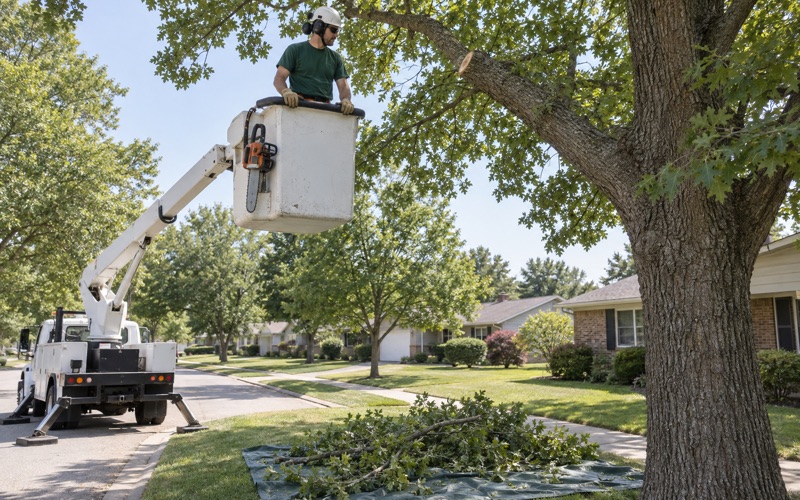
Section 50-75 is captioned PERMITS REQUIRED and requires no permit. What it says is that it is unlawful for any person or firm to engage in the business or occupation of pruning, treating, or removing street or park trees within the city without first applying and procuring a city occupational license. That obligation lands on the contractor, not the property owner, and only on street and park work. It is the most misread line in this city’s code, because the caption promises one thing and the text does another.
Section 50-78 and who may touch a public tree
Section 50-78 makes it unlawful for anyone other than city officials, agents and employees to prune, maintain, preserve, spray, trim or remove a street tree without the written approval of the Public Works Director. Removing or planting a tree in a city park needs the written approval of the Parks and Recreation Director, and a public tree needs the written approval of whichever department holds that power. Chapter 50 defines a street tree broadly, as woody vegetation on land between property lines on either side of any street, avenue or way in the city, which is wider than most people picture. Before we cut anything near a curb line here, we establish who owns the tree.
Nothing at all for your own back-yard tree
No permit is required to remove a tree standing on your own finished private lot in Pleasant Hill. The code’s approval machinery attaches to street trees, park trees and public trees, and a tree in your fenced back yard is none of the three.
Looking for tree-removal closer to Odessa? See Tree-Removal Services in Odessa.
The route the city takes to a tree on private land
A Tree Board order runs on a 60-day clock
Section 50-74(C) lets the City Tree Board order trees on private land pruned, removed or treated where they cause obstructions, present an insect or disease problem, or otherwise endanger public health or safety. The city notifies the owner in writing, and the work must be done by the owner at the owner’s own expense within 60 days after the date of service of that notice. If it is not done, the city may do the work and charge the cost on the owner’s property tax notice. An owner who disagrees may appeal the ruling or order to the City Council, in writing, within 30 days of service.
That order, not a permit, is the real compliance trigger here: a deadline with a lien behind it. Call us with the notice in hand and we will quote to the date printed on it.
The arborist whose opinion settles a hazard call
Where a determination of definition or identification of tree hazard is needed, Section 50-70 says the opinion of the City Arborist, or a designee, prevails. Section 50-72 seats that arborist on an eleven-member City Tree Board charged with an annual Tree Management Plan and an annual Official Tree List. Section 50-73(D) adopts a standard by name, requiring all public tree maintenance to conform to the ANSI A300 standards for tree care operations. We write our condition assessments to sit alongside a determination like that.
The duty the code puts on you
Section 50-76 disclaims city liability and then states the owner’s duty plainly: the owner of any private property has a duty to keep the trees upon the property and under their control in a safe and healthy condition. Missouri’s background rule runs the other way for healthy trees: the state follows what courts call the Massachusetts Rule, and gives no cause of action for the encroaching roots or branches of a healthy neighboring tree. Liability does attach where an owner keeps a tree in a damaged, decayed or diseased condition, and this ordinance writes an affirmative duty on top of that. It is why we document condition in writing whether or not you buy the removal.
Two tree cohorts, sixty years apart on one street grid
Pleasant Hill’s housing stock is split, and the split shows up in what we take down. There are 566 units here built between 1960 and 1969 against only 157 from the whole of the 1970s, and another 25.29 percent of the stock arrived in the 2000s. Those are two planting generations sixty years apart, failing in different ways on the same street grid.
The 1960s yards
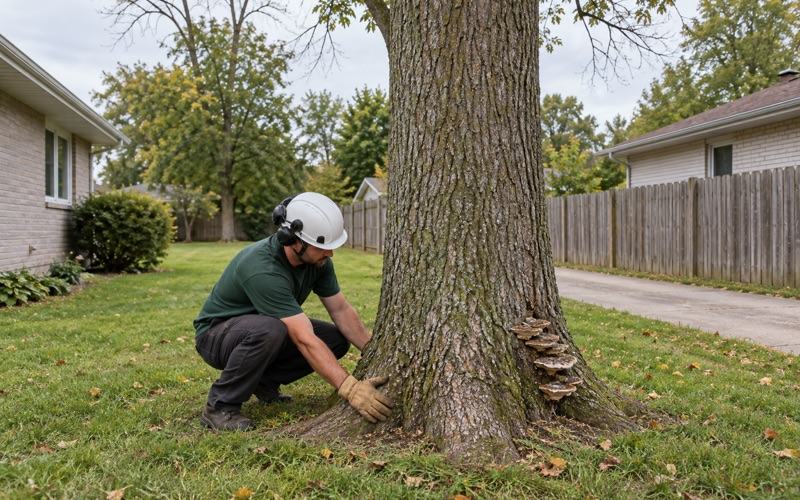
A tree set beside a new house in 1965 is now a full-size specimen with its root plate under a driveway and its crown over a roof. What we look for on those lots is heartwood decay, a conk at the root flare, co-dominant stems with included bark, and epicormic sprouts on a stressed leader. Silver maple, pin oak and green ash all sit on the Johnson County K-State Extension not-recommended list for the Kansas City area, for weak wood, soil problems and emerald ash borer, and all three were planted freely in that decade. Removals on these lots are rigging work more often than felling work, run on a bull rope and a friction device with a drop zone nobody stands in.
The 2000s subdivisions
The 2000s cohort is the planting generation that received Bradford pear, and the extension’s instruction on it is flat: do not plant the Bradford cultivar, because severe splitting occurs on ten to fifteen year old trees. Those trees are now well past that window. Callery pear also carries weak crotches, splits or blows over in wind, and throws vigorous sprouts from the stump that grow back into the thorny invasive form, so the lateral roots come out with the stump or the tree returns.
Pine wilt is the one removal in this trade that runs on a calendar. K-State’s guidance records that Scots pine plantings in eastern Kansas have been devastated by it, and the instruction is to cut the tree down by May 1 at the latest, take it to the ground leaving no stump, and chip or burn the wood immediately. It also says not to save the wood for firewood, which collides with any firewood credit someone offers you against the bill. We tell you where the wood and the brush are going before the saw comes out of the truck, and on a pine wilt job the answer is never your woodpile.
What the code calls a removal, and what it calls topping
Section 50-71 defines removal as cutting or removing fifty percent or more of a crown, trunk or root system, or any action causing the loss of aesthetic or physiological viability, so a heavy reduction here can legally be a removal. The same section defines topping as the severe cutting back of limbs larger than six inches in diameter within the crown, and Section 50-77 makes it unlawful as normal practice on a public tree while naming crown reduction by a qualified arborist as the substitute. That prohibition does not reach a private tree, but we do not top trees on either side of the line, and we will walk you through the decay and sprout response that follow a topping cut when somebody else offers to.
Storm work, and the brush that comes after
Every tornado warning and ice storm advisory that reaches the Kansas City metro is issued from a building in this city. The National Weather Service Forecast Office Kansas City sits at 1803 North 7 Highway, under call sign EAX with radar KEAX. That office publishes that since 1950 more than 300 tornadoes have been reported in the area it now serves, which is a multi-state county warning area rather than a metro count.
Who to call first when it is on a line
Pleasant Hill is on Evergy Missouri West, an investor-owned utility, and that changes one thing worth knowing. The Missouri statute that lets a homeowner ask an electric supplier to remove a tree at the supplier’s expense is written for cooperatives and municipal systems, and on its face does not appear to reach an investor-owned corporation, so do not plan around a free removal. What Evergy does publish for Missouri is that the service drop from the pole to your meter is the customer’s responsibility, and that requests for assistance are evaluated by inspection first.
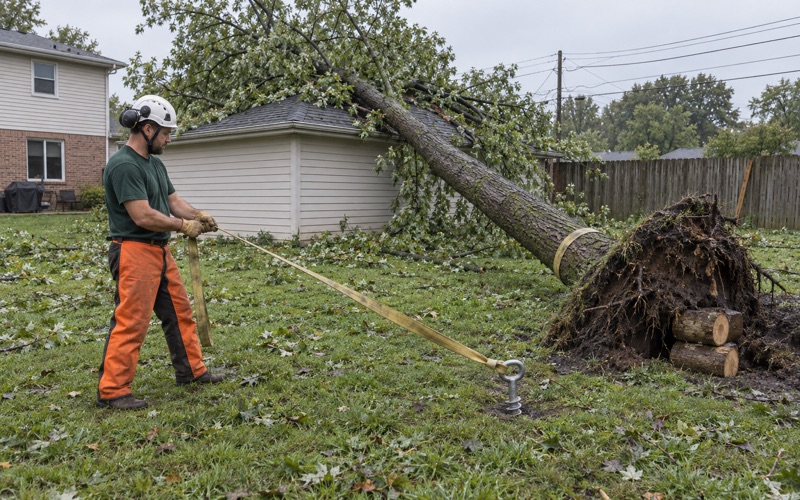
If a conductor is down or a tree is touching an energized line, treat it as live, keep everyone back and call the utility rather than a tree crew. No private crew works near energized conductors, and the ANSI Z133 safety standard forbids that work outright during thunderstorms, high winds, snow storms or ice storms. A tree across a city street or a sidewalk is Public Works; a tree across Route 7 or MO 58 is MoDOT. We answer the same day when a tree is on a roof, a car or a line, and that order of calls does not change because we are busy.
Brush, stumps and where it all goes
Curbside yard waste in Pleasant Hill runs weekly, year-round and unlimited, and tree limbs and tree trimmings are named in it; bags are 30 pounds or less and limbs are bundled with twine or rope. Be careful with one figure: the hauler and the city publish different maximum bundle lengths, so confirm which one your route works to. On our jobs it is moot, because the debris leaves with us and nothing is stacked at your curb for the city to refuse.
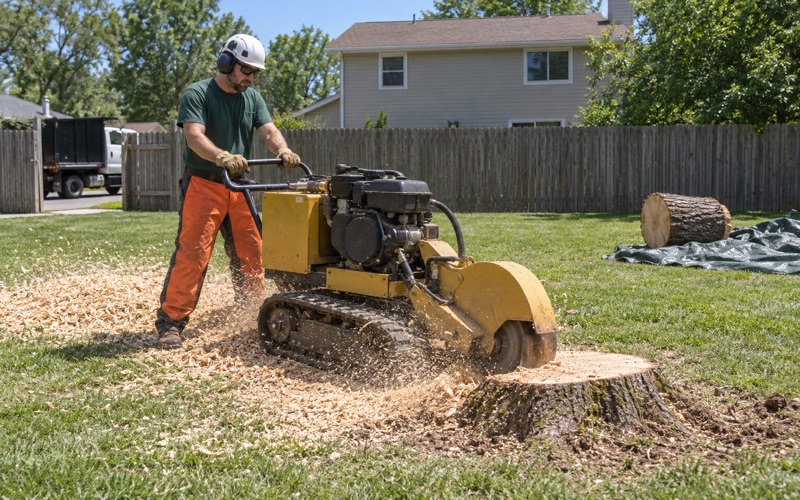
Cass County has no public yard-waste gate, and the county’s only outlet is a private composter whose published terms refuse stumps with dirt attached, which is why grinding is the economical choice here rather than pulling. The ground under this city is deep loess and prairie soil rather than the shallow rock that gets written into tree copy elsewhere, so on most lots the machine’s own cut limit stops the job first. We will not quote a depth sight unseen, and we call in an 811 utility locate before the wheel turns, because a private line in a 1960s yard is what nobody has a record of.
Proof of insurance reaches you before any crew sets foot on the property. The price we quote is the price in writing.
- 20+ Years in the KC Metro
- Free On-Site Assessment
- Written Price, Insured Crews