Blue Springs Tree Removal handles tree removal in Prairie Village, Kansas, and we have been taking trees down across this metro for more than twenty years. The first question on a Prairie Village property is not how big the tree is or how close it stands to the house. It is what else is happening on the lot.
That is not how most people expect a tree ordinance to read. Prairie Village’s tree rules sit inside its zoning regulations, and they switch on when a construction project switches on, or when the tree in question stands in the public right-of-way. A homeowner with neither of those is looking at a different job than the one a search result probably told them to expect.
So we start every estimate here by working out which side of that line your tree falls on, and we put the answer in writing along with the price. We tell you where the wood and the brush are going before a saw comes out of the truck, and we carry all of it away, because the curb in this city will not take it.
Ordinance No. 2446 and the three ways it applies
The Governing Body passed Ordinance No. 2446 on March 15, 2021, and it took effect on June 1 of that year. It added Section 19.47.060, titled Tree Protection, to Chapter 19.47 of the municipal code, the chapter headed Landscape Standards, and it wrote three new definitions into Chapter 19.02.
What matters most is subsection (a), headed Applicability, because it has exactly three triggers and nothing outside them is regulated at all. The first is any removal of a tree in the public right-of-way, except one authorized by an official City project. The second reaches applications already subject to the chapter’s landscape standards. The third applies only in R-1A and R-1B residential zoning, and only to four listed construction situations.
That structure is the whole story, and it is why we ask about your plans before we ask about your tree. If you are not building, not demolishing, and not touching a tree in the right-of-way, the ordinance’s thresholds never engage. The city’s own Tree Board packet puts it in one line: back yard tree removal permits are not required, only the right of way trees.
The measurement is caliper, not DBH
One detail is worth getting right before anyone quotes you a number. The thresholds in Table 19-47-D are written in caliper, not in diameter at breast height. DBH shows up only in Table 19-47-E, the protective fencing table, and in the definition the ordinance added at Section 19.02.168, which fixes it at four and one-half feet above natural grade. Quoting the removal thresholds as DBH figures puts the tape in the wrong place on the trunk.
Two drafting errors in the adopted text
We read the adopted text rather than a summary of it, and it carries two internal inconsistencies worth knowing about. Subsection (c) points readers to Table 19-57-D while the table it means is captioned Table 19-47-D, so cite 19-47-D. Subsection (a)(2) refers to landscape standards in Section 19.47.010 (B), but that section’s own subsections are numbered 1 and 2, with no lettered parts at all. Neither is ours to resolve; both are reasons to confirm scope with staff rather than assume it.
Looking for tree-removal closer to Roeland Park? See Tree-Removal Services in Roeland Park.
Teardowns, additions and the ten percent rule
The third trigger is the one that catches most Prairie Village projects, and it is written as a list of four situations in R-1A and R-1B zoning. A new residential structure going up on a vacant lot counts. A teardown counts, whether it is a demolition on its own or a demolition followed by a rebuild. So does a remodel that adds more than 600 square feet to the existing building footprint, and so does a remodel that tears down more than 10 percent of the existing structure as part of the new construction.
Once one of those is in play, the thresholds in Table 19-47-D decide what can come out and what has to be replaced. The table sorts trees into four areas by where they stand rather than by what they are.
The four areas and their thresholds
Frontage trees are those 3 inches caliper or more on private property within 20 feet of the front lot line: protected from 3 to 6 inches with one-for-one replacement, and prohibited from removal at 6 inches and above, with mitigation of one tree for each 6 inches of caliper removed, capped at three. Lot trees sit outside the frontage and buildable areas at 6 inches or more, protected from 6 to 20 inches and prohibited at 20 inches and above, mitigated at one tree per 12 inches of caliper. Buildable area trees, inside the setbacks that apply to the principal building, are protected from 6 to 30 inches and prohibited at 30 inches and above, mitigated at one tree per 15 inches.
Two more rows apply everywhere. Street trees, meaning any tree in the public right-of-way, carry no protected size range at all: every one of them is prohibited from removal, with mitigation of one tree per 6 inches of caliper up to three. And any Kansas Champion Tree, a designation the ordinance borrows from the Kansas Forest Service’s state register rather than maintaining itself, is prohibited across all four areas. Replacement trees have to be at least 2 inches caliper.
Fencing radius on a small lot
Table 19-47-E sets the protective fencing radius by DBH: 20 feet from the center of the tree above 28 inches, 15 feet from 20 to 28 inches, and 10 feet below 20 inches, or whatever area protects at least 75 percent of the drip line, whichever is lesser. A footnote lets the Director approve 15 feet above 28 inches and 10 feet up to 28 inches on lots under 10,000 square feet, and on a 1941 plat laid out to a 65-foot street frontage a great many lots are. Fences run at least 4 feet high with a 5-foot minimum radius, and grade changes of more than 2 inches inside them are off limits.
The right-of-way trigger, and the way out
The first trigger is the one that reaches a finished, occupied lot with no project on it. Any removal of a right-of-way tree is a regulated act under subsection (a)(1), with no size floor anywhere in the language, and Table 19-47-D prohibits removal of every street tree regardless of caliper. If the tree you are worried about stands in the curb strip, the route runs through the city before a saw starts, whatever its condition.
Written authorization from the Building Official
Subsection (e) puts exceptions with the Prairie Village Building Official, on a written request that identifies the specific tree and documents why it has to come out. The Building Official generally grants the exception where a tree is dead, where it is diseased or dying and threatens healthy trees, property or public safety, or where removal is necessary for construction under a three-part test: reasonable efforts through comparable alternative designs, undue financial burden, and no other reasonable accommodation, including adjusting the otherwise allowable footprint or site design.
That official may seek advice from the Prairie Village Tree Board, from other staff or departments, or from a third-party consultant, and the written authorization lasts as long as the permit it attaches to. Appeals run under Section 19.54.025, except where the application is tied to a site plan the Planning Commission approved. In practice the dead-or-dying route is a documentation exercise: somebody has to write down what is wrong with the tree, which is exactly what our written condition assessment is for.
Enforcement counts trees, not incidents
Subsection (f) makes removal, damage or impairment of a protected tree a violation enforceable under Section 19.01.045, and it says each tree is a separate incident, with fines and penalties on top of the mitigation planting already owed. The adopted text names no dollar figure; a $500-per-tree number circulates from the city’s Tree Board page and news coverage rather than from the ordinance itself, so we treat it as the city’s figure and not the code’s. Either way, the arithmetic runs per trunk, which is why we settle applicability in writing before we schedule anything.
A housing stock built in a single decade
Prairie Village holds 10,287 housing units on 6.211 square miles, and 4,667 of them, 45.37 percent of the entire stock, went up between 1950 and 1959. More than four-fifths of the city predates 1980, 84.37 percent is one-unit detached, and 7,245 units are owner-occupied single-family detached houses. Trees planted with a subdivision that size age on the same schedule the houses do.
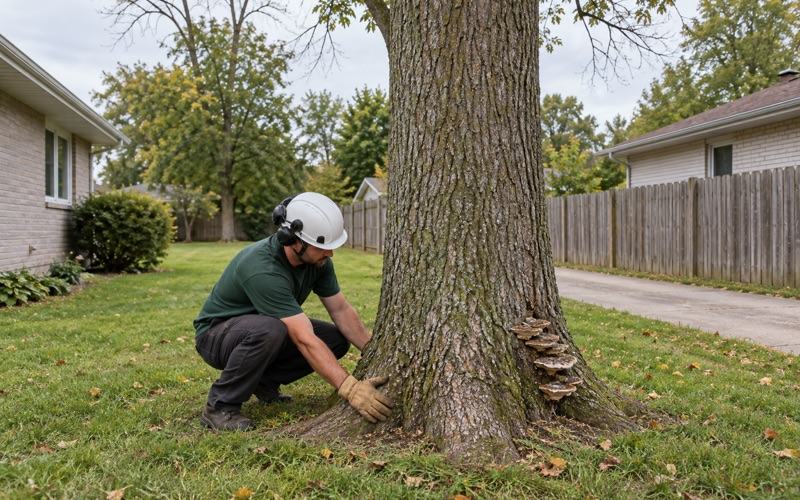
That is the practical reason failures arrive here in waves rather than one at a time. Co-dominant stems with included bark, a split leader, a conk at the root flare: the same defects show up on the same block in the same season, and the sensible answer is usually a sequence of jobs across a couple of years rather than one enormous day. When a tree can be held with cabling and bracing or brought back with crown cleaning, we price that instead and say so.
Access on a 65-foot frontage
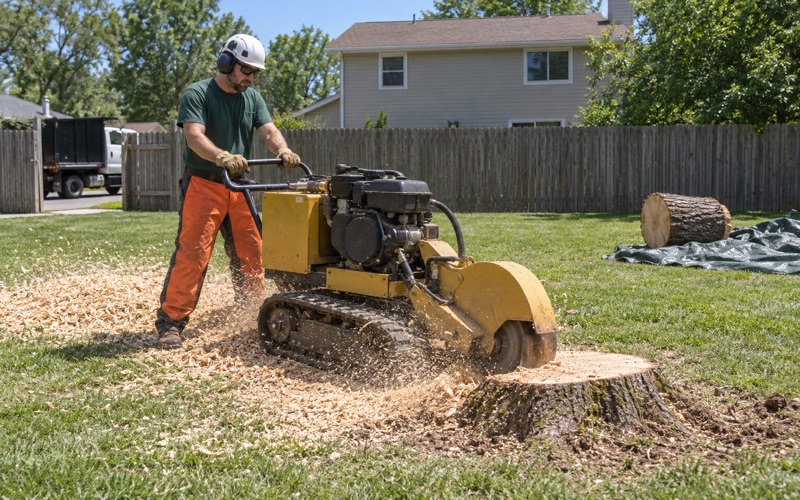
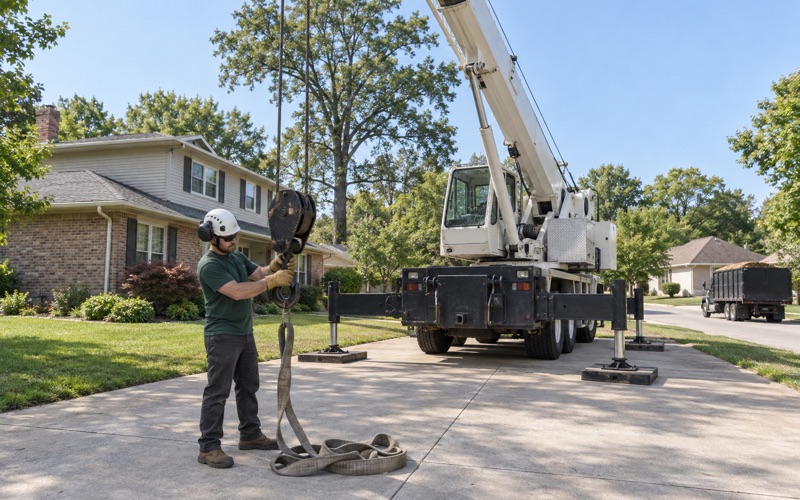
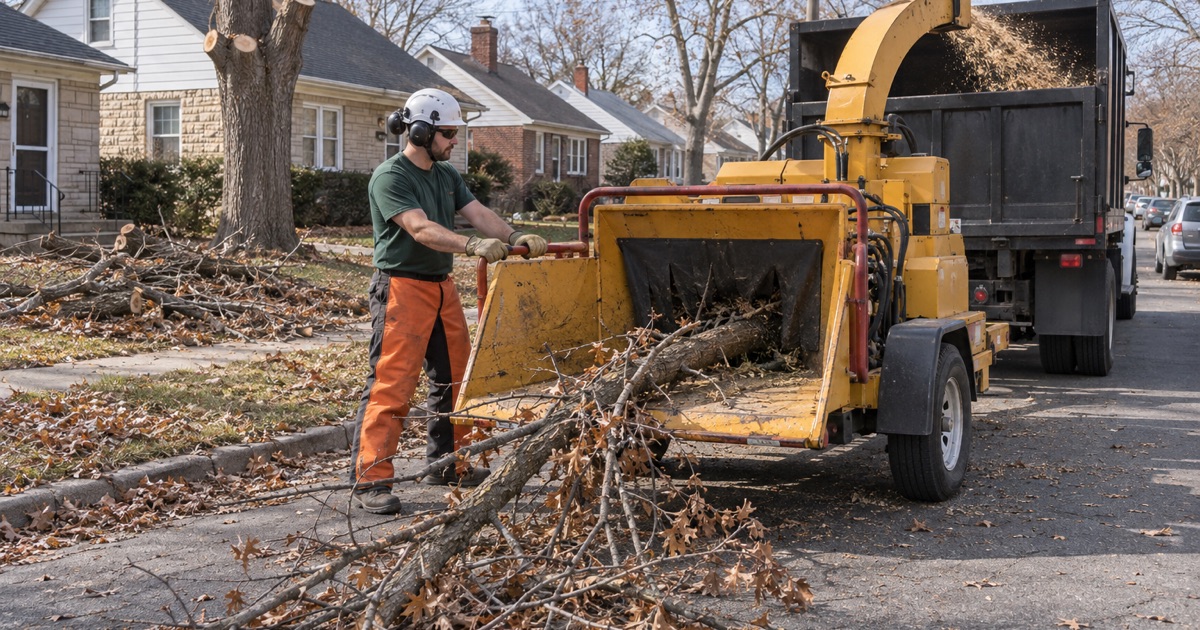
At 1,656 units per square mile on lots platted in 1941 to a 65-foot street frontage, crane reach and gate width bind at the same moment. A compact grinder gets through a 35-inch gate and a pedestrian-class machine through 25 inches, but the chipper never goes through a gate at all, so brush handling and carry distance are what actually set the price on a back-yard removal. We walk that route with you before quoting it, and we call 811 before any stump work, because services run close to the curb on a plat this old.
Where the wood goes
The city’s yard waste rules refuse removal wood in plain terms. Residents get 12 items a week year round; bundles run to 4 feet long, under 24 inches of circumference and under 50 pounds, tied with twine, with no individual branch over 3 inches in diameter, and logs are not accepted at all. Republic Services collects through December 31, 2026, with GFL Environmental taking over on January 1, 2027 at a 10-item weekly limit.
Behind the curb there is no county gate to fall back on either, so removal wood from Prairie Village crosses the state line to Missouri Organic Recycling in Kansas City, Missouri, at $10.00 per cubic yard for brush and $7.00 for lawn debris. That yard takes logs up to 40 inches in diameter if they are under 5 feet long and refuses stumps with dirt still on them. We tell you which of those the wood on your property is before the crew arrives, and it all leaves with us.
- 20+ Years in the KC Metro
- Free On-Site Assessment
- Written Price, Insured Crews