Blue Springs Tree Removal has been doing tree removal in Raymore and across this metro area for more than twenty years, on both sides of the state line. Most of the cities we work in give a homeowner nothing official to check before hiring a crew, because Missouri issues no arborist or tree contractor credential of any kind. Raymore is the exception, and it is worth knowing about before you call anyone.
The city says so itself. On its own pages it tells residents that all contractors performing work in Raymore must be licensed with the City, and that you should always ask for proof of a City license before hiring a contractor. That is a real, checkable thing, and it is rarer than it sounds.
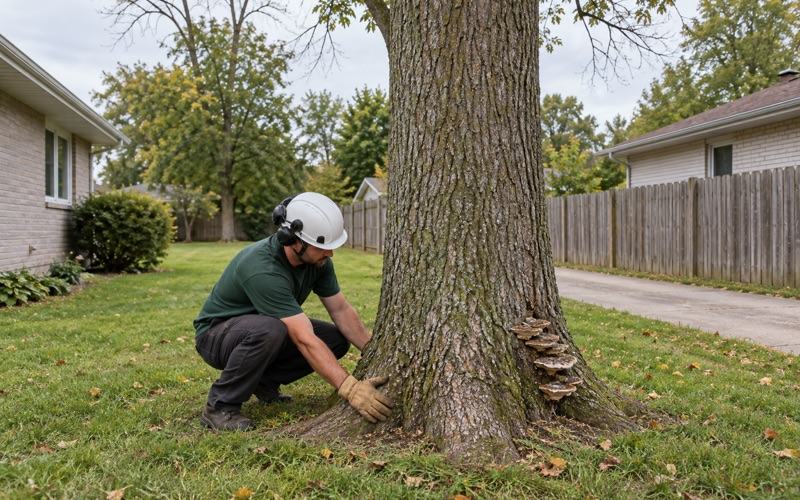
What we bring to a Raymore property is the rest of it: a written condition assessment rather than a number on the back of a card, proof of insurance in your hands before a crew steps onto the lot, a quoted price that stays the quoted price, and a plain answer about where the wood and the brush are going. If the tree can be kept with cabling or pruning, we will price that instead and tell you why.
The one credential a Raymore homeowner can check
The sentence the city publishes
After a storm the city addresses homeowners directly: hiring a tree service for cleanup instead, it says, be sure they are licensed with the City of Raymore, and it points to a list of licensed landscapers. The occupation license runs through the City Clerk’s Office, and the code side of it is not merely advisory: it is unlawful for any person to engage in the construction contractor business without first obtaining a license as required by that chapter.
The application has teeth a homeowner benefits from without ever seeing it. Among other things it requires a certificate of insurance naming the City of Raymore, Missouri as a certificate holder for workers’ compensation coverage, or a signed affidavit in its place. Workers’ compensation is the single most expensive thing to be wrong about on a removal, which is why our proof of insurance reaches you before the crew does.
One honest limit, because you should hear it from us rather than find it later. The city’s own sentence sends a homeowner hiring a tree service to that list of licensed landscapers rather than to its contractor categories, so which record a tree service sits on is not something we will guess at in print. Ask the City Clerk’s Office which list to look at, and ask every bidder to produce theirs.
What licensed does not mean in Missouri
It does not mean a state credential, because there is no such thing here. Missouri issues no arborist license and no tree contractor license, and a company can put the word on a truck door without breaking a rule. The only state credential that touches this trade at all is a Department of Agriculture commercial applicator certification under chapter 281 RSMo, in Category 3, Ornamental and Turf, and that governs pesticide application rather than cutting a tree down.
So when an ad in this market uses the word, ask which license and who issued it. In Raymore that question has an answer at City Hall, which is not true of most places we work. What carries the weight on our side is the standard the crew cuts to: ANSI A300 for pruning, ANSI Z133 for safety, and no work near energized conductors during a thunderstorm, a high wind, or an ice event, whatever the schedule says.
Looking for tree-removal closer to Liberty? See Liberty Tree-Removal.
What the tree code covers, and what it does not require
Raymore carries a tree chapter of its own. Chapter 260, Tree Maintenance and Care, runs from Section 260.010 through Section 260.140 and includes a section on public tree care and maintenance, and it has been amended by ordinance in its own right. The Property Maintenance Code points straight at it, providing at Section 545.440 that tree maintenance be completed in accordance with Chapter 260, with the nuisance section following immediately after.
We are not going to tell you what an individual section of that chapter says, because a tree service quoting an ordinance it has skimmed is how a homeowner ends up with confident bad advice. What the chapter plainly establishes is that the city has a tree maintenance duty on the books and a code path for a tree that becomes a nuisance.
There is no removal permit for a finished lot
What Raymore does not have is a permit to take a tree off a private lot that is already built on. The preservation provision in the development code, Section 430.100 inside the landscaping and screening chapter, says the City may require preservation of existing trees or vegetation as part of a request in front of it, which is permissive by design. When the council debated strengthening it in 2022, the local account of that meeting described the existing language as having little teeth, with no strict requirement and no enforcement mechanism, working only as an optional consideration during a development negotiation.
The permit that does bite is about disturbance, not trees
Chapter 455 of the Unified Development Code, Natural Resource Protection, runs Section 455.010 through Section 455.050 and requires a land disturbance permit for any entity stripping vegetation, clearing and grubbing land, or creating any type of land disturbance. That is not a tree permit and it is not set off by taking down one dead oak in a back yard, but it is the rule to ask the city about before a wooded back half gets opened up or a fence line gets cleared end to end. Chapter 470 carries a variance route at Section 470.220.
We raise it at the estimate when a job looks like area clearing rather than tree work, and the right move is a call to the city rather than a threshold we invent. None of it touches the everyday removal: a dead tree, a split leader over the driveway, a pear that came apart in a storm.
A young canopy arriving at the age things break
Better than half of Raymore’s housing, 55.19 percent of it, was built in 2000 or later, and only 1.32 percent of the stock predates 1960. There are 6,960 owner-occupied single-family detached houses here, and most of them carry yard trees that went in the ground with the house or shortly after. That is a different tree population from an older town’s, and it fails in a different way.
A tree planted with a subdivision is even-aged, fast-grown, and often a species chosen for how quickly it filled a front yard rather than for how it would hold together at twenty-five feet. Extension guidance for this metro area lists silver maple, pin oak, green ash, Austrian pine, Scotch pine, box elder, Bradford pear, Lombardy poplar, Siberian elm and willow as not recommended, and it is blunt about one of them in particular: do not plant the Bradford cultivar, because severe splitting occurs on ten to fifteen year old trees. A tree that went in with a house in 2005 is well past that mark.
Callery pear, and why the stump decides the price
The Missouri Department of Conservation records that Callery pear has weak crotches, is easily split or knocked over by wind, and that vigorous sprouts appear at the stump. That second half changes how we quote it. Cutting the pear flush and leaving the stump buys a thicket of sprouts, so the grinding has to take the root flare and the laterals with it rather than the visible stub alone.
Silver maple is the other one that comes apart on these lots, and the conservation record says the same thing about it: it easily loses limbs in strong winds and in ice storms. Ice is what this stock is least ready for. The weather service recorded an ice storm across this part of the state on February 5 through 7 of 2019, with one-eighth to one-quarter inch of accretion, and an evenly aged canopy full of co-dominant stems and included bark takes that load in a way an older, self-pruned tree does not.
Pine wilt is the one removal with a calendar
A Scots or Austrian pine that browns out between August and December is usually pine wilt, and the K-State guidance on it reads as a deadline rather than a preference: take the tree down as soon as possible and by May 1 at the very latest, April 1 being better, cut it to the ground rather than leaving a stump, and chip or burn the wood immediately. It does not get saved for firewood. A pine going off-color in the fall is a call to make before spring, not after it.
Gates, service drops, and where the debris actually goes
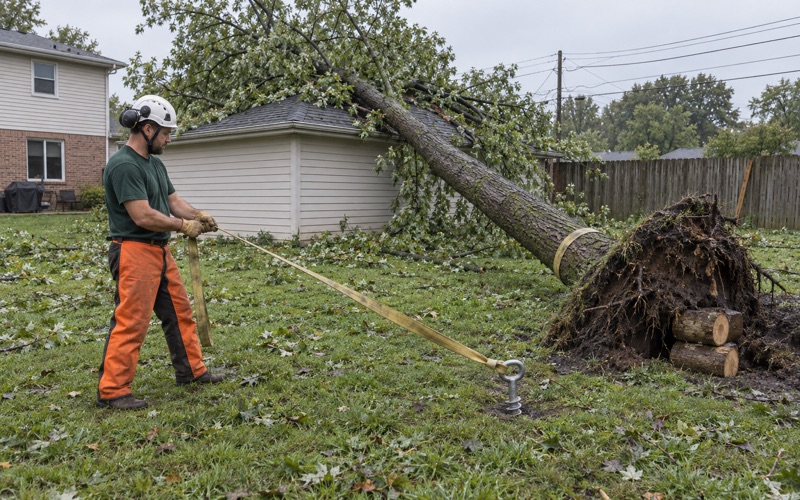
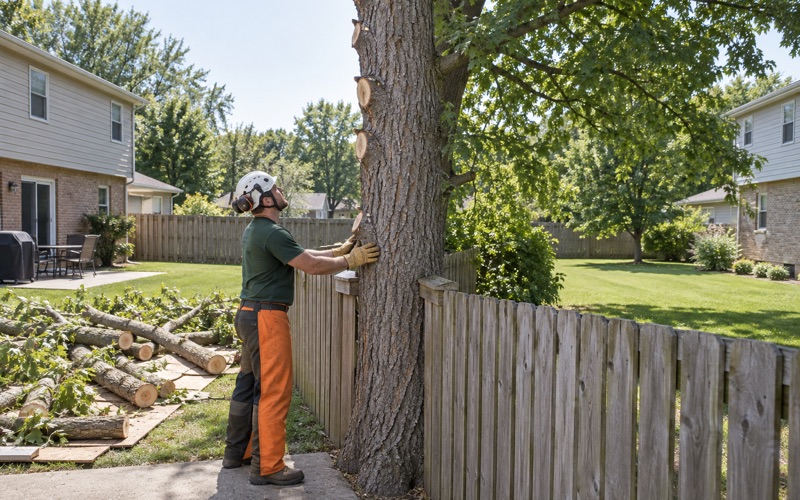
A fenced back yard is the standard Raymore removal, and the access question gets answered before the price does. A gate a chipper cannot pass turns a drive-up job into a rigged takedown: bull rope and a friction device, a drop zone measured against the fence and the neighboring roof, and brush carried out in pieces a person can hold. We would rather measure that gate at the free on-site assessment than discover it on the morning of the work.
The other constraint on these lots is overhead. The span from the pole to your meter is the service drop, and Evergy publishes that it belongs to the customer, which makes a limb lying across it your contractor’s work rather than a utility call. Higher up, in the primary conductors, it is the utility’s inspection to make: Evergy publishes that assistance requests are evaluated by inspection before work is assigned to a crew, that an assist normally covers overhanging branches and limbs within ten feet of energized conductors, and that debris is left at the worksite. A conductor down or arcing is an Evergy emergency call and not a City Hall one, because the city does not operate the electric system and cannot de-energize it.
The curb will not take a tree
Residential yard waste collection here is generous at one end and strict at the other. It is unlimited and runs year round, with no season and no container count, but limbs go out either in a biodegradable sack or in bundles no more than 3 feet long and 18 inches in diameter. Nothing that comes off a removal fits that, and the published rules draw no line between material a homeowner generated and material a crew did.
That is why the debris leaves on our trucks and nothing sits at your curb waiting to be refused. Missouri also bars yard waste from a solid waste disposal area under RSMo 260.250, so what we haul goes to a private composting yard outside the city limits rather than to a landfill, and those yards refuse a stump with dirt on it. Grinding in place is the economical answer to that rather than an upsell, since pulling a stump creates a piece of material almost nothing in reach will accept.
Before the grinder runs
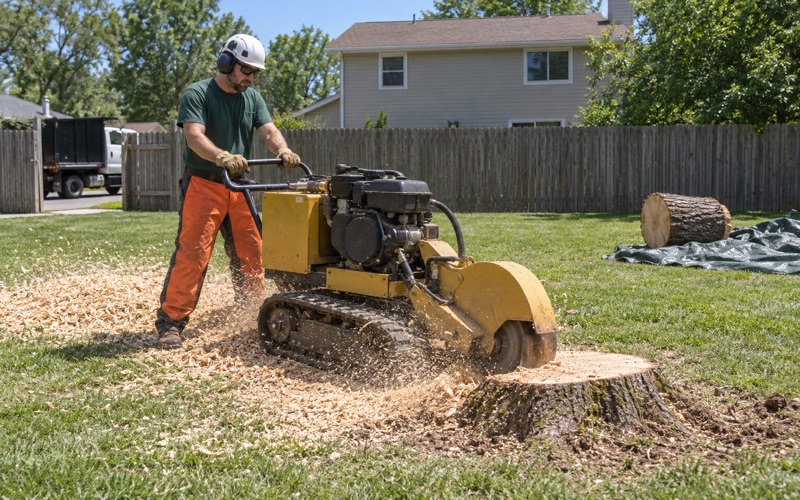
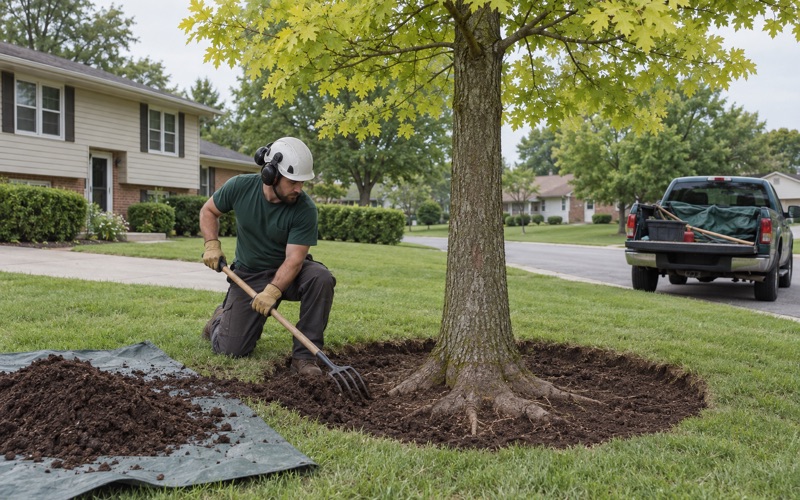
Every stump we grind gets a Missouri One Call locate first, under RSMo 319.010 and following, because a subdivision lot of this era has irrigation, low-voltage lighting and gas running through the same few inches of ground the tooth wheel is heading for. Below-grade depth is the one number we will not promise sight unseen, because the deep loess soils common on this ground usually let the machine’s own rated travel stop the cut before the ground does. What we will put in writing is the cut depth you are buying, where the grindings end up, and the price that will still be the price when the work is done.
- 20+ Years in the KC Metro
- Free On-Site Assessment
- Written Price, Insured Crews