Blue Springs Tree Removal has handled tree removal in Raytown for more than twenty years, working both sides of the state line across the Kansas City metro. Most of what we take down here was planted with the house, and most of those houses went up in the same two decades. That single fact shapes almost every estimate we write in this city.
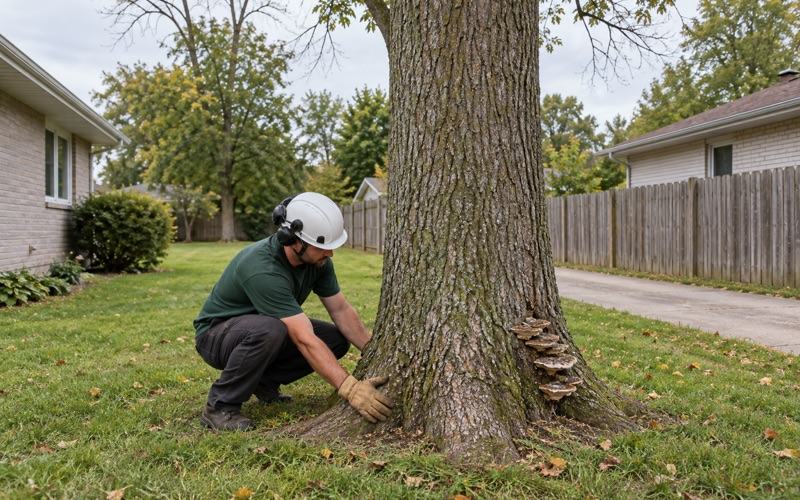
Every removal starts the same way: a free on-site assessment, a written condition report on the tree rather than a bare number, and a price that does not move after the crew arrives. Proof of insurance reaches you before anyone sets foot on the property. If cabling, bracing or a corrective prune would keep the tree standing, we price that instead and tell you why.
We also say where the wood and the brush are going before the saw comes out of the truck, which matters more in Raytown than in most places we work. Nothing is stacked at the curb waiting on a collection that this city does not run.
The ecoregion boundary along the north edge of town
Raytown sits in EPA Level IV ecoregion 40c, the Wooded Osage Plains, inside Level III ecoregion 40, the Central Irregular Plains. Two independent point queries against the EPA’s own mapping service returned 40c here, and the same layer returned 47f, the Rolling Loess Prairies, for control points a short distance north and west. A Level III boundary therefore runs between this city and the ground immediately above it, which is not a distinction most crews working the metro ever make.
The practical half of that is one word: unglaciated. EPA describes 40c physiography as unglaciated low cuestas and gentle undulating plains, with surficial material running to sandy clay, silty clay and clay decomposition residuum over alternating layers of Pennsylvanian sandstone, limestone and shale. Ground that never carried ice is ground where rock can sit close to the surface, and that changes what we can promise about a stump before we see the lot.
Oak woodland, and the species nobody should have planted
EPA gives 40c’s potential natural vegetation as little bluestem-sideoats grama prairie, big bluestem-Indiangrass prairie, cordgrass wet prairie and oak woodlands, and the mature canopy we work in Raytown reads that way: oak and hickory on the older lots, with the usual suburban additions crowded in around them. The ground a few miles north falls in a different Level III region and carries a different natural vegetation, so a species description borrowed from up there does not describe this city.
Those additions are the removal book. K-State Research and Extension’s Johnson County office keeps a list of trees not recommended for the Kansas City area, and it names silver maple for weak wood, pin oak for soil issues, green ash for emerald ash borer, along with Austrian pine, Scotch pine, box elder, Bradford pear, Lombardy poplar, Siberian elm and willow. The Missouri Department of Conservation puts it plainly for silver maple, which easily loses limbs in strong winds and in ice storms. Extension is blunter still about the Bradford cultivar, warning that severe splitting occurs on trees ten to fifteen years old.
Looking for tree-removal closer to Greenwood? See Greenwood Tree-Removal.
One cohort of houses, one cohort of trees
Raytown’s housing stock is not spread evenly across the twentieth century. Census estimates put 35.41 percent of its units in 1950-59 alone and another 23.87 percent in 1960-69, so roughly 59 percent of every house in the city came out of two decades. The trees planted with those houses were planted on the same schedule.
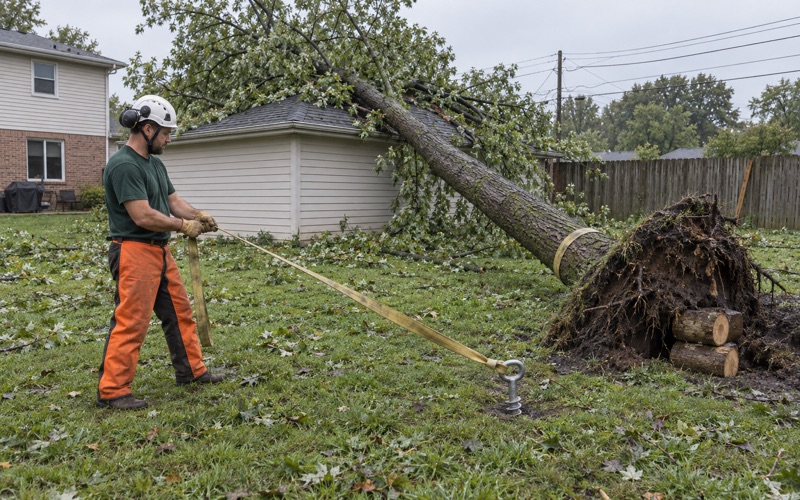
A canopy that goes in together comes apart together. Seventy years on, a street of silver maples set out behind new houses in the 1950s does not fail one tree at a time; it fails across a block in the same storm, because the wood reached the same age and the same size in the same season. We see it in the call pattern after every wind event in this city, and it is the reason we push condition assessments on whole streets rather than single trees.
Density is the other half of the problem
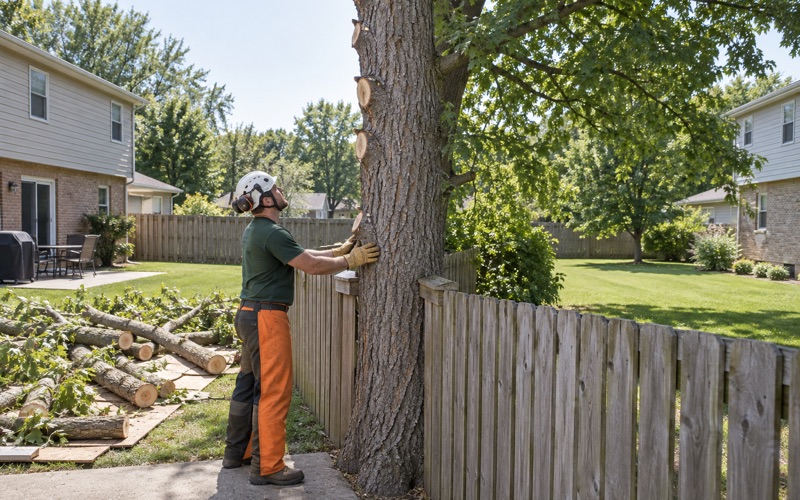
Raytown holds 13,452 housing units on 9.931 square miles, or 1,355 units per square mile, and 82.12 percent of them are single-unit detached houses. There are 8,008 owner-occupied single-family detached homes in the city. That density is what turns a routine removal into a rigging job: at that spacing the drop zone a big maple needs usually belongs to somebody else.
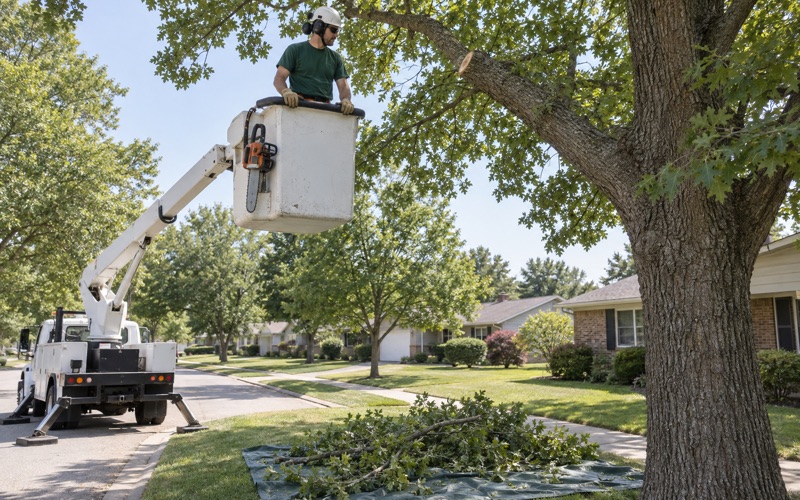
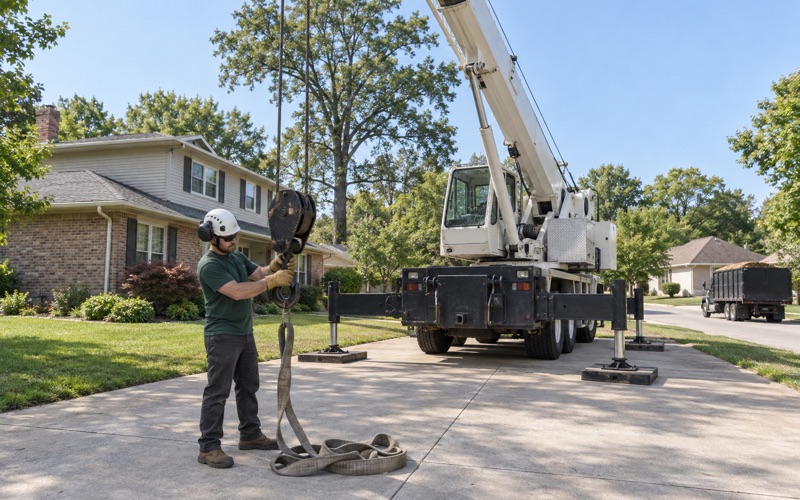
So most of what we do here is lowered rather than dropped. A bull rope through a Port-a-Wrap friction device, a rigging point chosen for its working load limit rather than its convenience, and the three-cut method on limbs coming over a fence line: that is the ordinary shape of a Raytown removal, and it is slower than a felling job by design. Where the setback leaves us nothing at all, a crane-assisted removal lifts the wood out over the roof instead of past it.
A built-out city, and the permit that catches people out
Raytown’s comprehensive plan describes a city with almost nothing left to build on: less than 8 percent of its total area is currently undeveloped, and over 63 percent is in residential use. The plan is equally direct about where that remaining land is, noting rugged terrain and 100-year floodplain, with residential construction having occurred largely along Round Grove Creek, the upper reaches of the White Oak Creek and along the tributary of the Little Blue River. Those creek corridors are where the hard-access work sits, and where a job needs planning rather than a bigger truck.
The same plan flags something unusual about the street pattern. Public right-of-way in Raytown totals approximately 16 percent of its entire land area, which the plan attributes to an extensive web of roads in a city that is almost fully developed. On lots this small, a removal that is nominally on private ground still puts the chipper, the truck and the cone taper in public space.
No permit for the tree, a permit for the street
No permit is required to remove a tree on a finished private lot in Raytown. Work in the city’s right-of-way is a different matter, and Public Works states it plainly: no work in the City’s Right of Way may begin until a permit is issued, a Raytown business license is also required, and the job must be completed within 60 calendar days from the date the permit is issued. The published fees are a $125 application fee for every 200 contiguous feet, a $70 Temporary Traffic Control Fee and a $50 Street Cut Fee for each cut.
On private ground the trigger is code enforcement rather than permitting. Raytown’s Code Enforcement Division is responsible for enforcing property maintenance regulations and general nuisance codes within the city, so a dead or hazardous tree usually reaches an owner as a notice with a deadline attached. The city also holds the right and responsibility to ensure proper and safe use of the right-of-way while the property owner is required to maintain this area, including keeping the sidewalk area free of brush and tree limbs.
Neither Missouri nor Kansas licenses tree work at the state level, which means a license number proves nothing about the crew in your driveway. What we hand you instead is proof of insurance before the first cut, a written assessment of the tree’s condition, and work performed to the ANSI A300 pruning standard and the Z133 safety rules that govern how a crew is allowed to work near an energized conductor in the first place.
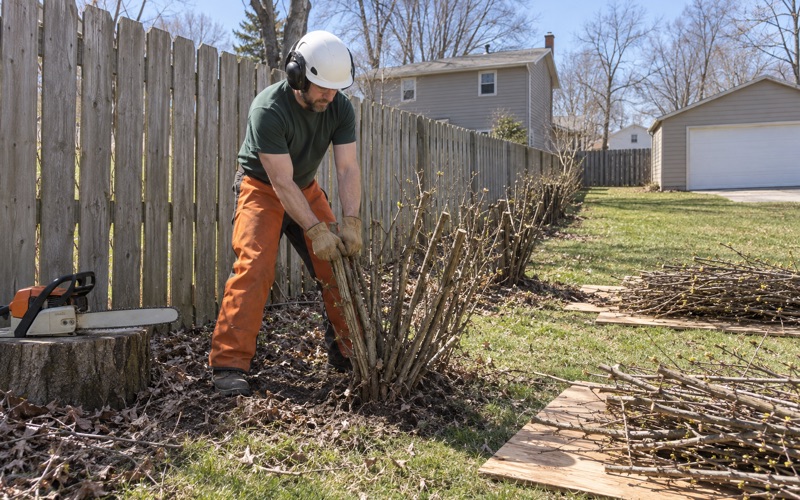
Stumps on unglaciated ground, and where the debris goes
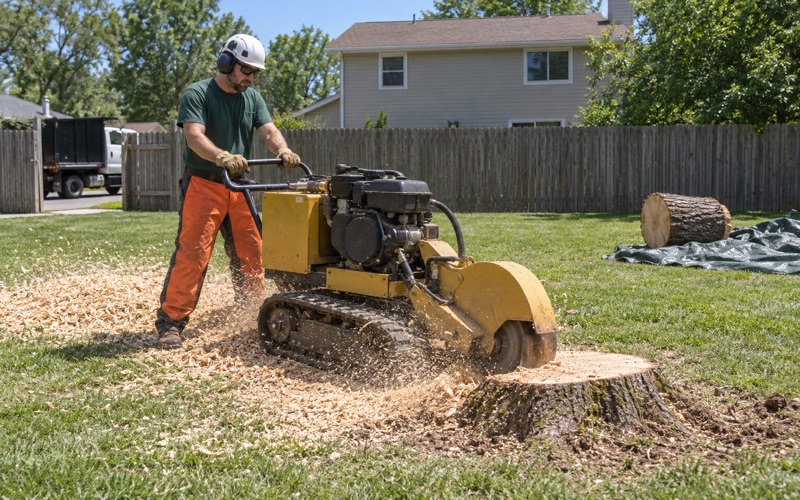
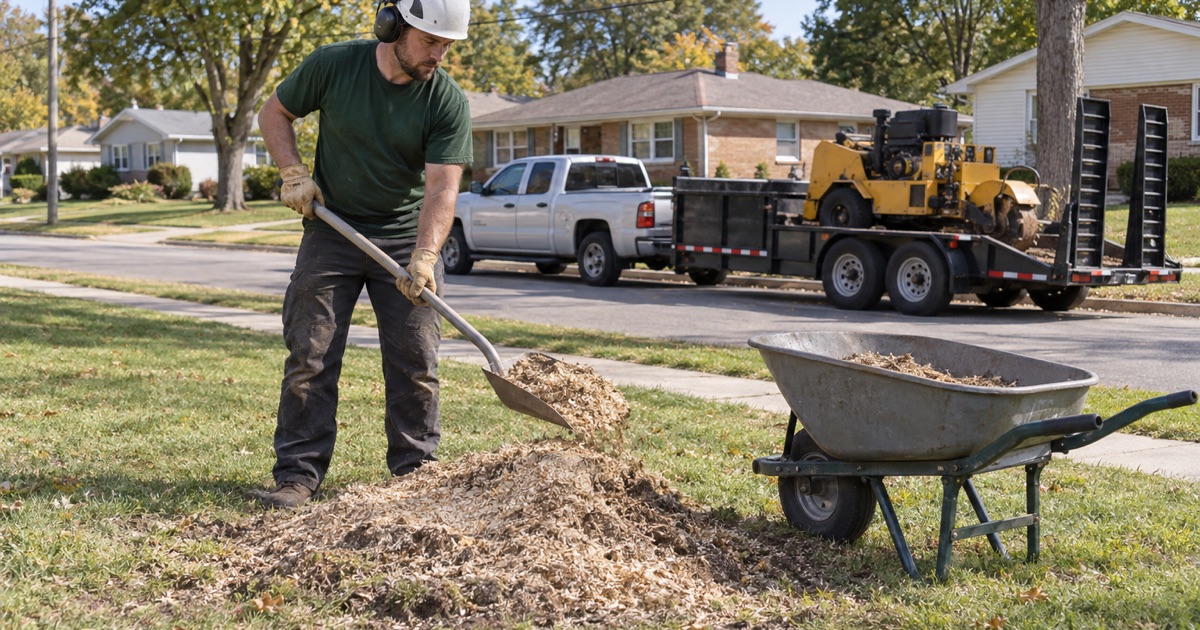
Most stump grinding ends when the machine’s own stop is reached, not when it hits something. On the residuum here that is less reliably true. EPA names Snead among the common soil series of 40c, and the NRCS description of Snead gives a solum 15 to 40 inches thick over a paralithic contact at 20 to 40 inches, formed in residuum weathered from calcareous, clayey, gray shales and thin interbedded limestone, moderately well drained with slow permeability.
Set that against a stump grinder’s rated below-grade cut, which runs about 12 inches on a narrow-access machine and up to roughly 25 inches on a larger tow-behind. A Snead profile at the shallow end of its published range puts a shale contact inside that range, which is a real possibility on this side of the ecoregion line and simply is not one on the loess ground north of it. So we do not quote a below-grade cut depth sight-unseen here; we tell you what the machine is rated for, what we found when the wheel got down there, and what it cost.
Access decides the machine as often as the stump does. A 35-inch grinder fits a four-foot gate; the same machine with the dual-wheel option widens to 56 inches and does not, which on lots this size is a question we settle at the assessment rather than on the morning of the job.
Every grind starts with an 811 utility locate. RSMo 319.026 requires notice at least two working days but not more than ten working days before excavation begins, while Missouri 811’s own site asks for at least three full working days; we work to the longer number so nobody is waiting on a locate ticket. Where the tree is close to the service drop, the line running from the pole to your meter is the customer’s responsibility rather than Evergy’s, and that changes who we coordinate with before the crew climbs.
Nothing gets left at your curb
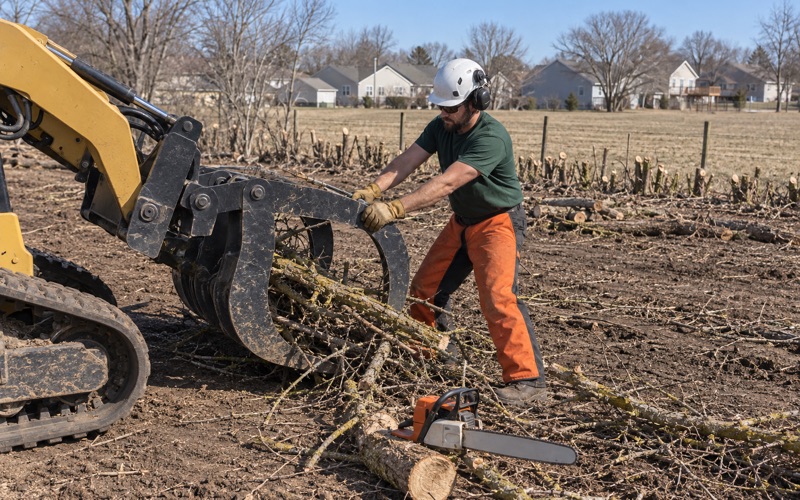
Raytown is unusual among the cities we work in one blunt respect: the City of Raytown does not provide trash or recycling services. There is no curbside brush pickup and no city brush yard, so wood and limbs left behind after a removal are not somebody else’s problem in a week’s time. The city’s substitute is a coupon program: every household within the city limits gets four coupons a calendar year at $5.00 each, holding a $25.00 value with Missouri Organic Recycling for yard waste and GFL Environmental for bulky items.
That is a homeowner benefit, not a contractor one, and it is worth knowing before you agree to a price that leaves the wood on site. Missouri also bans yard waste from landfills under RSMo 260.250, which is why every outlet on this side of the metro is a composter rather than a dump. Our own answer is simpler: the chips, the wood and the brush leave on our trucks, and the destination is named in the written quote.
- 20+ Years in the KC Metro
- Free On-Site Assessment
- Written Price, Insured Crews