Blue Springs Tree Removal has been doing tree-removal in Richmond for more than twenty years, and the first thing we explain to a caller in Ray County is that this city does not regulate trees the way most of its neighbors do. Richmond has no trees chapter in its code at all. The rule that reaches a dead silver maple in a front yard is a nuisance provision, enforced by letter, with an abatement power sitting behind it.
That one structural fact changes the whole conversation. Nobody here is going to make a homeowner apply for a permit before a private tree comes down, so the question is never whether you are allowed to remove it. The pressure runs the other way, toward removal, and the published duties are specific enough that you can check your own frontage against them in about a minute.
We work both sides of the state line across the Kansas City metro, and the answer to a tree question changes in real ways from one city limit to the next. In Richmond that means we quote the removal, the clearance work the code actually asks for, and the disposal, in writing, before a saw comes out of the truck.
No trees chapter, and a nuisance route in its place
Most Missouri cities of this size keep a vegetation or trees chapter that gathers planting rules, removal permits and clearance heights in one place. Richmond does not have one. What it has instead is a nuisance regime that compels removal rather than restricting it, and the practical effect is that a tree becomes the city’s business only once it is dead, broken, or in the way.
We have looked for tree language everywhere it would normally sit in a code of this shape, including the streets and sidewalks chapter, which carries a sight triangle section whose text we have not read. We do not tell a customer what that section says in either direction. What we do tell them is that the enforcement page and the nuisance articles are the two documents that will actually be quoted at them.
The eight and twelve rule
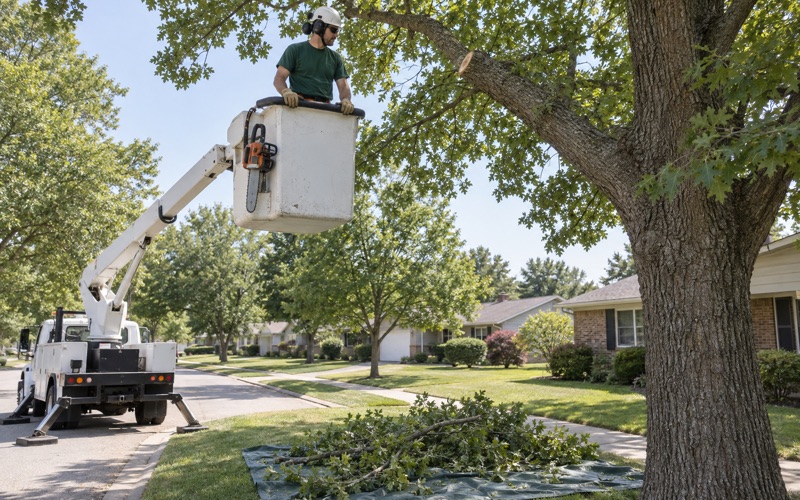
The city’s Codes Enforcement page states the homeowner duty in plain numbers: limbs must be at least 8 feet over a sidewalk and 12 feet over a street. That is a crown-raising specification rather than a removal question. On a mature street tree it is usually two or three cuts made at the branch collar, not a stub cut that throws epicormic sprouts back into the same space within two seasons.
When we price a removal on a corner lot here, we look at the clearance on whatever else is standing along the same frontage while the crew, the chipper and the drop zone are already on the street. One visit costs less than a second mobilization in the fall when a letter arrives.
What the nuisance articles reach
The city’s nuisance article makes a nuisance of noxious or rank weeds, thickets, brush, dead or fallen trees, limbs or shrubs, unkempt shrubbery, uncut high grass and other vegetation, and a separate weeds and vegetation article reaches piles of brush, dead or fallen trees, limbs and unkempt shrubbery. Read that second list closely, because the brush pile left behind after a removal is itself a listed nuisance. A tidy takedown that leaves limbs stacked at the property line has traded one violation for another.
The enforcement side has teeth behind it. The City Nuisance Inspector, city employees, or parties the city contracts with for abatement may enter the premises to abate, and complaints are kept confidential, so a letter often arrives with no warning from a neighbor first. Code Enforcement takes those calls at 816-776-5304.
Looking for tree-removal closer to Kearney? See Tree-Removal Services in Kearney.
Where the brush goes when the county has no gate
There is no yard-waste or brush gate anywhere in Ray County. That single absence shapes disposal in Richmond more than anything else does, and it is why we settle the debris question before an estimate is signed rather than after the tree is on the ground.
The city’s own arrangement is curbside. RTS Waste Services LLC collects trash by ward, Monday through Thursday, taking up to five bags or three 64-gallon containers, with one bulk item per residence on the first collection day of each month. Curbside yard waste is a separate service billed on the same monthly city utility statement, and it runs weekly from April 1 through October 31.
Five months a year with no route
Those two dates are the operative numbers for anyone planning a winter removal. From November into March there is no curbside yard-waste route running in this city, so a stacked pile of limbs is both undisposable and, in the city’s own language, a nuisance. Storm damage does not respect that calendar, and the trees an ice event brings down come down squarely inside the window with no route.
Missouri law closes the other obvious exit. Under RSMo 260.250 yard waste may not be disposed of in a Missouri solid waste disposal area, which is why every outlet within reach of this city is a composter rather than a landfill. Composters set their own diameter limits, and across this region they run a wide ladder, so the same trunk section that one gate takes is turned away at the next.
The nearest yard-waste drop-off the regional recycling directory lists for Richmond is not in Ray County at all; it sits over in Clay County, at a facility whose own posted terms limit part of its intake to residents of that city holding a current water bill. We do not build a disposal plan on that, and we would not send a homeowner across a county line on the strength of a directory listing. The debris leaves on our truck, and nothing is stacked at your curb waiting for a route that may not run again for five months.
The ground under the stump, and the trees standing on it
Richmond falls in EPA Level IV ecoregion 40a, the Loess Flats and Till Plains, inside the Level III Central Irregular Plains. The published vegetation for that unit is a mosaic of little bluestem and Indiangrass prairie with bur oak woodland and white oak woodland, and the mosaic is the useful part. Within one ecoregion this city carries both the oak that colors hard in the fall and the oak that does not, which is why we identify what is actually standing before we write a recommendation.
Out on the unincorporated acreage the work changes shape entirely. Osage orange fencerows, hedge in Missouri vernacular, no longer serve the farming operation they were planted for, and eastern redcedar moves into unmanaged pasture on its own schedule. That is forestry mulching and lot clearing rather than a takedown, and it prices by the acre and the stem density rather than by DBH.
Why we will not promise a below-grade depth
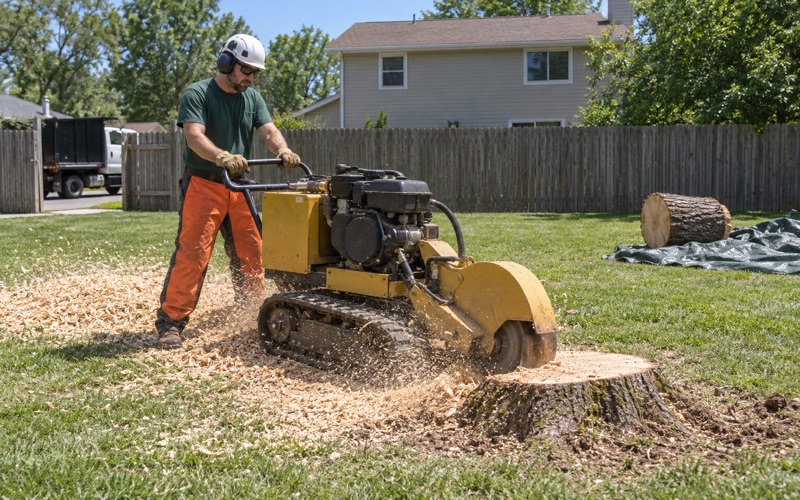
Stump grinders in the class we run are rated somewhere between 12 and 25 inches below grade, and on ordinary upland ground in this part of Missouri the machine’s own rating is what binds. The soil series that would change that answer is Snead, a moderately deep soil formed in residuum from calcareous, clayey, gray shales, whose depth to a paralithic contact runs 20 to 40 inches. The shallow end of that range sits under a 25-inch cut.
Snead’s own series description calls it extensive in northern and western Missouri, type-locates it in Caldwell County immediately north of Ray County, and puts it on upland side slopes of 2 to 30 percent. That describes the dissected valley sides along the creeks here rather than the flats. Nobody has mapped whether it occurs inside the city limits, so we quote the machine as configured and we do not promise a below-grade cut depth on a lot no one has walked yet.
Every grind here starts with an 811 utility locate before a tooth wheel turns. Grindings stay on site unless you want them hauled, and we say which it will be in the quote.
A county with its own forecast zone
Richmond sits in forecast zone MOZ030 with the rest of Ray County, under the Kansas City and Pleasant Hill weather office. That boundary is operational rather than decorative: a warning can be issued for this county and not for the ones south and west of it, or the reverse. The local record here is convective wind, tornadoes and ice, and ice is what finds the co-dominant stems with included bark that we flag on a risk assessment long before they fail.
A courthouse square town where the rental share changes who decides
Richmond was laid out on the Midwestern county-seat pattern, with the courthouse at the center of town and the business district around the four sides of the square. The residential stock spreads out from there at roughly 470 housing units per square mile, and 72.41 percent of it is single-unit detached. That is not an alley-and-fence pattern, so we do not assume tight access from the age of a block; we read the plat and expect the constraint to sit in the back yard and the drop zone rather than at the curb.
The age of that stock is the part that changes the work. Some 46.35 percent of Richmond housing predates 1960, 437 units predate 1940, and the single largest decade is the 1950s. Trees planted with those houses reach the end of their service life on the same schedule, which is why failures on a block here arrive as a cohort rather than one at a time.
Tenure is the second number worth knowing. At 56.91 percent owner-occupied there is a real rental fraction in this city, which means a meaningful share of removal decisions get made by a landlord reading a code letter rather than by the person living under the tree. We write those estimates differently, with the condition assessment and the photographs in a form an owner two hours away can act on without driving over.
What is settled before the crew arrives
Work here starts with a free on-site assessment and a written condition report rather than a number scribbled on the back of a card. Proof of insurance reaches you before anyone sets foot on the property, and the price we quote is the price in writing. We tell you where the wood and the brush are going as part of that quote, which in this county is not a small detail.
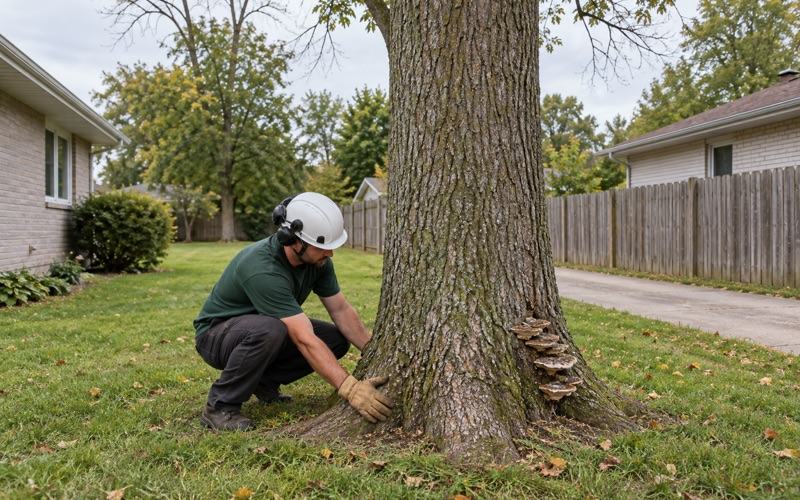
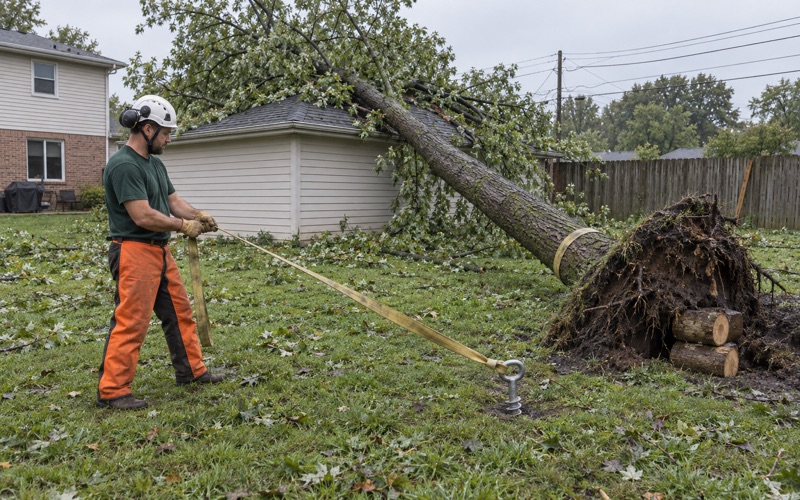
We do not top trees, and when someone else offers to, we will explain what topping does to a mature oak and what it costs you five years later. When a tree can be held with cabling and bracing, or brought back with crown cleaning instead of coming out, we say so and price that work instead. And when a tree is on a roof, a car or a line, we respond the same day, because in a city where the brush pile itself is a nuisance nobody can afford to leave it lying there.
- 20+ Years in the KC Metro
- Free On-Site Assessment
- Written Price, Insured Crews