Blue Springs Tree Removal has handled tree removal in Riverside for more than twenty years, working both sides of the state line across the Kansas City metro. Every job here starts the same way: a free on-site look, a written condition assessment of the tree rather than a number scribbled on a card, and a quoted price that stays the price in writing.
What changes in this city is the ground and the paperwork. A large share of Riverside sits on Missouri River bottomland behind a levee and flood-control system, which grows a different set of trees than the upland loess does, and most of the housing stock is rented, which means the person who calls us is often not the person who signs. Proof of insurance reaches you before a crew sets foot on the property, whether you own the house, manage the building, or hold the lease.
We do not top trees, and if a tree can be kept standing with pruning or cabling we will say so and price that work instead. When removal is the answer, we tell you where the wood and the brush are going before the saw leaves the truck, which matters more in this city than in most.
Bottomland behind a levee is not the same growing ground
Riverside maps to EPA Level IV ecoregion 47f, the Rolling Loess Prairies, inside the Western Corn Belt Plains. That is prairie-derived country rather than closed forest, so most of the residential canopy here was planted rather than left standing, and the species mix reflects what nurseries and developers were selling when the houses went up.
The ecoregion label only describes half of this city, though. A large share of the ground inside these limits is Missouri River bottomland sitting behind a levee, and bottomland grows trees on its own terms: a high water table, periodic saturation, and deep alluvial fill instead of in-place loess. Two working environments live inside one city limit, and an estimate written for either one alone describes half the job.
What the wet ground grows, and how it fails
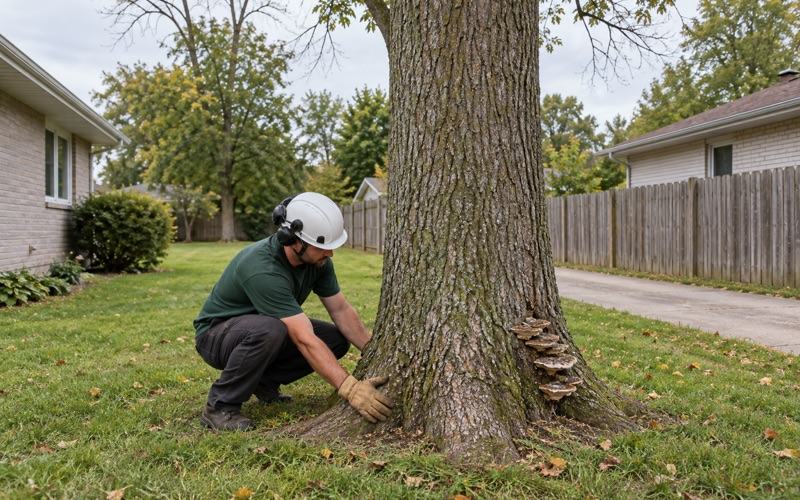
Bottomland canopy runs to fast-growing, weak-wooded species, and those trees fail in predictable ways rather than randomly. Co-dominant stems with included bark split at the union under load, epicormic sprouts on an old topping wound tear out at the attachment, and a saturated root plate lets a whole tree lean before anything in the trunk gives way. Our written assessment names the defect we found and where, so you are reading a condition report rather than a verdict.
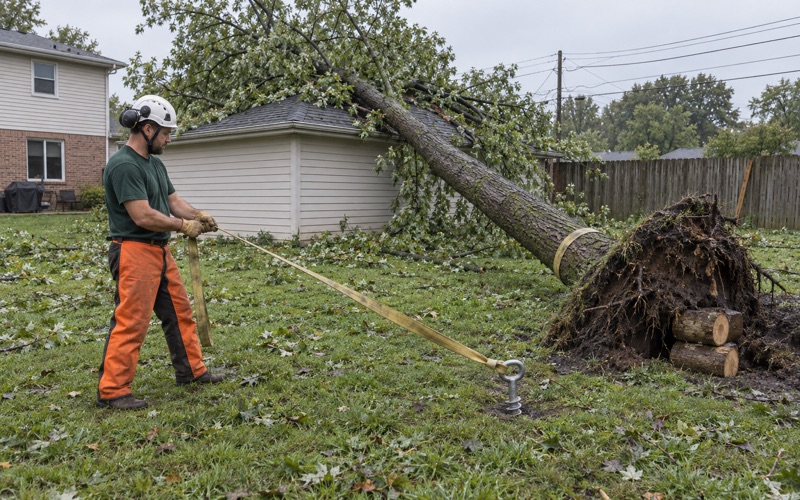
Open bottom ground also gives a straight-line wind a longer run at a tree than a sheltered upland subdivision does. The Kansas City and Pleasant Hill forecast office puts this city in zone MOZ028, Platte County, a different zone from Clay County to the east, so a warning can be live here and not there. Wind, ice and the occasional tornado are what the local record actually holds.
Stump grinding on ground the soil survey does not describe
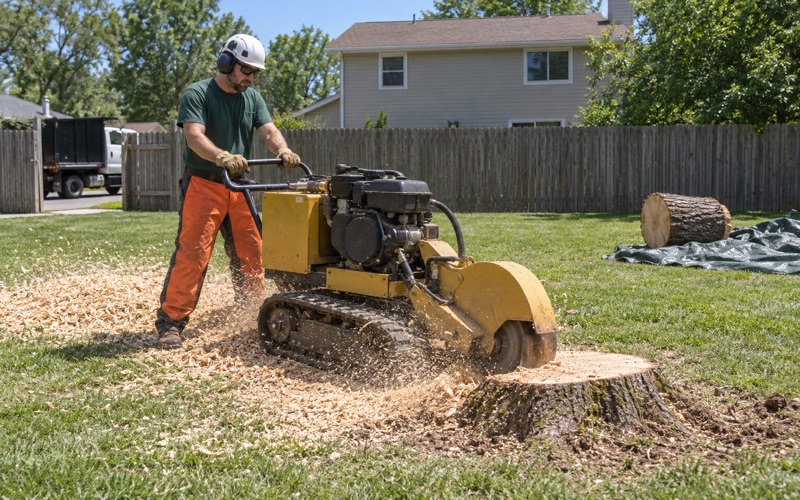
On undisturbed upland loess the grinder is the limiting factor, not the earth. The Marshall series that characterizes this loess country is described as very deep, with the typical pedon logged to 203 centimeters, roughly 80 inches, while a compact stump grinder is rated to cut 12 to 25 inches below grade. The machine’s own stop binds first by several times over, so bedrock never enters the job through the tooth wheel on that kind of lot.
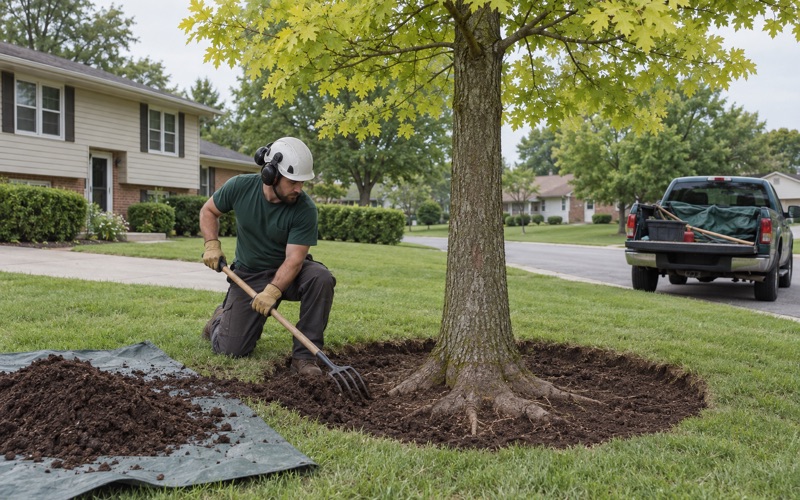
Bottom ground is a different problem. Levee work, river-bottom development and industrial fill mean the working medium under a stump in much of this city is imported fill and compacted subgrade, which no soil survey describes and which changes both the grinding and the shape of the root plate. We quote the machine as it will actually arrive, configured, and we will not promise a below-grade cut depth on a lot we have not stood on. Every stump gets an 811 utility locate before the wheel turns.
Looking for tree-removal closer to Excelsior Springs? See Tree-Removal Services in Excelsior Springs.
Who signs when most of the city rents
Riverside is 57.59 percent renter-occupied, against 42.41 percent owner-occupied, so most of the housing here answers to an owner who does not live under the tree. A dead tree behind a rental is a cost-versus-risk decision made by a landlord on a timescale set by a lease renewal or an insurance letter, not by the tenant who parks beneath it.
Nothing municipal forces that decision either. The city publishes the list of violations its code enforcement pursues, and it covers trash and debris, illegal dumping, grass or weeds over 10 inches, unregistered vehicles, outdoor storage, deteriorated buildings and several more, with no tree, limb or brush item anywhere on it. The trigger for a call here is usually an insurance requirement, a pending sale, or a failure that has already happened.
A small detached base and a large multifamily one
Only 40.90 percent of the housing stock is single-unit detached, which leaves 59.10 percent attached or multifamily, and the whole city holds just 642 owner-occupied single-family detached units. That is a small homeowner market sitting next to a large one owned by companies, so half of what we do here is quoted to a property manager or an apartment owner rather than to the person who will watch the crew work.
Off-site owners need paperwork that survives a forwarded email, so that is what we send: a written condition assessment naming the tree, its diameter at breast height and the defect, the scope of work, and a fixed price. Proof of insurance goes out with it. Nobody has to relay a verbal quote from a maintenance call to an owner three states away.
Gates, widths and what fits between buildings
At roughly 306 housing units per square mile the pattern is compact, and access decides the method more often than tree size does. Compact grinders and tracked lifts are built to fit gates in the 25 to 35 inch class, while the chipper is seven to eight feet wide and around ten thousand pounds and never goes through a gate at all. Narrow and shallow are not the same thing: some 35-inch machines still cut 25 inches below grade, and a dual-wheel option widens the same unit to 56 inches.
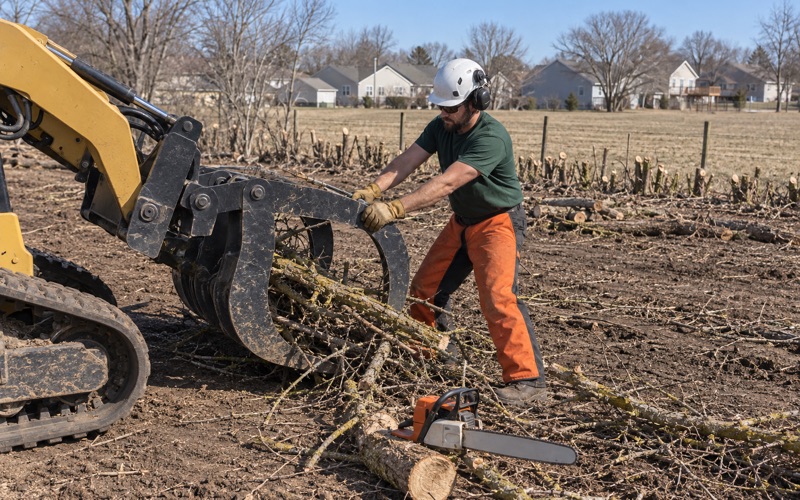
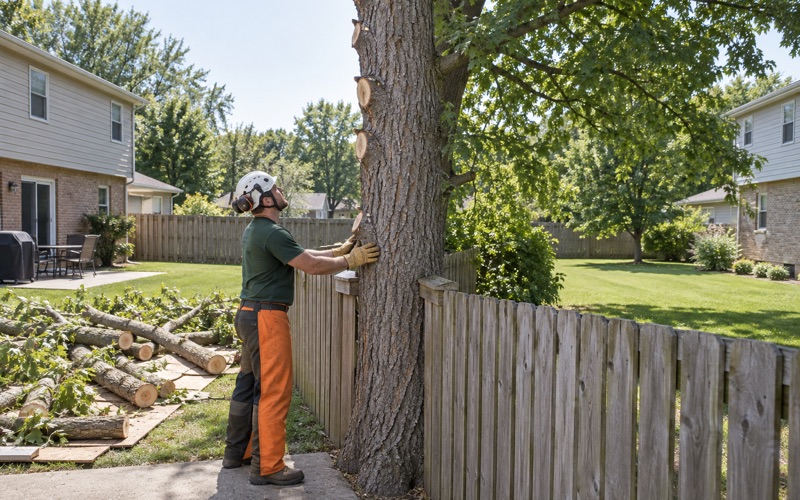
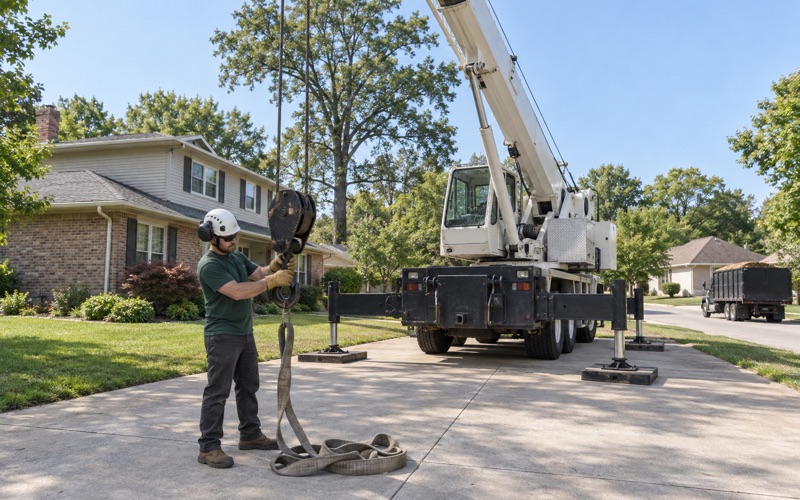
Where a lift cannot reach and a drop zone does not exist, we rig the tree down in pieces on a bull rope through a Port-a-Wrap, taking the load in controlled sections rather than dropping length. On the tight multifamily lots that is usually the only honest answer, and it is priced that way from the start.
A 1960s and 1970s canopy with a newer cohort on top
Riverside was formally incorporated in 1951, and the housing record matches: not one unit in the city dates to 1939 or earlier. Then 47.93 percent of the entire stock, 416 units in the 1960s and 395 in the 1970s, went up inside two decades. Trees planted alongside those houses were planted at the same time, and a planted cohort ages on one clock.
On fast-growing bottomland stock that clock has already run out on a good number of them, which is why so much of our work in these blocks is first-cycle removal rather than maintenance pruning. A second cohort sits on top of it: 21.69 percent of the stock has been built since 2010, with young trees on tight new lots and utility trenches still fresh under them. The two cohorts need opposite work, and quoting them the same way is how a bid goes wrong.
What we do instead of topping
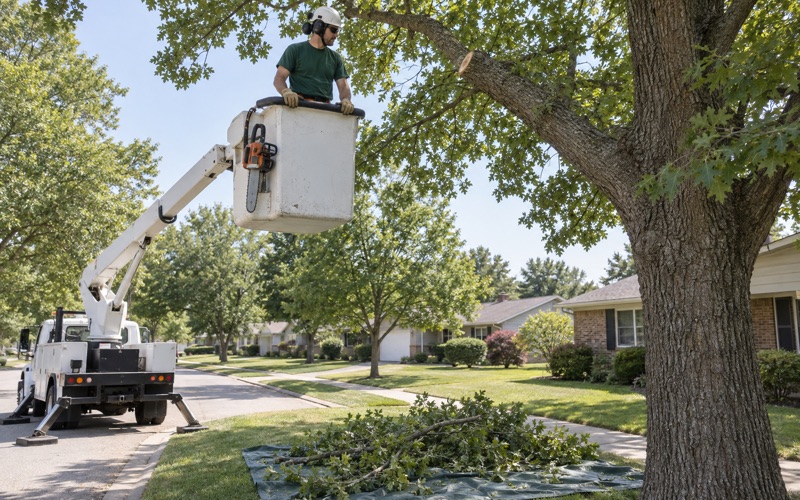
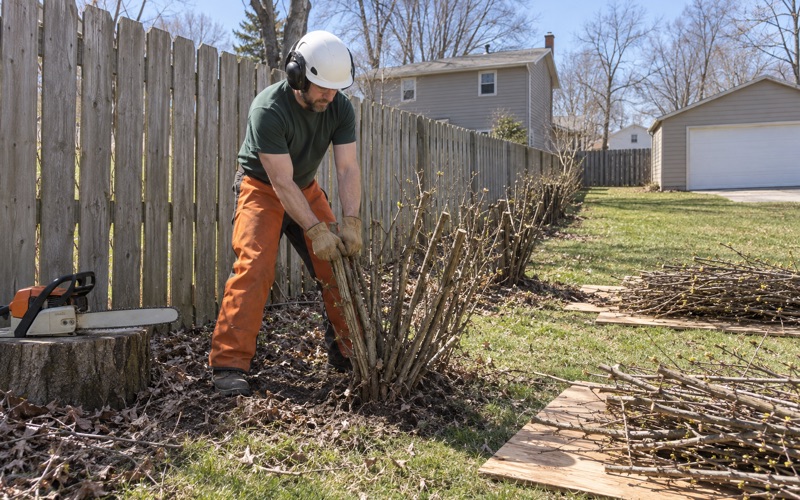
A synchronized canopy attracts the offer to top everything back, and we will not do it. Topping strips the leaf area a tree lives on and forces epicormic sprouts that attach only to the outer wood, so the tree comes back weaker and more likely to shed limbs than before anyone touched it. Crown cleaning, crown raising over a drive or a sidewalk, and a measured crown reduction under the ANSI A300 pruning standard get the clearance without buying a bigger problem in five years.
Crown raising has a local reason behind it here. Public Works publishes two duties that touch vegetation: keep the sidewalk adjacent to your property at the established grade, in good working order and clear of ice, snow, earth and obstructions, and keep trees and bushes from blocking drivers’ views. Neither carries a number, so we prune to the sight line and the walk as they actually are, and we do not quote you a clearance height this city has never published.
No city gate: where the debris actually goes
This is the hardest fact about doing tree work in Riverside, and almost nobody quotes it out loud. The city’s solid waste arrangement gives every single-family household free curbside trash and recycling through GFL, and that is all it gives: no yard waste stream, no brush collection, no leaf pickup, and no drop-off site published by Public Works. A homeowner here has no municipal outlet for a tree’s worth of wood, and a contractor has less than that.
Burning is not the way around it. Missouri’s open burning rule reaches the whole state, and a commercial land clearing burn inside a city limit has to sit at least 200 yards from the nearest structure, run only between sunrise and sunset, stay supervised, and be reported to the local fire control authority beforehand, which here is the Southern Platte Fire Protection District. In 5.53 square miles there is essentially no lot that can hold a 200 yard setback, so the legal burn does not exist for a contractor in this city.
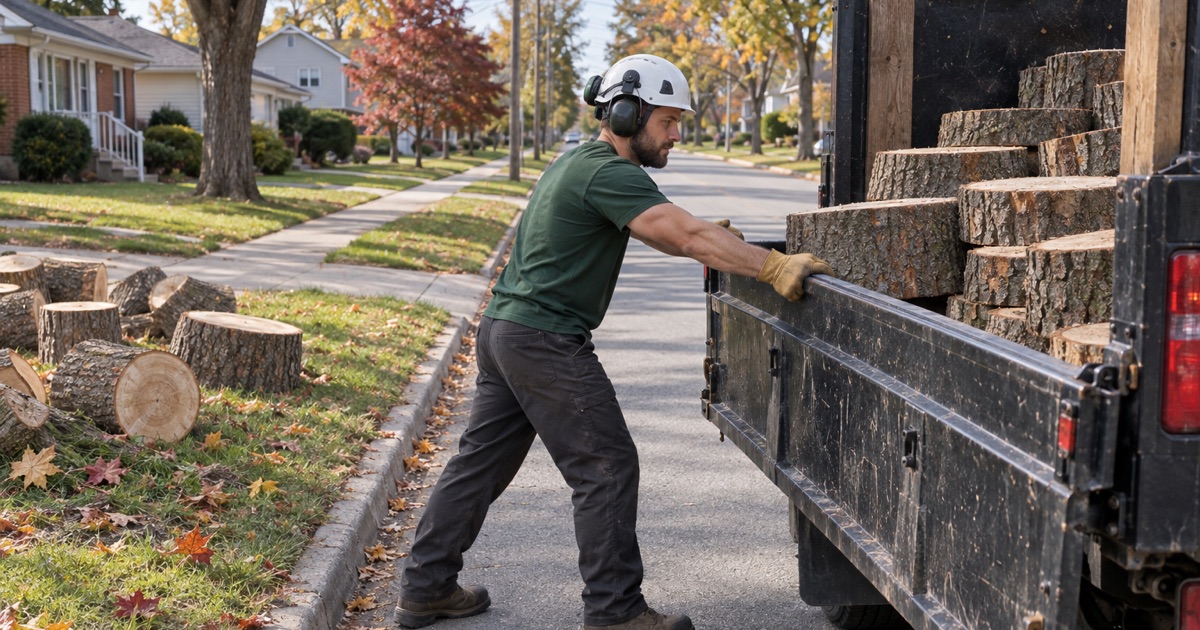
So every job here carries a priced haul, and we tell you where the load is going before we start. Missouri law bars yard waste from a solid waste disposal area, which is why every outlet within reach is a composter rather than a landfill, and those gates price brush by the cubic yard, refuse stumps with dirt still on them, and set their own diameter caps. The same trunk section is accepted at one and turned away at another, so we confirm the cap before anything is loaded.
Nothing gets stacked at your curb for a hauler that was never contracted to take it. The debris leaves with us on the same visit, and the grindings go where you want them, backfilled into the hole or hauled off with the rest.
Who to call before we do
The city says plainly on its own page that it does not have its own utilities, which settles a question people get wrong in an emergency. A downed conductor or a leaning pole is Evergy at 816-471-5275, not City Hall, because the city cannot de-energize a line it does not own. A burning tree or a fire is the Southern Platte Fire Protection District, and a limb blocking a street or a question about where the city’s right-of-way strip ends is Public Works at 816-741-3993.
That strip is defined in the city’s own words as a city-owned band running from the edge of the street back about three to ten feet, used for the street, curb, gutter, storm sewer and utility maintenance. It is the boundary question every caller has, and it is worth knowing the answer before you pay anyone to cut on it. Call us for a free on-site assessment and a written price, and when a tree is already on a roof, a car or a line, we respond the same day.
- 20+ Years in the KC Metro
- Free On-Site Assessment
- Written Price, Insured Crews