Blue Springs Tree Removal has been doing tree removal in Roeland Park for more than twenty years, and the ground rules here changed under every homeowner in the city on December 16, 2024. That is the day Ordinance Number 1062 took effect, and it moved the front yard tree out of the owner’s sole discretion. Anything twelve inches or larger in front of the house is a protected tree now, and it does not come down without written authorization.
That reorders the job. On most properties the first question is whether a tree can be reached, rigged and dropped safely; here the first question is whether it may legally be removed at all, and the answer comes from a City Arborist rather than from a crew leader standing in your driveway. We settle that question first, in writing, before anyone quotes a price.
We have worked both sides of State Line Road for two decades, and we do not treat Kansas as Missouri with a different sign at the border. The authorization chain, the disposal options and the rule covering a neighbor’s overhanging limbs are all different here. Assuming otherwise is what costs a homeowner money.
Twelve Inches in the Front Yard, With No Project Required
Ordinance Number 1062 was passed by the Governing Body on September 16, 2024 and took effect ninety days later, on December 16, 2024. It amended Chapter 13, Article 5 of the Roeland Park Municipal Code, the article titled Trees Shrubs and Growth, and rebuilt it as Sections 13-501 through 13-512. Seven pages replaced what had been a short maintenance article, and most of the new weight sits in its last two sections.
What covered property actually means
Section 13-506 carries the definitions and they repay a second reading. A protected tree is any tree with a diameter at breast height of twelve inches or more located on covered property, measured through the main trunk four and one half feet above natural grade. Covered property is the front yard of privately owned lots or parcels, together with all rights of way, parkland, green space and city owned property inside the city limits.
Front yard has its own definition and it is narrower than people assume: the portion of privately owned land running the full width of the lot between the public street right of way line and the exterior elevation of the main building. Draw that line across your lot and everything in front of it is regulated, while a tree standing behind the house is not a protected tree under this definition. The curb strip counts too, because right of way is covered property.
Replacement, the Tree Fund and the mitigation fee
For a healthy tree the city’s tree protection policy gives an owner two ways to satisfy the replacement requirement: plant an approved replacement tree, or pay a $500 mitigation fee into the Roeland Park Tree Fund. A replacement tree is defined by caliper, preferably two and one half inches and never under two inches measured a foot off the ground, standing at least seven feet tall when planted.
A tree approved for removal because it is dead, dying, diseased or invasive clears without a replacement or a payment. Section 13-510 also runs the other direction, which almost no one knows: where removal is authorized for disease, health or another public safety reason the mitigation fee is waived, and the owner may ask the City Council to reimburse the cost of the removal out of the Tree Fund, decided on the owner’s ability to pay. We say so when your tree looks like that case, because it changes what you should be asking the city for.
Looking for tree-removal closer to Leawood? See Leawood Tree-Removal.
Over Thirty Inches, the City Council Decides
Above thirty inches diameter at breast height the City Arborist is no longer the last word. Section 13-512 provides that a protected tree that large may only be removed with approval from the City Council, and then only where at least one of three criteria is met. The burden of proof that a criterion has been met falls on the applicant, which in practice means on the homeowner.
The three are narrow. The tree is dead; the tree is diseased or dying and constitutes a threat to healthy trees, to property or to public safety; or removal is necessary for construction, development or redevelopment, where all reasonable efforts have been made to avoid it, the tree places an undue financial burden on the applicant, and no other reasonable accommodation preserves it. Two of the three carry the same note, that confirmation would commonly come from an expert such as an arborist.
The written assessment is what the vote runs on
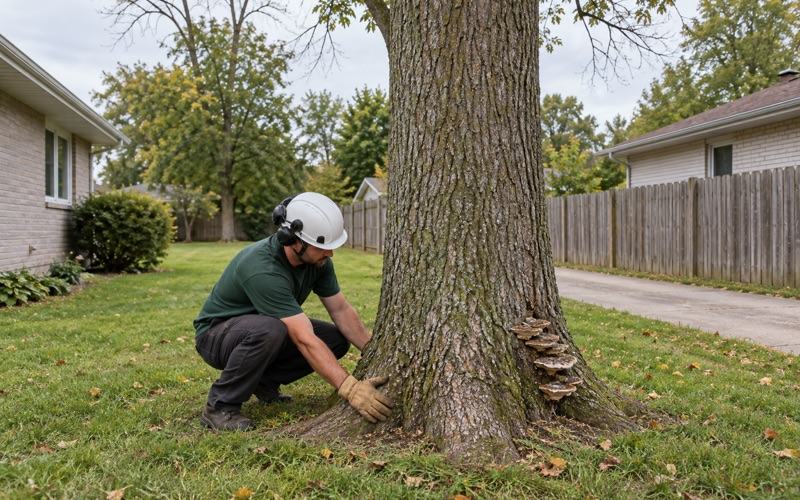
That expert route is named twice in the same section, which is why a large removal here begins with paperwork rather than with a saw. A council vote needs a document describing the defect, and a homeowner at a microphone describing a lean is not that document. Every tree we look at gets a written condition assessment, with the diameter measured rather than estimated and the visible indicators named: a conk at the root flare, included bark in a split leader, heartwood decay sounding hollow under a mallet.
Section 13-506 defines a condition rating as a value from zero to one hundred, set according to the ninth edition of the Council of Tree and Landscape Appraisers guide, weighing wounds, decay, storm damage and insect or disease injury. It defines the City Arborist post by credential as well, a professional certified by the International Society of Arboriculture or registered with the American Society of Consulting Arborists, or a qualified designee.
That is a striking credential to find written into municipal code in a state that licenses no one to take down a tree. Roeland Park has taken part in the Johnson County Contractor Licensing Program since 2014, and none of its eleven classes reaches tree work, so proof of insurance and a written scope are the only paperwork a homeowner actually gets to check.
The fine is per tree, and emergencies are carved out
Section 13-507 puts enforcement with the Public Works Director, who notifies a violator in writing and may assess an administrative fine of not more than $500 for each incident, with the unlawful injury, destruction or removal of each protected tree counted as its own incident. Left unpaid for thirty days, that fine can become a lien on the property. Appeals go to the Roeland Park Municipal Judge through the City Administrator’s office within thirty days of the notice.
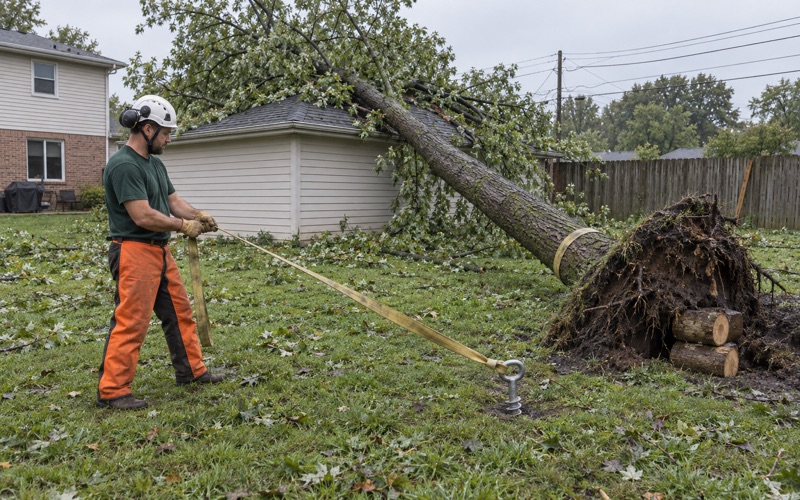
The closing sentence of that section is the one to remember at two in the morning: the administrative fine is not imposed in special circumstances, including emergency tree removal and removal by a utility. A trunk across your roof in a wind event is not a permit problem, and we will not stand in the yard pretending it is. Same day response is what that call needs, and the authorization conversation happens afterward.
A 1940s Plat at 2,147 Housing Units per Square Mile
Roeland Park was platted in 1937 and 1938 and filled in quickly afterward. Some 37.12 percent of the housing stock dates from 1940 to 1949 and another 26.08 percent from the 1950s, which puts 77.32 percent of it ahead of 1960. There are 3,478 units on 1.620 square miles, or 2,147 housing units per square mile, and 86.66 percent of them are single unit detached houses.
That is eighty year old canopy standing over lots nobody drew with a chipper in mind. Mature protected trees and tight side yards arrive together here, and the ordinance decides whether a job is legal before anyone works out whether it is physically possible.
The chipper, not the crane, sets the limit
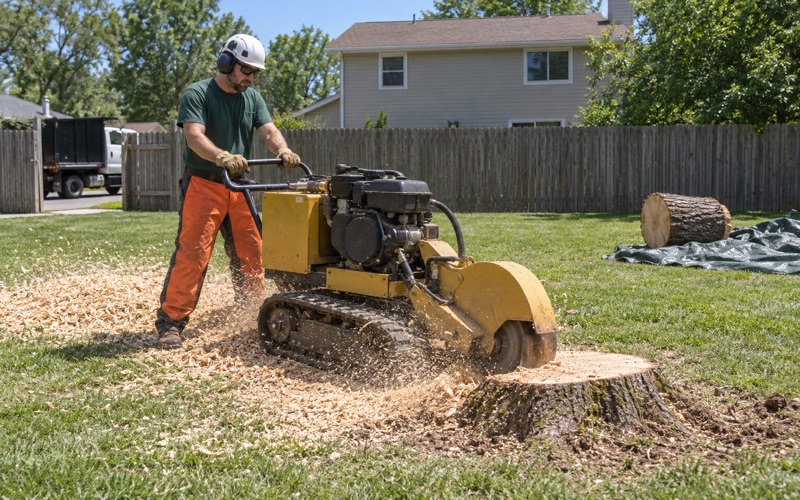
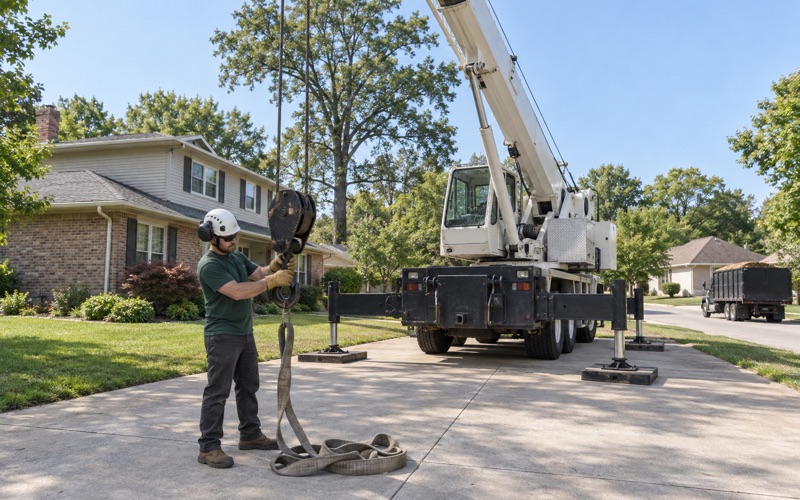
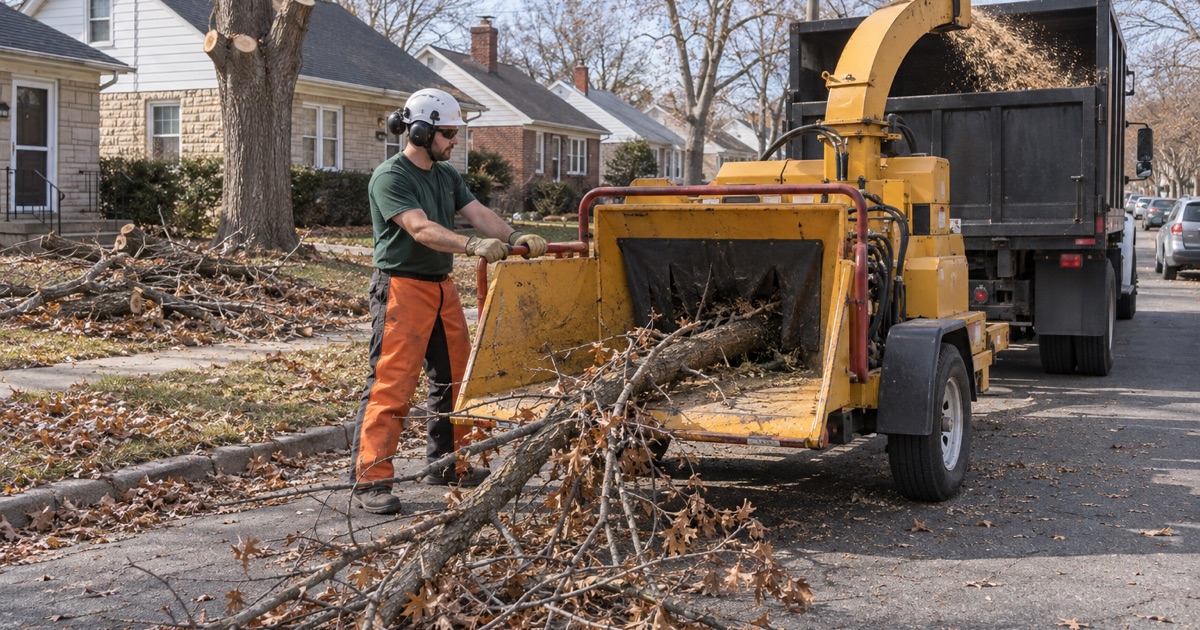
Gate width is the number homeowners ask about and it is seldom the one that decides the day. A compact stump grinder passes a thirty five inch gate and a pedestrian gate machine fits through twenty five inches, but a full size chipper runs seven feet nine inches wide at 10,500 pounds and never goes through a gate at all. The brush therefore walks to the street by hand, and carry distance is what moves a price more than anything else on a lot this size.
Under the stump, rock is a real possibility
The Johnson County soil survey publishes depth to a restrictive feature by series, and two of the series mapped in this county are shallow enough to matter. Vinland reaches a paralithic contact at ten to twenty inches and Sogn hits lithic bedrock at four to twenty inches. A stump grinder’s rated below grade cut is roughly twelve to twenty five inches by machine class, so on the shallow series rock stops the tooth wheel before the machine’s own limit does.
This is a cuesta landscape of alternating limestone and shale benches, so that is a genuine possibility rather than regional color. Which series lies under any one parcel was never established, so we do not promise a below grade depth before seeing the stump, and we call 811 before the wheel turns.
Where the Wood Goes Before the Saw Comes Out
Curbside yard waste here runs through GFL, and the published rules stop well short of a removal. Brush and branches must be bundled under four feet long and eighteen inches across, with no individual limb larger than two inches and no bundle over fifty pounds, tied with twine rather than tape or plastic. A two inch limb cap means almost nothing off a removal qualifies, and no contractor exclusion is needed because none of it fits in the first place.
Behind the curb there is nothing in county either: Johnson County operates no public yard waste gate and its landfill caps landscape waste at three inches in diameter. So removal wood crosses the state line to Missouri Organic Recycling in Kansas City, Missouri, at $10 per cubic yard for brush and $7 for lawn debris, taking logs up to forty inches in diameter under five feet long and refusing stumps with dirt still on them. We name that destination before the saw comes out of the truck, and the debris leaves with us.
Diseased wood cannot stay on the property
Section 13-504 makes it unlawful to harbor a tree, plant or shrub infected or infested with disease, insect pest or larvae, and unlawful to store or otherwise harbor on any property in the city the material from a diseased or infected tree. That second clause is a debris rule at ordinance grade, and it lands squarely on the handshake where a crew leaves the rounds behind in exchange for a lower number. On a diseased removal that arrangement asks a homeowner to hold material the code says may not be kept here.
Pine wilt is where that bites hardest. Kansas State extension guidance tells homeowners to cut an infected pine as soon as possible and by May 1 at the latest, calls April 1 the better deadline, says to cut it to the ground rather than leave a stump, and says to chip or burn the wood immediately rather than save it for firewood.
When a tree can be kept we say so and price that instead, because in a front yard here removal is the expensive path twice over: the authorization, then a replacement tree or a mitigation payment. Cabling a split leader or a crown reduction under the ANSI A300 standard is often the cheaper answer, and we do not top a tree to get there.
- 20+ Years in the KC Metro
- Free On-Site Assessment
- Written Price, Insured Crews